Goodbye My Friend…

Growing up I knew about Billy Graham.  It seems almost everyone knew of his numerous and large evangelistic crusades in the 60’s, 70’s and 80’s.  I don’t know that I had great deal of respect for him because I did not have a personal relationship with Jesus during this time; I did not know much about God, much less about evangelists who were doing God’s work.  With this as a backdrop, when I began to blog on his book in June of 2018, I did not know what to expect. When I started commenting on his book The Holy Spirit, I did not intend to admire Billy Graham as much as I have grown to admire him.  I did not intend to write so long on his book.  I just figured his book was a lightweight attempt to explain the Holy Spirit.  I soon found that my assumption was very wrong.  It seemed like every page or two caused me to think, to learn and to grow.   Every page or two gave me a chance to comment. Well here it is, eleven months later and I feel like I have to say good bye to a friend as I write my last post on his book.  I have run out of pages.

Graham has taught me so much about The Helper, The Holy Spirit that all Christians have when we give our lives to Jesus Christ.  He has taught me that to grow as a Christian, you have to call upon the Holy Spirit.  If we take our lives seriously and we respond to God’s Word, we have to take seriously the Apostle Paul’s urging of Timothy to pursue righteousness:  “But you, man of God, flee from all this, and pursue righteousness, godliness, faith, love, endurance and gentleness.”  The question we all have to face is how do we pursue righteousness?  Are we pursuing righteousness with half effort?  Have we decided that the world’s pursuits are more important than God’s?  I don’t mean to be obscure, but a fourteenth century English monk* may have said it best:  “Every man fights immortality and physical desires throughout his life; bad men do not fight at all except against God…They make a truce with sin.”

We can’t wage this fight alone.  We can’t will ourselves to be righteous.  It takes real spiritual help to wage this war and that help comes in the form of the Holy Spirit.  The help is there for all Christians if we just listen and respond. 

Graham says the first step is to admit our spiritual poverty.  Admitting poverty in any part of life is hard; we want people to think we have all that we need. Graham cites the Laodicean Christians who declared “I am rich, and have become wealthy, and have need of nothing.”   Little did they know how wretched and miserable they were.  Maybe we have sins that are blocking the Holy Spirit.  We need to examine ourselves in the light of God’s Word and see if we need help with those sins.  The Holy Spirit will reveal to us every sin that is hindering us.  For sins that are hard for us to determine, it is so easy to deny those problems even exist but those problems can be the root of dangerous habits over time.  Maybe we are neglecting things that need to be done, not dealing with our responsibilities.  Whatever our concerns, we have to lay them honestly before God.  The Holy Spirit can help handle all of our problems over time as we strive to live a righteous life.

The next thing we have to do is confess and repent.  All of us know that confession and repentance are necessary when we sin but the big question is what will we do as follow-up?   Are we going to turn from our sin and seek to be obedient to God?   Many times in my life I have confessed my sin, only to return to it at a later time.  Then I find myself in a sin-confess-repent, sin-confess-repent cycle.  How do we get out of this situation?  The key is to sin, confess, repent and obey.  Confession does little good if you don’t follow it with some action.  God promises us in John 1:9 “If we confess our sins, He is faithful and righteous to forgive our sins and to cleanse us from righteousness.”   God’s forgiveness is what I seek daily; the action ideas that I need to perform to walk away from my sin come directly from the Holy Spirit.

The last step is breakthrough.  Revival in your life can come as you find yourself unable to tolerate sin any more.  If you are truly listening to the Holy Spirit, you have a new hunger for more righteous living.   One of my favorite quotes comes from Pastor John Piper who says that man can come to love God more than sin.  God wants to touch us, God wants to use us as His servants and we of course, we want to live a life of freedom, a life of victory.  Sadly, if we never have a breakthrough, we may live a life that is ineffective or lukewarm.  God does not intend that for us.  He wants us to open our lives to the recreating power of the Holy Spirit.  Graham says it this way: “No person can seek sincerely the cleansing and blessing of the Holy Spirit and remain the same afterward.”

If you want to exhibit the gifts of the Holy Spirit, start listening to the Holy Spirit in your life.  If you want to produce fruit of the Holy Spirit, start acting on the urgings of the Holy Spirit in your life.  If you truly believe in Jesus, you need to prepare to be used.  A wise older man in my intercessory prayer group at church told me one day that he awakes every morning saying the same prayer.  His faith is so strong.  He says “Holy Spirit, show me what you want me to do today.”

Wouldn’t it be nice if we all had the courage to pray that prayer?

Wouldn’t God be happy if we then did what He asked us to do?

*Richard Rolle

Posted in Uncategorized | Leave a comment

Eight Signs of Holy Spirit Revival

“What would happen if revival were to break out into our lives and into our churches today?” [Billy Graham, The Holy Spirit].  So many of my comments on Graham’s book have been positive, but if this revival occurred…

We might like it.

We might not.

Pastor Graham thinks eight things would happen.

1.People would be confronted with a God that is not just tender, merciful and compassionate.  Today, pulpits are full of pastors who preach this version of God, you know the “warm, fuzzy God, tender, merciful and compassionate.  Many well-known pastors preach on television and the God they describe is often not a God of justice, holiness and wrath.  The message is that all is well; live your best life now!  Graham says that version of God is a “caricature of God.”  If the Holy Spirit broke out in our churches and in our lives, God would confront our sins and it would not be comfortable all the time.

We might not like that. 

2.There will be new vision of the sinfulness of sin.  The “new” vision will be soundly centered on the cross.  Jesus Christ came to die for the forgiveness of our sins so we know that sin is a dark and terrible thing in the eyes of God.  When man sins, lust takes over and sin matures into death.  As merciless sinners, we cannot live without God.  Without Jesus Christ, we are unworthy.  Life is not about an endless number of do overs.  When the Holy Spirit comes, we must realize that we must admit our unworthiness and make efforts to lead a more righteous life.

Some might not want to do that.

3.There will be an emphasis on the necessity of repentance, faith and new birth.  Jesus came and said unless man is born again, he would not see the Kingdom of Heaven.  If there is a Holy Spirit revival, it will be necessary to have changed hearts.   It will be necessary to become a new creature.   It will be necessary for old things to pass away and everything to become new.

Change is hard; some won’t want to become a new creature or they see no need to become a new creature.

4.There will be the joy of salvation.  Finally this may be a total positive for the Holy Spirit revival.  If the Holy Spirit invades our lives and our churches, thousands of sinners will undoubtedly repent and there will be joy in heaven.  Luke 15: 7 talks about the joy in the presence of the angels of God over the repentance of one sinner.  Pastor Graham’s vision of a wrathful God, the dark nature of sin and the need to change may be negative but many will be convinced of God’s truth and many will experience the joy that only comes from a dedication to a righteous life.  Won’t that be glorious?

5.There will be a new realization that is it our responsibility to evangelize the world.  The best evidence that one is a new believer is concern for others.  Too often Christians hesitate to share their message; maybe they alter their behavior to fit into the world.  That will not be the norm when the Holy Spirit comes.  Graham cites the Apostles who went anywhere and everywhere to share the message of Jesus Christ.  That type of attitude will be evident if the Holy Spirit invades our lives and our churches.  People won’t hold back.

6.There will be a deep social concern.  Matthew 22: 37-39 is one of the most well-known verses in the Bible but do we take it seriously?  Loving our neighbor as ourselves?  Get real.  That does not happen.  Graham has some cogent words about this: “Too many people today want a brotherly world in which they can remain unbrotherly; a decent world in which they can live indecently.  Too many individuals want economic security without spiritual security” [290].  Let’s be honest, Christians should have high moral standards, high ethical standards, but it is clear that Jesus came to show us that society needs a solid Christian brotherly love.  If we do not exhibit this, we fall short.  We won’t fall short in this department when the Holy Spirit comes.

7.There will be an increased evidence of both the gifts and the fruit of the spirit.  When the Holy Spirit pours into your life, your gifts of ministry will be evident and they will be used.  The world will no longer say the Church is powerless.  The world will no longer say the Church is silent.  Individuals will no longer lead ordinary lives, lives that are indistinguishable from the rest of the world.  We will know our gifts, we will be using our gifts.  Others will know us by our fruit. 

The Holy Spirit will have come.

8.There will be renewed dependence on the Holy Spirit.  Graham writes the Holy Spirit “is the one who reproves, convicts, strives, instructs, quickens, regenerates, renews, strengthens and uses.   The Holy Spirit gives us liberty, direction, discernment, power and fruit” [292].  The Holy Spirit reveals the things of Christ.  The Holy Spirit teaches us how to use the “sword of the Spirit,” the word of God.  He guides us to the truth; He directs our lives toward Godliness.  The Holy Spirit gives us the answers we need when we are attacked by enemies of God.  The Holy Spirit gives us access to the Father.   The Holy Spirit helps us with our prayers.

These are things we can’t go to the corner market and purchase.  No matter who you know, no human contact can get you all of this.  No matter how eloquent you are, you can’t talk you way into getting this. 

This revival if it comes, if a true gift from God.  It will cause change, it will be challenging as we come face to face with unpleasant truths but let’s focus on the good aspects of this.  Let’s focus on joy.  Let’s focus on the need that the world has for this revival.

Let’s focus on the words of Zechariah who said “Not by might nor by power, but by My Spirit, says the Lord of hosts.”

What would we not like about that?

Just say “thank You Lord!”

For Your Holy Spirit!


Posted in Uncategorized | Leave a comment

Come to the Altar…

Billy Graham was well known for his alter calls at his evangelizing events.   

He would invite people to come forward to ask Jesus to be their Savior and then his assistants would pray with the respondents.  In Moscow, in 1992, one-quarter of the 155,000 people in Graham’s audience went forward at his call.

The Holy Spirit is a book, not a sermon and yet when we get to the last chapter, his writing sounds like he is making an altar call.  It is entitled “The Need of the Hour.”

The first part of the chapter describes an America that is in need of awakening.  The Holy Spirit was published in 1978 and he describes an America that is turning away from religion.  The country is distracted with materialism, the poor are covetous for what the rich have and the rich are flaunting their wealth for all to see.  The nation is in the midst of racial unrest and the financial market is unstable, going up and down.  Some would say this might sound a bit like today.

Then you read that Graham is not describing 1978;  he is describing America in 1850.

Have things changed much in all these years?  I don’t think so. The world is again in desperate need of a spiritual awakening in 2019.  Graham laments “In the midst of the vast problems that face our world, Christians are strangely silent and powerless, almost overwhelmed by the tides of secularism” [284].  We are called to be “the salt of the earth” in Matthew 5:13.  Then we read we are to be the light of the world in 5:14.  We are supposed to give our guidance to a world that has lost its way.  Philippians 2:15 states we are called to be “children of God above reproach in the midst of a crooked and perverse generation, among whom you appear as lights in the world.”

Let’s state a sad fact; today there are many instances of Christians who are being used by God to do Kingdom work but for every Christian who is being used, there are many more who are leading defeated, joyless lives.  Of course a defeated, joyless person is incapable of winning souls for Christ.

Graham thinks that the greatest need in the church today is to discover the power of the Holy Spirit.  Christians need that special touch so they can have revival and renewal.  God can take care of all the needs of the age.  He can reverse the course of evil in the world through the Holy Spirit working in the lives of individual Christians.  God is all powerful but He works in us through our Helper, the Holy Spirit.  He gives us wisdom that we normally don’t have.   He gives us strength that we should not ordinarily possess.   He gives direction and purpose to us in the midst of a lost world.  Graham writes “only His Holy Spirit can bring true spiritual awakening which will stem the tide of evil and reverse the trend.  In the darkest hour God can still revive His people, and by the Holy Spirit breathe new vigor and power into the body of Christ” [285-86].

Graham challenges us with the following statements and questions: “Our world needs to be touched by Christians who are Spirit-filled, Spirit-led and Spirit-empowered.  Are you that kind of Christian?  Or is there in your life the need for a new touch of the Spirit?  Do you stand in need of genuine spiritual renewal in your own life?  If so, know that God the Holy Spirit wants to bring that renewal to you right now.”

The time for renewal is now.  None of us knows how much time we have left on this earth.  Do we need reminders?  Most of us live lives that ignore this fact.  We think we are going to have endless opportunities to do His work, but we don’t know that.  Graham recounts the touching story of Billy Bray, a godly clergyman of old who was at the bedside of a dying Christian, a man who had been very shy about sharing his testimony for Christ.  The dying man said “If I had the power I’d shout glory to God.”  Bray said “It’s a pity you didn’t shout glory when you had the power.” 

“If ever we are to study the Scriptures, if ever we are to spend time in prayer, if ever we are to win souls for Christ, if ever we are to invest our finances for His kingdom—it must be now” [287].

Come to the altar…

Posted in Uncategorized | Leave a comment

Manifestation

At this point in our discussion of Pastor Billy Graham’s book The Holy Spirit, we have considered the following fruit of the Spirit: love, joy, peace, patience, kindness, goodness, faithfulness, gentleness and self-control.  It is God’s intention for us to produce this fruit in our lives.

This is what God intends, but do we have to do something? How does this fruit manifest itself in our lives?

These are essential questions and after studying the Holy Spirit so much over the past several months, I can’t leave the book without providing Graham’s answers. 

First of all, one has to give their life to Christ.  If that is a true submission to God, then what happens next?

What happens next is your “walk.”  Christians refer to a life with Christ as a walk for a reason.  It is something that begins and continues throughout life, if a person is interested in becoming “Christ-like.”  Sometimes the walk is not a straight line from point A to point God.  Sometimes the walk stops, it takes a detour or sometimes it seems to reverse directions and go away from God.

Wow, talk about intimidating.  Trying to become Christ-like is hard, overwhelming and even frustrating.  Why?  Because we are trying to become Christ-like in our pitifully weak bodies, tossed and turned by temptations, sidetracked by our laziness and lack of self-discipline and hammered by lack of support from it seems like almost everyone in the world. 

We can’t do this alone.

We need help.

From the “Helper”.

The Helper is a word which represents the Holy Spirit.  Where is this Helper?  It is in all of us who have given our lives to Christ.

When we give our heart to Jesus, God expects us to change.  Pastor Billy Graham calls this process “space for fruit-growing”.  He also describes the process as “displacement.”  To explain, he uses the metaphor of a boat.  “A boat does not sink when it is in the water, but it does sink when the water comes into the boat.  We do not fail to enjoy the fruit of the Spirit because we live in a sea of corruption; we fail to do so because the sea of corruption is in us” [281].  Our goal should be to remove as much of that sea of corruption from our boat as we can.  That is a pretty good explanation.  We do this with aid from the Helper.  When the process begins, over time we may begin to see characteristics in our lives that are different from our past.  Maybe you have lived a sad life and you don’t have much motivation.  Over time you may eventually begin to see joy replace that sadness.  Maybe you have had problems with excessive behaviors; some of those are addictive and harmful.  Over time people may see you as more under control.  Maybe your everyday display of impatience is eventually replaced with a new patient attitude toward life.  

Let’s add another “kink” to this process.  The kind of person that God wants us to be will never be produced with our own effort.  It is that indwelling of the Holy Spirit that helps us tremendously with our effort.  A man told me recently that he has changed so much in his life due to his own willpower.  I don’t like to think of these types of changes being brought about by willpower even though willpower may help; I like to think they are brought about by Godpower, Godpower delivered to us via the Holy Spirit. 

Another problem is the time it takes to make real changes.  In our culture we are bombarded by commercials saying try a diet food and you will drop 15 pounds in one month.  Rub a solution on your hair and it will begin to grow thicker in two weeks.  We like instant results.  Getting the sea of corruption out of our boat takes time. This kind of change works on God’s time, not ours.  If you want instant fruit, you will be disappointed. Don’t get me wrong.  God is all powerful.  He could make changes in us instantaneously if He chose to, but He would rather display His power over a longer period of time.  God wants to teach us to depend on Him daily.  He requires our time, He requires our trust and He requires our cooperation.  He wants us to really learn how to live our best life here on earth.  He has already provided a prototype in His Son Jesus and He wants us to try to be as Christ-like as we can be.  In this process, God desires for us to get to know Him as much as we desire to be changed.  All of us know what would happen if change happened instantaneously; we would soon forget God.  Look at the Old Testament and the all-powerful acts performed by God and look at how quickly the Israelites forgot God’s acts and fell back into their old ways.  It happened over and over again.

Graham concludes his book with an extensive discussion of the fruit of the Spirit for a reason.  That fruit begins to appear in the Christian’s life when God slowly takes over via the Holy Spirit. 

It all begins with surrender, as our old selves are crucified with Christ and our new selves emerge to display the fruit characteristic of the life of Jesus Christ.

What causes this all to come about?

What Pastor Billy Graham writes about for two-hundred and ninety-five pages…

The Holy Spirit.

Posted in Uncategorized | Leave a comment

An Upcoming Classic…

This post is going to be a bit different.   Soon I will be through discussing a book that has been wonderful for me.  I have blogged on it since June of 2019 [that’s a bit of a sign that I have liked it].  I am not sure that everyone understands but commenting on a book gives a writer a chance to learn, and learn I have.   I have learned a lot about the idea of the Holy Spirit, its supernatural power to transform human nature, its role in allowing us Christians to be salt and light, its ability to bring about a dramatic revolution in those around us and its usefulness in times of crisis.

As I begin to wind down my study of The Holy Spirit, it is time to commit to a new book and that new book will be Knowing God by J. I. Packer.  This book has a vaunted reputation as a “classic” in the field of Christian living literature, and besides announcing the new book, I want to introduce you to the author, J.I. Packer.

Packer* is believed by many to be second only to C.S. Lewis as one of the most influential theological writers of the 20th Century.

Packer suffered a child-hood injury at the age of seven.  He was chased from the playground by a bully and ran into the street, only to be hit by a bread truck.  This was a serious injury and it had an impact on his life that was unusual.  Packer eventually recovered from his injury and wanted a bicycle at the age of 11.  Instead of a bike, his parents gave him a typewriter to keep him from going back into the streets.  He took to typing and writing from a very young age.

Packer attributes C. S. Lewis’ Mere Christianity as the book that stirred his soul the most and when he went to Oxford University in 1944 [where Lewis taught],  he gave his life to Christ after hearing Charles Elliot’s famous hymn “Just As I Am.”

Packer struggled in his early Christian life with what he called “indwelling  sin.” He experienced great frustration over the inability to get past daily sins into the promised victory of a life in Christ.  This robbed him of the joy of his salvation. He was told that he simply needed to re-consecrate himself, over and over again, until such time that he could identify whatever obstacle stood in the way of the fullness of moral victory.  Energetic obedience to the will of God was useless.   He felt this focus on reconsecration held back his Christian growth.

Packer was ordained a deacon in the Church of England and eventually he became a priest.  He got his doctorate in philosophy from Oxford and after several appointments in England he moved to British Columbia, Canada where he lives at Regent College today [age 92].

Packer biographer Sam Storms says of Packer “One of the things, among many, for which I especially admire Packer is his insistence that all theological reflection, to be of value, must issue in holiness of life in which the love of God and his glory are preeminent. Put another way, theology and spirituality are inseparable. For Packer, theology ‘cannot, and should not, be detached or dissociated from the relational activity of trusting, loving, worshiping, obeying, serving, and glorifying God.  One way of judging the quality of theologies [he explains], is to see what sort of devotion they produce.’”

nWhen choosing the next book, I often peek at amazon reviews [as if they really matter].  When I looked at thoughts about Knowing God I was astounded.  Of seven hundred and twenty-six reviews, eighty six percent were five-star.  I can’t say that amazon reviews intrigue me that much but the overwhelming positive response got me curious.

As we leave Pastor Billy Graham and move to Knowing God, I wonder about my response to a book that is described as a “masterpiece”, a “work of Christian literature that deserves the title of contemporary classic” and a man who gets comments like “this man lives what he writes”. 

Chuck Swindoll [popular evangelist, writer, educator and radio preacher says “for years I have been asked to list the top twenty Christian books I have read.  Knowing God has been on my list since the mid-1970s.”

My next book…

J.I. Packer  Knowing God.

From Sam Storms “Ten Things You Should Know about J.I. Packer”.

Posted in Uncategorized | Leave a comment

Our Anchor

Self-control.

This is the third fruit in the cluster of inward-turning fruit.  The first cluster of fruit of the Spirit is toward God [love, joy and peace].  The second cluster [patience, kindness and goodness] is toward others.  The last cluster [faithfulness, gentleness and self-control] is toward man himself. 

We know that faithfulness is all about yielding your life to Christ so God can work through your life.  We know that gentleness is modesty, the characteristic of keeping our feelings under control instead of lashing out at others.  Silence in the face of threat; humbleness in the face of arrogance; peacefulness in the face of threat.

Self-control seems to be fruit that can be applied across one’s life in many, many areas. 

Self-control [referred to as temperance in the King James Version] means the ability to rein in the body and mind.

Think about all the areas of life that can cause one trouble.  Too often we focus on the “thou shalt nots” of the Ten Commandments.   Maybe we need to go beyond those and zero in on pride or hatefulness toward our fellow man.  Let’s be honest, we will never get a handle on the many bad things we can do in this life.   Once we stop gossiping, we have a bout of jealousy.  We feel kindness toward others and then pride pops up.  Selfishness gets under control and then we find ourselves dealing with gluttony. 

Jerry Bridges in his book Respectable Sins writes “in the same way that a city without walls was vulnerable to an invading army, so a person without self-control is vulnerable to all types of temptations.”  To use another metaphor, when one problem is fixed, another problem crops up, like an old boat with leaks.  We put our finger in one leak and then we discover another.

Temperance means moderation and not getting this correct “moderate” balance in life can cause problems in legitimate desires and activities, much less sinful desires and activities.   I once had a student who enjoyed playing with her computer; there are lots of fascinating games that one can play.  She did not practice moderation.   She got so entangled into a computer game and other players that she neglected to go to work, she skipped meals, and eventually she lost custody of her daughter because she did not take care of her basic needs.   All she wanted to do was “be a gamer.”

Many think that self-control is akin to will-power and we can point to many people who have accomplished a lot in life through will-power.  Many professional athletes credit their self-discipline as the key to their magnificent skill levels.  For most of us however, will-power is not as powerful as the power of the Holy Spirit at work in our lives.  We need God’s Word and prayer.  Bridges says you might “say that self-control is not control by oneself through one’s own willpower but rather control of oneself through the power of the Holy Spirit.”

Self-control needs to be exercised in all areas of our life, but Bridges points to three areas of life where Christians fail to exercise it.  The first is eating and drinking.  Graham agrees as he says that moderation is an unknown word for many Christians when it comes to food and drink.   Too many of us give into our desires.  Before you think this is a picky problem and not very important, just consult statistics about American eating habits and obesity rates.  What we are talking about is eating a small bowl of ice cream instead of the whole container.   One soda is ok once in a while but what about the person who goes through a six pack in one day?   A rare donut is very tasty but how about a daily half dozen over a lifetime?

A second area that Bridges feels that Christians need some self-control is our problem with temper.  Some people have short fuses; they become angry and out of control very quickly, sometimes about what some would call small, insignificant things.  Proverbs has several verses devoted to anger: “A man of quick temper acts foolishly” and “Whoever is slow to anger is better than the mighty; better to have self-control than to conquer a city.”  In the New Testament, James encourages us to be “slow to anger.”  Think about the witness of the hot-headed Christian.   We see a father abuse his son with horrible words in a public setting.  Then we see him scream profanities at the umpire at the church league softball game.  As he swerves to cut us off on the freeway and as we read the profane words on his lips, we catch the glance of the fish symbol on back of his car.

The last area of work that needs attention is personal finances.  Google the average American household credit card debt and you will see the average is $7,000.00.  This indicates that most of us are spending beyond our means.  As a nation we are not exercising financial self-control.  If we want new clothes, charge them.  If we want the latest digital devices, charge them.  Go on an expensive vacation; charge it.  One can easily see that this is a problem in the Christian community due to the many Christian ministries devoted to helping Christians get control of their money. 

This is a tough thing to say, but today we see so many areas of life that need self-control.  When we encounter people who are selfish we don’t need to follow their lead.  When apathy seems to be all around us, we don’t need to join that crowd.  When we are tempted to live undisciplined lives because everyone seems to live that lifestyle, do we just do the “stylish” thing?

The answer is no.  Christians don’t have to give into the temptation to lose control.  We are not perfect and to expect us to not make mistakes is asking too much.  Paul taught so much about self-control; he admonishes us to take control in all things, even saying “I buffet my body and make it my slave.” 

That is a tall order and Pastor Graham knows it.   I like his image of the life of the Christian struggling with self-control.  He knows we need to set an example and we are all living in a world that at times seems to toss us like we are in the middle of a raging sea. 

What do we have that others do not?  When we are tempted to lose control, we have an anchor…

That anchor is Jesus Christ.

Posted in Uncategorized | Leave a comment

If You Believe Your Bible…

“Blessed are the meek for they will inherit the earth.”   Matthew 5:5

Do you believe your Bible?  Stop for a minute and read the quote above and truly ask yourself if you really believe the “meek” will inherit the earth…the “meek.”

Many times in my life I have read the Bible but only recently I have been privileged to stop and meditate on God’s Word.  Maybe it is a sign of advanced age.  Maybe it is a longing for a deeper knowledge.  Maybe it is a need to have the Word more strongly embedded in my life.

I don’t know.

But stop and think about Matthew 5:5 in the context of the world today. 

It does not seem to fit, yet gentleness or meekness is a fruit of the Spirit.

What is this gentleness that is referred to?  In the King James Version of the Bible, the word gentleness is referred to as “meekness.”  Some translations substitute the word gentleness for meekness. It comes from the Greek word meaning mild or mildness in dealing with others.  Pastor Graham* writes that in biblical times, gentleness meant far more than it does today.  It meant “tamed, like a wild horse that has been brought under control” [273].  He references Peter who was a man who was the opposite of gentle.  When Peter saw the glory of God in Jesus and became a believer, his rough and tumble energy was used for God, not for his own desires.   Graham also references Moses who was a high-spirited man who needed forty years in the desert to be brought under the control of God.   After those forty years Moses became quite possibly the strongest advocate for God in the Old Testament and quite possibly the most important leader of the Israelites.

But how does gentleness manifest itself in the Christian?  Like much of the fruit of the Spirit, it is not easy to pinpoint how this characteristic looks. 

First of all, it is powerful and strong, not weak.  Graham called gentleness “wildness under control.”  Gentleness is modesty, the opposite of flamboyance and self-indulgence.  The opposite of arrogance and hurtfulness.   As a student of human communication, I especially like how Graham describes gentleness as “a sensitive regard for others and is careful never to be unfeeling for the rights of others” [274].  This is the baseline for polite behavior and is the bedrock for positive feelings toward others in spite of differing perspectives.  In our world, to respond to others with meekness seems to be so “unfashionable.”   If someone is hostile or maybe just different, the common response is to be hateful. 

A few years ago, like many of you, I saw “The Passion of the Christ.”  It was so hard to watch.  Everyone (including me) knew how it was going to end, but that did not prepare me for what I was going to see.   Of course it was “just a movie” but for me it was more than “just a movie.”  It was a contemporary pictorial of my Savior on the screen.  When Jesus was arrested, Simon Peter took his sword and cut off  Malchus’ ear.  Jesus said put up your sword and then proceeded to put the ear back on the man’s head.  Down deep inside I wanted this defensive response, but Jesus only confounded His captors with His gentleness.  He was tried, tortured, and crucified and He responded with gentleness.  Isaiah 53:7 describes the scene so well for the Old Testament:  “He was oppressed and He was afflicted, yet He did not open His mouth; like a Lamb that is led to slaughter, and like a sheep that is silent before its shearers, so He did not open His mouth.”

I watched the movie and the brutality was horrifying.  It was so extreme that at times I cried out stop! [I was watching at home alone].  I was confounded that the actor portraying Jesus did not say a word.  I wanted him to, not that it would have done any good.  When it was all over, the strength not to speak was not lost on me.  The movie displayed a Christ who was more powerful than His tormenters.  His gentleness was stronger than cruelty.

Graham writes that “a river under control can be used to generate power.  A fire under control can heat a home.  Meekness is power, strength, spirit and wildness under control” [274].   He further writes that the Christian growth of “meekness, takes place in the heavy atmosphere of hostility.  This kind of poise and inward strength as a growing work of the Holy Spirit does not come on the playground, but on a spiritual battleground.”

What is the result of this growth?   How is gentleness manifested in the Christian life?  When our feelings are ruffled, we do not rise up defensively.  We never put ourselves first; we always put God first.  We should not seek recognition or high regard or even desire to be the voice of authority.  We need to devote ourselves to others and honor others instead of self.

Gentleness may be one of the most tangible signs of the Holy Spirit in our lives.  In the face of hatred, we give back love.  In the face of hostility, we give back gentleness.  When detractors use vile language against us, we give back honest positive regard.

In this world we may never be respected as the “voice” of authority, we may never gain the praises of those in this world, we may never “swing the baton of power” but one day…

If you believe your Bible, the Word of God…

The meek will inherit the earth.

From his book  The Holy Spirit

Posted in Uncategorized | Leave a comment

The Threat…[maybe not]….

This is going to sound like a threat.

I write this knowing that some may read this and just stop.  You won’t finish this post.

“Someday all Christians will stand before Jesus Christ to give an account of the works they have done since conversion.  We will be judged not on the basis of how successful we were in the eyes of the world, but on how faithful we were in the place God put us…faithfulness will be the basis on which God renders judgement” [Billy Graham*, 272].

Get right with faithfulness or be damned…

Quite a threat [that is the way some may read these words].

Of all the fruit of the Spirit, faithfulness may be the most vague fruit.  What does faithfulness mean?  What do I have to do to be faithful?  How can I face Jesus and get a positive evaluation based on this concept “faithfulness”?

Here are some answers.

First of all, the reason faithfulness is a “vague” fruit is it is based on our being faithful.  Other fruit of the Spirit may have some outward quality that people can point to but faithfulness is an inner quality.  Paul writes of the inward quality of faithfulness in Philippians 2:13 and 1:6 “It is God who is at work in you, both to will and to work for His good pleasure.” And “He who began a work in you will perfect it until the day of Jesus Christ.”  Faithfulness is a concentration on being what we can be on the inside, with the idea if you are right with God on the inside, you will be able to produce more fruit on the outside.

Some may question what fruit?  I am weak of body or weak in spirit.  I don’t have what it takes to evangelize like Pastor Graham.  What can I do?  I can’t do God’s work.  I can’t bring people to Christ.  It is not about quantity; it is about quality.  God knows your situation and knows what you are capable of.  For example, I have a friend who is totally blind.  Some would look at his life and say, he can do very little…poor man.  Truly if you make a list of all the things he cannot do, the list would be long.

But he can pray.

He is a faithful intercessor at our church’s Tuesday prayer group.  He prays.

He never complains about what he cannot do.  He just does what he can do.  God gives all of us talents that we can use to further His kingdom.  We either are too busy to use them, or we downplay them or we refuse to use them.  Faithfulness in our Christian walk is what we do with our talents.  In Matthew 25:21 we find the story of the men who are in charge of “talents” and it says if “you are faithful with a few things, I will put you in charge of many things.”  Graham writes “Morality is not so much a matter of magnitude, but of quality.  Right is right, and wrong is wrong, in small things as well as in big things” [269].  Do what you can do to further God’s kingdom; we can all be more faithful. 

We all get frustrated from time to time as we grow at a much slower rate than we wish we could.  God sent His son Jesus to show us how to live a Christian life, and as a professed Christian we are supposed to become as Christ like as we can be.  Faithful obedience can be a very slow process as we wait for the Holy Spirit to remove any “vile habit or developing infection” that our sinful nature inflicts on us.  We should be patient and faithful, because waiting to become like Jesus is worth it, even though mature Christians know that we can’t achieve Christlikeness in our own power and no one can claim perfection in this life anyway.  Running the race is worth it; it is a race fueled by faithfulness and when we stand with God in eternity, we know we will be glorified with Him anyhow.  All we have to do is say “yes” when the Holy Spirit says act.

Lack of faithfulness is actually a sign of spiritual immaturity.  Graham uses an industrial expression to explain how we are supposed to react to God’s calling.  You may have heard of “turn-around time.”  That refers to the time that elapses between the order and the filling of that order.  Many Christians will regret one day the time lag between the point when God showed them His plan for them and their ability to take action.  We must take responsibility for the label Christian.  Some of us want all the privileges of the label but none of the work.  When we are disobedient and refuse to accept the responsibility of being Christian, we are unfaithful.

Being faithful means accepting responsibility; it is a sign that we are spiritually mature and Pastor Graham calls it “one of the most important fruits the Spirit brings to our lives” [270].

Some Christians think about their judgement day and see the threat.  I am not good enough.  I am sure I am going to be eternally damned.  Others see their judgement day in very different light.  My life is my race and I [like Apostle Paul] want to fight the good fight and finish my race.

For “there is laid up for me a crown of righteousness, which the Lord, the righteous Judge shall give me at that day.”*

Hallelujah!

From his book  The Holy Spirit

From   2 Timothy 4:7, 8

Posted in Uncategorized | Leave a comment

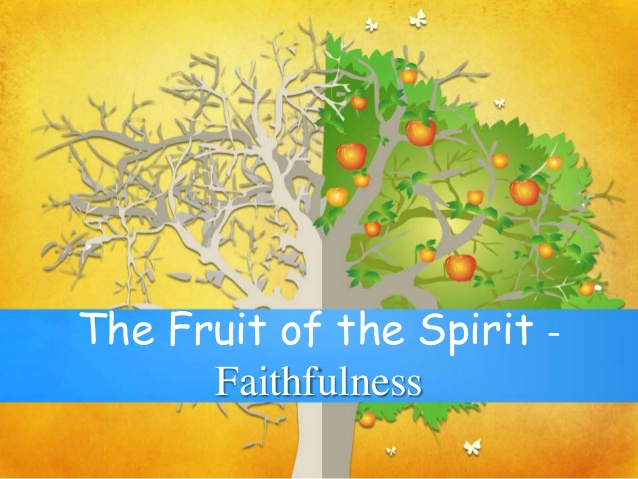
The Spiritual Fruit of Faithfulness

When you become a Christian, you may sometimes begin to change certain aspects of your life [at least that is expected].  One thing you might do is begin to hang out with other Christians.  You may begin to pick up their expressions and wonder what they mean. 

One such expression I often heard in the beginning of my walk was “I am not as good as I want to be, but I am better than I was yesterday.”

Over the years I have begun to understand what that means.

It refers to the faithfulness that God expects of us when we become one of His children. 

Billy Graham calls faithfulness an inward fruit of the Spirit.  “The Spirit works in us that He might work through us.”

When a person becomes a Christian, God expects us to change…inwardly.

Sadly, becoming a Christian is “it” for many.  They have a moment when they make the decision to become a follower and they feel they don’t need to worry about anything beyond that.   That is “the moment” in their lives when they feel the most connected to God and beyond that, they ride [so to speak] on that moment.  They love to say things like “once saved, always saved.”  They don’t realize that God has so much more for them if they would just continue on in their growth; God expects them to be faithful from the point of conversion to the time of death. In short, they don’t understand God’s expectation of Christian growth [i.e. working toward spiritual maturity].

Becoming a Christian also means yielding your life to Christ.  Faithfulness means fidelity according to Pastor Graham* and fidelity means being true to someone or something; of course, in this context it means being true to Jesus.  I have myself experienced the “partial yielding” of my life to Christ.   It is almost as if I am holding out certain aspects of my life that I really want to indulge in but I know down deep in my heart that God is not happy that I have not given those aspects up for Him.  In truth, He wants all of me and it is the most important job of my life to learn how to yield as much of me to Him as I can.  All I can do is wrestle with this and learn how to give more of me in the future.

Graham says “faithfulness is not a faith exercised by the Christian, but rather to faithfulness or fidelity produced by the Holy Spirit in a yielded Christian life.”  If a person grows beyond their conversion or I can yield more of my life to Christ, it will be because the Holy Spirit is working through me to develop the fruit of faithfulness. It is not me having faith as much as me experiencing faith in my walk with Christ.

Where do we get the idea that this is a growing fruit?  Matthew 25:21 says “You were faithful with a few things; I will put you in charge of many things.”  Graham writes “Morality is not so much a matter of magnitude, but of quality.   Right is right, and wrong is wrong, in small things as well as big things.”  The Disciple Peter has harsh words for Christians who cannot turn from the “world’s ways” in 2 Peter 2: 21, 22:  “For it had been better for them not to have known the way of righteousness than after they had known it, to turn from the holy commandment delivered unto them.  But it happened unto them according to the true proverb, the dog is turned to his own vomit again; and the sow that washed to her wallowing in the mire.”  I read this as Peter admonishing us to get right with Jesus and turn from our old ways; don’t return to the bad habits that we have had.  He is advocating for our growth.

Now I have already admitted that I have a ways to go.  We all do.   Pastor Graham says “even if we could become totally mature Christians I am not sure that we would be conscious of it. Who of us can claim total perfection in this life?”That is a good point.  None of us will ever be able to claim total perfection because we don’t have what it takes to reach that.  All we can do as Christians is try to live better lives.  We know we will fall, but when we do, don’t listen to the voices that say “you don’t have to worry about it; you are saved and that is good enough.”  Don’t listen to those voices that say “You don’t have to yield everything to Him.  You can hold some back.”

Listen to this voice…

Get back up and walk with God again. 

How many times? 

As many times as it takes…

Until you are free…

from Billy Graham’s book The Holy Spirit

Posted in Uncategorized | Leave a comment

The Purest Water I Have Ever Found…

The Greek word translated “goodness,” agathosune, is defined as “uprightness of heart and life.” Agathosune is goodness for the benefit of others, not goodness simply for the sake of being virtuous.  This sounds pretty “high and mighty” but when you turn to the word ‘good’ in the language of Scripture, it literally means ‘to be like God’” [Graham, 266].

Yes, it means to be like God…

Goodness is a fruit of the Spirit and you might think of it as an ordinary word but in the context of Jesus’ teaching and the working of the Holy Spirit, we should not  take it for granted. 

Many might think that of course a Christian should be good, that goodness should be second nature for a follower of Jesus Christ.    “Where we had harbored selfishness, cruelty, rebelliousness, and spite, we now possess love, joy, peace, patience, kindness, goodness, faithfulness, gentleness, and self-control. Everything in the list reflects the character of God, and goodness is one that relates directly to morality.”* In fact, goodness according to Pastor Graham represents the highest in moral and ethical values.

The Apostle Paul writes “For the fruit of the light consists in all goodness and righteousness and truth” [Ephesians 5:9].  He also writes “To the end also we pray for you always for that our God may count you worthy of your calling, and fulfill every desire for goodness and the work of faith with power; in order that the name of our Lord Jesus may be glorified in you” [2 Thessalonians 1:11, 12].

The kind of goodness that is the fruit of the Spirit is a special goodness.  Graham uses an example in his book that means a lot to me.  I had an experience as a country kid growing up in a small school [grades 1 through 8 in the same building].  I rode to my school in a little panel bus with about seven other kids.   Every day we went over country roads and we passed by a freshwater spring.  Today this would never happen, but when I was a kid, things were a bit more relaxed I guess.  Often the bus driver would stop the bus in the afternoon and all of us would share a dipper and we would get a drink from the spring.  In Graham’s example in his book, he writes of spring water that was on his property; he had a technician come and test the water.  The technician said “it’s the purest water I’ve ever found.”  In my recollection, the water we drank from the spring on our bus route had a special taste, maybe the purest tasting water I have ever tasted.

The “good” Christian exhibiting good fruit pours out goodness, like pure drinking water from a freshwater spring. 

This goodness goes far deeper than just the normal acts that happen from time to time in our lives.  What we are talking about here is love in action.   Goodness springs from a righteous heart and a righteous heart is not acting to please others.  These “good” Christians are acting to please God.   They don’t expect recognition.  They don’t expect rewards.  They don’t desire medals.  This is the kind of good that Christ expects from all Christians and guess what? Many of us fall short. 

In reality, we actually have no other choice than performing good in our lives if we are bona fide Christians.  God and His Son Jesus Christ command it.  

What is the end result of all this.  The end result is the powerful witness that we can have as we do good.  People notice people who do good, especially good that comes from what appears to be a pure heart.  When people notice people doing good, it preaches a strong message to all of us.  Just yesterday, my pastor prayed in her benediction for the people of the church to live lives that exhibit the love of Christ.  She went further and said that our lives may be the only Bible that some people will ever see. I have been reading a book lately entitled Faith and Doubt, by John Ortberg. I think Ortberg may explain best what I am trying to say. When Jesus appeared to His disciples He lived a new kind of life, a life that not only preached goodness but a life where He lived goodness. The more Jesus’ disciples stayed around Him, the more they began to believe that what Jesus offered was attractive. Eventually they began to think, I like His life. I wish I could live like that. “The growth of the disciples looked something like this; first they had faith in Jesus; they began to have the faith of Jesus” [Ortberg, 50].

Will people doubt the good that a Christian does?   Yes.  Some people cannot just accept things at face value.  What is your ulterior motive?  Are you trying to manipulate me?  I guess you are putting a mark in your little black book; I will owe you in the future.  You have an agenda.  Graham writes “Satan can take any human effort and twist it to serve his own purpose, but he cannot touch the spirit that is covered by the blood of Christ and rooted deep in the Holy Spirit.  Only the Spirit can produce the goodness that can stand up under the test” [267].

If goodness is a fruit of the Spirit, our efforts to achieve it with our own strength can never succeed.  This goodness is born of our righteousness, our response to the urgings within us to do the work that God has for us to do here on earth.  It is much deeper than trying to do something for the sake of being virtuous.

When you are in the presence of a truly good Christian, you are in the presence of someone special.  They are not God, but when you receive what they are giving to you, you may feel like they are. They are doing God’s work, and yes some unbelievers may be so impressed that they wonder about your action. They may copy your actions. They may even develop a faith they never had before.

The fruit of goodness is a Christian being like God. 

Graham summarizes by saying patience, kindness and goodness all go together, and “all were beautifully manifested in the life of the One who is the perfect prototype of what you and I should be.  By the power of the Holy Spirit these traits of character become part of our lives that we might remind others of Him” [267].

*From the website gotquestions.org  “What is Goodness?

Posted in Uncategorized | Leave a comment