
“I don’t understand what I do. For what I want to do I do not do, but what I hate to do” [the Apostle Paul in Romans 7: 15].
Isn’t it interesting to see such a strong man of God saying such things? He is obviously confused about his behavior. He has done something that he knows he should not do, but he has done it anyway.
He has sinned.
Every human being reading Romans 7: 15 should know Paul’s feelings. We all do what we hate to do from time to time. We all sin.
It is difficult to read; Paul’s honesty is an honesty we don’t want to admit. We don’t want to own up to our sin nature, the fact that we have the urge to do what is wrong and when those urges take over, our moral sense gets put “on the back burner.” We may want instant pleasure (even though it is a sin) and we forget consequences (often the anguish of guilt). It sounds to me that Roman 7: 15 is written when Paul is in the guilt phase. Sin has occurred, he reflects back on his actions and he is beating himself up over the fact that he has sinned.
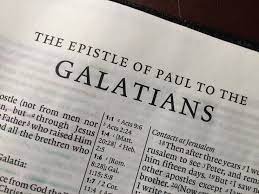
Paul writes to the Galatians “Those who belong to Christ Jesus have crucified the sinful nature with its passions and desires” [5: 24]. What does this Scripture mean?
This is an indication of what Paul wants (in a perfect world). This is affirmation six of the seven affirmations that John Stott uses to conclude The Cross of Christ. Man’s sinful nature is the major reason that Jesus came to earth, the major reason he died on the cross.
This raises the question about what Jesus expects of us. We did not deserve Jesus’ sacrifice for us but we got it anyway. We are left to grapple daily with the sins we commit because we are not capable of living a perfect life like Jesus. Every day I awaken, I have to “die daily” to the sins I have committed the previous day only to live my life (in the new day) finding myself committing more sins.
What the Apostle Paul is calling for is for us to do is try to practice self-control. Stott says that Paul is concerned with “the meaning of moral freedom” [338]. We do have the capability of making moral choices. What happens is we become more focused on “self-indulgence” than “serving each other in love.”
This is the age-old problem of sinning and our ability to do what is right in the eyes of God. Many places in Scripture this “battle” is between “the spirit” and the “flesh.” In my life I can speak to this quite frankly by stating what all believers have to say. When a person commits to believing in Jesus, the Holy Spirit comes to us to guide us, counsel us and comfort us. That Holy Spirit is our guide in life. When Jesus left this earth, He said that He needed to leave so the Holy Spirit could come to every believer.
Even though this Spirit comes, the old sin nature does not go away. Believers have habits of sinning that don’t disappear immediately. They exist beyond our “salvation” experience and they reappear from time to time. Jesus was the only man who had total control of his sin nature. Sadly I do not. In Galatians, Paul describes the contest between sin and Godliness, flesh and spirit.
When Paul uses the words “crucified the sinful nature” in Galatians 5: 24, those words are not to be taken lightly. Stott calls those word “an astonishing metaphor.” Crucifixion was a horrible, brutal form of execution. What he is saying is that we should not play with sin. Do not “coddle or cuddle it, not to pamper and spoil it, not to give any encouragement or even toleration.” He is urging us to reject sin together with all the desires we have that make us want to do it.
Stott continues “Paul is elaborating the teaching of Jesus about ‘taking up the cross’ and following him. He is telling us what happens when we reach the place of execution: the actual crucifixion takes place” [339]. He cites Luther who writes that Christ’s people should nail their flesh to the cross, for even though it may be alive, it cannot do what it would ordinarily do. It is nailed to the cross.
When we turn to Paul’s messages in Galatians, we see a powerful man of God urging us to crucify ourselves with Christ by crucifying our sin nature. We can have freedom from the law by sharing in Christ’s crucifixion and freedom from the power of the flesh by ensuring its crucifixion. “These two, namely to have been crucified with Christ (passive) and to have crucified the flesh (active), must not be confused” [339].
The struggle continues for us all. That is the nature of life for the descendants of Adam and Eve. That is God’s plan for humanity.
I think Stott writes a very strong thought related to this issue and I will end this post with that thought. “If we are not ready to crucify ourselves in this decisive manner, we will soon find that instead we are ‘crucifying the Son of God all over again.’” [Stott, 339].
Do we really want to do that?
*see First Corinthians 15: 31
 St. John Studies