Basic: Jesus Is The Son of God…

“I don’t fit in with those people in there.  They are perfect and I have my share of problems.  I am not sure I even want to get rid of my problems.  At least I can have a little fun out here in the real world.”   “I used to belong to that church but I got tired of them spreading gossip about each other.  They are so hypocritical.  Why would I want to attend services where people don’t practice what they preach?”  “Those people believe in God and they believe that ______ [some politician] is a good man.  How can that be?  There is very little about his positions that truly reflects Christianity, there is little about his character that reflects Christianity.  I can’t associate with people like that.”

Actual conversations I have had with people who have turned their back on the church…

Why all this discussion of not valuing the church?  That’s how John Stott begins his book Basic Christianity.  *

He describes the state of many people as “hostile to the church, friendly to Jesus.”  I would agree.  I have personally known many Christians who say they believe, yet they rarely go to church.  They may attend church one time per month and that is what they describe as “regular” or they may not go to church at all.  Many people don’t want to have anything to do with church.

What is going on?  Stott says too many people today see contradictions between the teachings of Jesus and the current state of the church or the current behaviors of believers.  For many, Jesus has not lost His appeal.  His call to love one another is admirable.  He preached that it is important to try to live a sinless life and people who read the Bible know that Jesus was a person who acted out His faith.  He was not afraid to take a stand against convention; many times He did what was right and found Himself pitted against the strict religious leaders of His day.  Another problem with many people today is they just don’t find church appealing, with its institutionalized “rules.”  Add to that the idea that it is easy to denounce churches and church members for “corrupt” behaviors [falling short of the glory of God].

People still seem to need some spiritual guidance in their lives.  When times get tough as they can do, that is the time to turn to a higher power and ask for help. So what do they do?

They turn their back on the Christian church and turn to other faith worldviews.  Maybe they just get so busy with today’s values that there is no time to think about God.  [I am doing fine in my successful life, thank you very much].

Let’s say that belonging to a church is the problem, but there is still a fascination with Jesus Christ.  Stott addresses a basic question that some people may have.

Did Jesus really exist?

The answer is yes.  Multiple Christian writers attest to his life as well as pagan writers.  He was very much a human being, being born into this world, growing up as a child and then an adult, He worked as a carpenter, He slept, ate and drank, He suffered pain because He had a human body, He had human emotions and He died.** 

But according to Stott, the biggest stumbling block for many who are on the fringes of the church is the following question: Was Jesus God?

For one to be a believer, that is an essential.  Jesus was not some bizarre Christian superstition.  Jesus was the unique Son of God.

Stott comments: “This question is fundamental.  We cannot dodge it.  We must be honest.  If Jesus was not God in human flesh, Christianity is exploded.  We are left with just another religion with some beautiful ideas and noble ethics; its unique distinction has gone” [Stott, 8].

At earlier times in my life, I was not sure I was truly ready to accept this.  I found the Bible to be an interesting “book,” not really the “Word of God.”  It had lots of passages where I found problems [it says this here, and over here it says something else types of problems].  I was raised to go to church so it was a given that I continue that after I left home.  It was more of a duty than anything.  I was not sure that I was getting something valuable from church service.  I did not think deeply about my faith.  If someone asked me if Jesus was God I would have said “Yes!” without thinking because that was the proper response.  In those days I am not sure I could even explain the significance of the God-Jesus connection. 

Then I had a chapter of my life where I lost my moorings.  I was living as I wanted and then I was confronted with the fact that all I depended upon was taken away.  I needed help quickly and like many who find themselves in a foxhole in the middle of an artillery bombardment, I made a sincere overture to God Almighty. 

It was a simple one-word statement but it was the first time in my life I had ever said it. 

“Help!”

I asked God for help.

I asked Him for help, believing He could do something for me.  I asked Him for help, knowing deep in my heart that He would be there for me.  For the first time in my life, I truly wanted Him and needed Him.

He had already sent His Son to earth to help me, but as I said above, that God-Jesus connection was something I just accepted because I was told to accept it.  I could not explain it.  It did not seem that important to me.  Then in 1998 I was very interested in it.  When all that I believed in life was called into question, I needed a new “rulebook.”  That rulebook was the New Testament.

I turned to the New Testament and read it like a novel.  Page after page held clues for me about how to live a better life.  For much of it, the message was articulated by Jesus or His Apostles and it made so much sense.  Little did I know that when I asked God for help that I would find myself studying His word, but I had always been a Christian on the fringes, not serious about my beliefs, but someone who did go to church regardless.

One of the first books I read to supplement the Bible in 1998 was Basic Christianity by John Stott.  I loved the New Testament but I also loved John Stott’s writing.  He was clear in his message.  He challenged me with his declarations.  He instructed me about the basics that I missed somewhere along the line. 

He made me think about how it is essential that I accept Jesus as the Son of God and the more I went to church and actually listened to my pastor, attended adult Sunday school and took my teacher’s lessons to heart, the more I read the Bible and other good books, the more I formed a rock-solid belief that Jesus was Divine, the true Son of Almighty God.

I still had my problems as I began to attend church on a regular basis.  The people in my church did not condemn me about my problems; they loved me anyway.  I saw that many of them were struggling too, but they knew that God loved them and forgave them.  Some people misbehaved in church but I began to see that as normal.  We are all human beings and to be held to a perfect standard just because you walk into a church is a bit of a stretch.  Their behavior was regrettable but it was understandable. We are all human.  Over the years I have heard people express their political views in church [not pastors], but I tried not to do that.  I understand how non-believers can be upset about that.  I began to feel that taking politics of the world into a church somehow takes something away from the worship of God.  I don’t discuss politics in my adult Sunday school class and when I hear someone saying political things, I just don’t respond.

I won’t turn my back on church.  I need it.  I won’t turn my back on God.  I have to have Him.  I won’t turn my back on His Son.  He inspires me.

You see, God sent His Son Jesus to help me.  He is there to help you too.

There it is…

Basic Christianity

*My first post on The Cross of Christ made reference to Basic Christianity so I am going to insert comments on that book in between posts on The Cross…  I just finished chapter one of The Cross [November 30, 2020].  I think readers may find this approach interesting.  For my opening comments on Basic see the post “Studying Stott Again” on October 25, 2020.  I have never worked on two books at a time but now is the time to do that. 

**See “Archaeologists Believe They’ve Unearthed Jesus’s Childhood Home”  Caroline Delbert,  Popular Mechanics Website, December 1, 2020 for recent discoveries.

Posted in Uncategorized | Leave a comment

Two Books: One Author

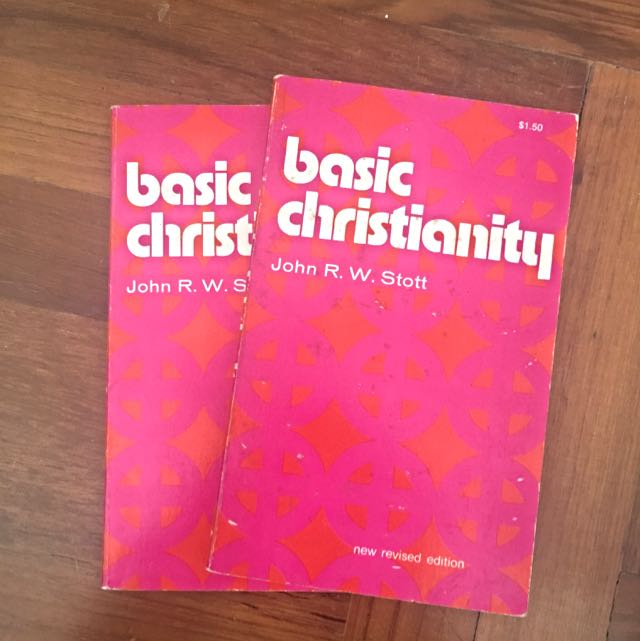
I guess you can find images of just about anything on the internet. Here are images of the exact R.W. Stott book I read in 1989, when I gave my life to Christ. At a time when I needed to read about basic Christianity, Stott gave me clear information about the faith.

Beginning December 7, 2020, I will mix commentary about this book in with commentary about The Cross of Christ.

This is the first time I have ever blogged on two books at the same time, but my heart is telling me to do this.

Two books: one author. One book basic; another book quite complex.

I know I will enjoy this.

I hope you do too.

David Carter

Posted in Uncategorized | Leave a comment

The Cross and Opposition

I daresay that many of us are searching for a faith, a worldview, an outlook that works for us.  Some of us may try on various “philosophies” like we try on clothes.  This one looks good.  This one feels right.  I can see value in this way of living.  We may adopt it for a while and then over time things happen: the faith is tested and we think it fails, the worldview crumbles as it confronts reality and what we consider to be a good outlook is no longer good any more.

Such was my life in college.  I dallied with a worldview that I thought was “cool”.  It seemed to explain a lot.  I had a mentor who believed it and he encouraged me to read literature that espoused it but in my heart I knew that something was lacking.  At the time I could not figure out what was wrong but I knew something was wrong.

It captivated my heart for awhile…

John Stott closes “Chapter One” of The Cross of Christ by pointing to several competing thoughts in the world that do not support the idea that the cross is the most important symbol for Christianity.  I have already discussed the Roman attitude toward crucifixion and the Jewish attitude toward crucifixion [see Nov. 1, 2020 post entitled “When I Survey the Wondrous Cross”].  Romans felt the cross represented a horrific way to die and Jews felt that Jesus’ death was a curse from God.  Certainly culture in First Century A.D. did not think the cross a significant or worthy symbol.

Other examples come from religions like Hinduism which has been around for five thousand years.  Stott writes Hindus “repudiate the gospel of the cross” [47].  Gandhi was attracted to Christianity for a while but could not accept the divinity of Christ.  Writing in 1894, he said “I could accept Jesus as a martyr, an embodiment of sacrifice, and a divine teacher, but not as the most perfect man ever born.  His death on the cross was a great example to the world, but that there was anything like a mysterious or miraculous virtue in it, my heart would not accept.”  Hinduism was the worldview I was fascinated with but I remember feeling that it was a bit hollow, that it did not seem to go anywhere.  Maybe I wanted a faith that inspired people to grow.  As I said above, something about it was “lacking.”

The Muslim faith ranks second today with 2.22 billion followers and it is considered the fastest growing religion in the world.  Muslims feel that Jesus was a major prophet, a Messiah, but they don’t accept the Christian concept of the need for the sin-bearing death of a Savior.  They believe each man will reap the fruit of his own deed.  Allah is capable of being merciful and capable of forgiving those who repent, but they just don’t feel that Jesus’ death on the cross served any purpose.  Stott describes Muslim theories of Jesus’ death as “God cast a spell over the enemies of Jesus in order to rescue Him” and other people were substituted for Jesus on the cross at the last moment. Nothing miraculous occurred on the cross, certainly nothing so important that a large number of people should hold up a cross as a significant religious symbol.

Western cultural thinking has long been an enemy of the Christian cross.  Friedrich Nietzsche [considered a major influence on modern intellectual history] wrote that Jesus was weak and Christianity was a weak form of faith.  “What is more harmful than any vice is active sympathy for the ill-constituted and weak Christianity.”   Darwinism emphasizes “survival of the fittest” and he found that conception much more attractive than a Messiah who found Himself sacrificed on the cross.

Other scholars like Sir Alfred Ayer wrote that “among religions of historical importance, there was quite a strong case for considering Christianity as the worst.”  He cites the “contemptible and morally outrageous” doctrine of original sin and Christ’s atonement on the cross.

One could go on and on citing example after example of opposition to the cross.  In fact, it is amazing that the cross is the central symbol of the Christian faith that it is today.

How did Christians persist in the face of opposition?  What happened to cause this symbol to be the central symbol of a faith with 2.3 billion followers, making Christianity the largest religion in the world?  Stott summarizes this phenomenon in a single word—“integrity.”   

What he means by integrity is personal loyalty to Jesus.  Stott has already written that he feels Jesus knew His life was leading to a death on the cross.  In my November 8 post entitled “Looking into the Mind of Jesus” I comment on the idea that Jesus was fixated on the saving cross as His significant last act as a human being.  Stott cites numerous Christian theologians that support his argument, P.T. Forsyth and Emil Brunner among them.  Forsyth writes “All that was in heaven or earth was put into what He did there [at the cross]…Christ, I repeat, is to us just what His cross is.  You do not understand Christ until you understand His cross.”  Brunner feels there is no other way to understand Christianity if one does not understand the significance of the cross, what he refers to as “revelation and atonement through the Mediator.”  “He who understands the Cross aright—this is the opinion of the Reformers—understands the Bible, he understands Jesus Christ.”*

Given this Christian theological emphasis, it is no wonder that Stott describes the cross as the center of Christian history and theology.  Christians “naturally perceive it [the cross] as the center of all reality.  So they see it everywhere, and have always done so” [Stott, 49].    Anglican theologian Stephen Neill writes “the death of Christ is the central point of history; here all the roads of the past converge; hence all the roads of the future diverge.”**

Why all this concern for the cross?  Why has Stott spent a whole chapter detailing the role of the cross in the history of the church?  Why has he argued that Jesus had every intention of going to the cross as His life unfolded?  Why does Stott turn to Scripture to make the case that Biblical writers knew that the cross was the central symbol of the faith?

The answer lies in the faith of the believer.  Jesus was the Son of God, God in human form.  Jesus came to save us sinners, to tear down the wall of sin that separates all of us from God.  Jesus did all this through His death on the cross.

We need to have that faith, that cornerstone of our belief, that the only authentic Jesus is the Jesus who died on the cross.

*From Emil Brunner,  The Mediator

**From Stephen Neill “Jesus in History” in Truth of God Incarnate

Posted in Uncategorized | Leave a comment

Paul, Peter and John…The Centrality of the Cross

Jesus knew He had to die in order for His mission on earth to be complete but how did His apostles view His death?  Many Christians think that the main thrust of the New Testament is the resurrection of Jesus, John Stott writing “It is often asserted that in the book of Acts the apostles’ emphasis was on the resurrection rather than on the death of Jesus” [38].  Of course there is nothing wrong with that but Stott is writing a book entitled The Cross of Christ, and his focus is not on resurrection but on the importance of the death of Jesus.  Do we as Christians prefer to skip the uncomfortable negative news so we can get to the good news?  Do we ignore the sacrifice in order to get to the salvation?  Is it easier to turn away from the vision of our Savior hung upon the cross than stare directly at that spectacle and consider its meaning?

Furthermore, is there any evidence for a doctrinal explanation of Jesus’ death in the writings of the apostles?  Is there any evidence for the centrality of the cross in the minds of the apostles or were they like us; they just wanted to skip over the bad part to the good news of the resurrection?

The “human verdict” for Jesus was death on a cross; of course, the resurrection was the “divine reversal of the human verdict.”  You can’t have one without the other, but do we dwell on the resurrection too much and ignore the sacrificial death of our Savior?  Stott argues that the writings of Paul, Peter and John do provide ample evidence that Jesus’ key followers knew that Jesus was on a divine mission directed by His Father God, a mission that led to a purposeful death.

In turning to Paul, it is clear why he refers to his own writings as “the message of the cross.”  In First Corinthians and Romans, he uses phrases like “we preach Christ crucified,” Jesus’ baptism is referred to as initiation “into His death” and the Lord’s Supper as a “proclamation of the Lord’s death.”  Paul felt that Jesus’ death on the cross was proof of the very essence of God’s wisdom and power.  When Paul wrote to the Corinthians, he was convinced that Christ died for our sins “according to the Scriptures.”   Repeatedly Paul focuses on how humankind is sinful and guilty before God and Jesus came to make “the unrighteous right;” in Jesus, “God presented as a sacrifice of atonement, through faith in His blood” [Romans 3:21-25].  We are “justified” through the blood of Jesus, “reconciled to God through the death of His Son.”  Paul knew that the sacrificial death of Christ was necessary for us to be saved from our sin.  In Galatians, Paul boasted in nothing “except for the cross”.  Certainly Paul did not let resurrection overshadow the importance of the cross; there is evidence that the cross was central to his message. 

When we focus on Peter, his testimony about the importance of the cross is also clear.  His first letter opens with a statement that his readers have been sprinkled by the blood of Jesus.  He reminds his readers that they are redeemed at a cost, not with “perishable things such as silver or gold” but rather “the precious blood of Christ, a Lamb without blemish or defect” [First Peter 1:18-19].   Peter connects the sacrifice of Christ to our need for redemption: “He Himself bore our sins in His body on the tree” and “Christ dies for sins once and for all, the righteous for the unrighteous, to bring you to God” [First Peter 2:24; 3:18].   In the context of First Peter, the cross is the main point of emphasis and Christ is our “sin-bearer and substitute.”  Peter does not gloss over the cross in his writings, moving on to the resurrection; he knows the importance of the cross for the Christian’s life and he explains it clearly. It is central.

No apostle concentrates on the cross more than John.  John even tied the incarnation of Jesus to the death of Jesus: “he saw the incarnation as being a view to the atonement” [Stott, 42].   God’s love for mankind was seen in the birth of His Son, whom He “sent . . . as an atoning sacrifice for our sins” and whose “blood purifies us from every sin” [1 John 3:16, 4:9 etc].

An even more striking portrayal of John’s focus on the death of Jesus is seen in the last book of the Bible, Revelation.  Jesus is introduced in this book as the “firstborn of the dead” and “the Living One” who was dead but is now alive forever.  The most common designation that John gives Jesus is “The Lamb”.  This title occurs twenty-eight times in the book and it has nothing to do with Jesus being meek.  It is about Jesus as a sacrificial character whose blood has been shed so His people can be set free.  Stott says in order to understand the full ramifications of The Lamb, you have to divide the symbolic meaning into salvation, history, worship and eternity.

We owe our salvation to the blood of The Lamb.  “Salvation belongs to God, who sits on the throne, and to The Lamb.”  Man has been “washed . . . and made white in the blood of The Lamb.”  In other words, all of mankind owes their righteous standing because Christ went to the cross.  Furthermore, our salvation is secure because not only are our names written in The Lamb’s book of life, but the Lamb’s name is written on our foreheads” [all references to Revelation].

History is also depicted in Revelation.  Our Savior is standing in the center of God’s throne, sharing the rule of Almighty God.  The occupant of the throne is holding in His hand a seven-sealed scroll which is generally identified as the book of history.  In Revelation, John weeps because no one can break the seals on the scroll but The Lamb does break the seals and proves He is a part of history.  Stott writes “It is significant that what has qualified Him to assume this role is His cross, for this is the key to history and the redemptive process it inaugurated.”  No matter what will come to man, God will overcome the devil due to the blood of The Lamb, which is in all of history, until the final victory.

In Chapter Five of Revelation, choir after choir sings the praises of The Lamb.  “Four living creatures and the twenty-four elders” fell down before The Lamb and began to sing a new song.  They sing that Jesus is worthy to take the scroll of history and open the seals because He has been slain “With your blood you purchased for God, from every tribe and language and people and nation.”  Next John hears a hundred million angels singing “worthy is The Lamb, who was slain.”  When the four living creatures [representing all of mankind] fall down and worship The Lamb, this (of course) is worship to the extreme.

Finally, John makes the case that the cross entitled Christ to have eternal importance.  Revelation is one of the most difficult books to understand in the Bible but “eternal” imagery is powerful regarding the lasting influence of The Lamb.  John is telling the reader that from the eternity of the past to the eternity of the future, the “center stage” is occupied by The Lamb of God who was slain for all of us.  Jesus is placed on an equal level with God.  Jesus mediates God’s salvation, shares God’s throne, and receives God’s worship.   What allows Jesus these privileges forever is the fact that He was slain for man and died to procure our salvation.  John has the vision that God and Jesus are forever coupled: Stott describes this as “the seer’s uninhibited coupling of ‘God and The Lamb’” [44].

I have been a Christian all of my life, attending church all my life and making a “born again” commitment in 1998.  I know first hand that as Christians approach the Christmas season, the incarnation will get a tremendous amount of attention and 100 days later, we will have a tremendous celebration of the resurrection.  John Stott is trying to take a little of the emphasis off of the beginning and the end of the life of Jesus. He is trying to suggest that we should stop and consider the importance of Jesus’ death, for it is in His death that we are forgiven, in His death we are made righteous before God, for it is in the sacrifice of His life that we have a chance for eternal life.

Paul, Peter and John certainly did not forget the importance of Jesus’ death.  One might examine their writings and conclude that they felt it was the key to all that followed.  Like us, maybe they would have preferred to “skip over the bad part” to get to the resurrection but when one does a close reading of their writings, they certainly did not ignore the fact that Jesus died for all our sins.

They did not turn away from the fact that Jesus hung upon the cross.  They stared directly at that spectacle and had a serious consideration of its meaning.

They recognized the centrality of the cross…

Posted in Uncategorized | Leave a comment

The Awareness of Jesus*

Most of us don’t think about it all the time.  Overemphasis on it may lead to depression.  Too much concern about it can cause us to stop accomplishing anything in our lives.  I once had a doctor tell me “None of us are going to get out of this alive.”  I had an aunt who had terminal cancer and she spent the last year of her life obsessing about it, planning every detail of her final moments on earth.  What I am talking about, of course, is death.

We will all have to go through it.  None of us can avoid it.  It is a fact; we all have to die.

Jesus was no different.  He knew He was going to face death.  But then again, Jesus was different; Jesus was God.  Christians believe He had divine powers, extraordinary insight, a sense of purpose for all that He did in His life.  In the post “Looking  Into the Mind of Jesus” [November 8, 2020, St. John Studies] I summarize John Stott’s argument that Christ knew He had a purpose for His life and that purpose centered on His crucifixion.  Stott even tried to make the case that Jesus intended the cross to be the central symbol of Christianity. That idea was in Christ’s mind from the beginning.

That may be, but some would say that is a bit far-fetched.  How could anyone plan for a religion to adopt a symbol that represented a horrific method of execution?  How can Stott write an outrageous sentence like “the centrality of the cross originated in the mind of Jesus Himself.” Others might say that of course Jesus could have done that; He is all powerful.  He is God.    

Whatever one chooses to believe about this matter, let’s put this centrality of the cross debate aside and deal with more practical matters about the imminent death of Jesus Christ.  Stott states that there were three “earthly” factors that led to the death of Jesus Christ.  Jesus was very aware of these factors, in fact some would say He did very little to avoid His death.  He knew that Jewish national leaders hated Him, He knew that Biblical Scripture predicted His death, and there is evidence that He made very deliberate choices which led to His death.  

Can we argue about the centrality of the cross as a plan in the mind of Jesus?

Yes…

Can we argue that Jesus was surprised that He was going to die a horrific, violent death?

No…

Jesus knew that Jewish leaders were actively trying to find a way to have Him killed.  Christ did not have a rigid attitude toward the Law, especially the Law regarding The Sabbath.  When Jesus encountered a poor man with a shriveled hand in a synagogue on Sabbath day, He did not hesitate to help the man.  He healed his hand.  The Gospel writer Mark comments that the “Pharisees went out and began to plot with the Herodians how they might kill Jesus” [Mark 3: 6].  Christ knew this and He also was well aware that other important prophets had already been persecuted.  Essentially, Jesus threatened the power structure of the day.  Stott recounts Jesus’ interpretation of Isaiah 61 in the synagogue when He expressed a “divine preference” for Gentiles.  As recorded in Luke 16-30, the Jews in attendance drove Jesus out of town, took Him to a hill and were ready to throw Him down a cliff.  Jesus walked away from this threat, but He knew that eventually they would succeed in their mission to kill Him.

Furthermore, Jesus Christ knew the Scriptures.  It was foreordained that the Messiah would have to suffer, would have to die, would be resurrected and would experience God’s glory.  Stott comments on Jesus’ Old Testament references about His fate but for me, the strongest forecast of His death comes in Isaiah.  As a novice Christian, I was not an avid reader of the Old Testament, but when I had to read Isaiah as part of a Bible study at church, I marveled at the words from the Eighth Century B.C. Prophet.   Yahweh is “despised and rejected by men, a man of sorrows, and familiar with suffering.”  He was “pierced for our transgressions” and “crushed for our iniquities.”  He is “raised and lifted up and highly exalted.”   The thoughts of Isaiah influence so much of what Jesus said in His last days.  When He commented that He “must suffer many things” and has “not come to be served but to serve, and to give His life as a ransom for many” His thoughts allude to Isaiah 53.  Stott comments: “It was from this chapter more than any other that He learned that the vocation of the Messiah was to suffer and die for human sin and so be glorified.”  It all makes sense when Jesus turned to the disciples on the road to Emmaus and said “Did not the Christ have to suffer these things and then enter His glory?”  Christ knew the Scriptures; He knew He had to die for mankind.

Finally, one can analyze Jesus’ choices that led to His death.  I have always wondered why Jesus did not summon Angels to save Him from the suffering He had to endure.  I have always wondered why Jesus had to answer Pilate’s query about Jesus being king with “Thou sayest that I am a king. To this end was I born, and for this cause came I into the world, that I should bear witness unto the truth. Every one that is of the truth heareth My voice.”  He could have just said “No!”.

He was the Son of God; He had the power.  He had a mind and could make choices; He did not have to condemn Himself.

Yet He did…

Stott writes that Jesus was determined “to fulfill what was written of the Messiah, however painful that would be” [37].  It was not due to a sense of fatalism or a desire to be a martyr for the faith.  He believed the Old Testament Scripture and was determined to do the will of His Father.  “Father, if You are willing, please take this cup of suffering away from Me. Yet I want Your will to be done, not Mine.”  The human side of Jesus knew that He was headed for great suffering but He chose to accept the will of His father over the dread of the pain ahead.  He did not have to go to Jerusalem for Passover, but He went.  In His last days His language changed.  The Son of Man must suffer many things and be rejected.  What has been written about Him must be fulfilled.  When He did not appeal for Angelic help it was because God’s strength must shine forth in His weakness.  “It was not because He was the helpless victim of evil forces arrayed against Him or of any inflexible fate decreed for Him, but because He freely embraced the purpose of His Father for the salvation of sinners, as it had been revealed in Scripture” [Stott, 37].

Without a doubt, Jesus knew His days were numbered as He travelled to Jerusalem to celebrate His last Passover.  It was clear to Him that the people who hated Him the most were the ones who had the most power.  It was clear to Him that the Scripture foretold that He would have to suffer many things and He would have to give His life as a ransom for many.  It was also clear that He had to make hard choices in order to bring about His Father’s will.  He was a man on a mission and His own death dominated His mind.  He knew that He had come to save mankind, to suffer for our sins. 

He was not surprised by His death; in fact He knew it was coming. He knew when it would come and how it would come.  This foreknowledge does not compare to my knowledge that I will die one day; it is much more.  He did not ask to be delivered from death because that is the reason He came to earth, for He knew His death was “glorification”…

We know why He came to earth, for in His death we are saved.

“For I have not come to be served, but to serve, and to give my life as a ransom for many.”

“God made Him who had no sin for us, so that in Him we might become the righteousness of God”**

*This post is from a series done on John Stott’s book The Cross of Christ.

**2 Corinthians 5:21

Posted in Uncategorized | Leave a comment

Looking Into the Mind of Jesus

Attribution…

It is a normal part of everyday life.  People around us do things and we make guesses about their behavior.  I use the word “guesses” on purpose because it is pretty impossible to be certain about why people do what they do.  Maybe the best words to describe the process of attribution are we make interpretations of others’ behavior.   This is not an exact “science” to say the least.*

The reason I start my comments with this discussion is the following statement by John Stott:  “The fact that a cross became the Christian symbol, and that Christians stubbornly refused, in spite of the ridicule, to discard it in favor of something less offensive, can only have one explanation.  It means that the centrality of the cross originated in the mind of Jesus Himself” [Stott, 35].

Sounds to me like Stott has ventured into unknown territory.   He is saying that our emphasis on the cross came from the life that Jesus led and the things that Jesus said.  He is attributing the cross to “the mind of Jesus.”

The next question follows: How can he say that?

Here is a summary of his argument.

Granted, the popular opinion of the Jews of Jesus’ day was that the Messiah would be a revolutionary political leader.  Instead we all know the story; that the Messiah was born of a virgin in a manger in a livestock shed.  We know of no sign that Jesus was even aware of His divinity until He was twelve years old.  He was in Jerusalem with His parents for the celebration of Passover.  They lost track of Him and when they found Him, He was in the temple and when His parents approached He said the following words: “Didn’t you know I had to be in my Father’s house?” [Luke 2: 41-50].  Stott points to how He said this as a sign that He knew He was on a mission.  God had sent Him into the world for a purpose.

The next momentous occasion was His baptism and the moments of temptation after His baptism with the devil in the desert.  There was no hesitation in His response to the temptation.  He knew to avoid the powerful prizes offered by Satan.  He knew His purpose.

In His public ministry, Jesus began to reveal His mission.  When His disciples began to state that Jesus was the Messiah, Jesus told them to “not tell anyone.”  Stott writes that He was aware that the Jews wanted a powerful hero to save them from Roman oppression.  After feeding the five thousand, the crowd intended to force Him to be king, but He slipped away.  He knew His mission must be completed through His crucifixion, not elevation to some earthly throne.

Peter blurted out that Jesus was the true Messiah, but what was Jesus’ response?  “Out of my sight, Satan!  You do not have in mind the things of God, but the things of man.”  Again, He knew this statement by Peter would only impede his pathway to the cross.

Jesus took His disciples aside several times and predicted His future.  We see this in the book of Mark: “We are going to Jerusalem and the Son of Man will be betrayed to the chief priests and teachers of the law.  They will condemn Him to death and will hand Him over to the Gentiles, who will mock Him and spit on Him, flog Him and kill Him.  Three days later He will rise.”  We see this prediction three times in Mark 10, Matthew 20 and Luke 18.  This was a man on a mission.

In the last week of His life on earth, Jesus referred to perfume that was going to be poured over His head as preparation for His burial.  He gave out bread and wine as emblems of His body and blood, a sign that He knew that these elements would be in commemoration of His death. 

In the Garden of Gethsemane, He could have called on men and angels to help Him in His time of need but He didn’t, saying “how then would the Scriptures be fulfilled that say it must happen this way.”  Stott writes that Scripture “bears a common witness to the fact that Jesus both clearly foresaw and repeatedly foretold His coming death [on the cross]” [brackets mine].

What we are discussing here is Jesus’ perspective on His own death.  What Stott is arguing here is that Jesus knew He had crucifixion in His future and He responded to events in a way that would get Him up on that cross.  Repeatedly Jesus used the expression “My time has not yet come” to say that circumstances were not quite right yet.  When He changed water into wine, He was urged to go Jerusalem and declare His divinity and He said “My time has not yet come.”  When he made what the Jewish leaders labelled as blasphemous statements there was a push to seize Him but He slipped away “because His time had not come yet.” 

But when circumstances were right, He changed His expression.  He went from “My time has not yet come” to “the hour has come for the Son to Man to be glorified.”  In Jerusalem when some Greeks asked to see Jesus, he repeated that sentence about His glorification.  He commented later on His death and said that it was to glorify the name of His father.  Twice in the upper room He said that it was almost time for Him to leave the world and be “glorified.” 

This shift to “my time has not come” to “the hour has come” is solid evidence that Jesus knew the reason He had come into the world.  He knew that He was destined to meet a violent, premature and purposive death on the cross and He was directing Himself to that end. 

Stott goes further in his writing: “From this evidence supplied by the Gospel writers, what are we justified in saying about Jesus’ perspective on His own death?  Beyond question He knew it was going to happen” [Stott, 35].  Are we willing to go as far as Stott and say “the centrality of the cross originated in the mind of Jesus Himself?”

As in all attributions, Stott may be right or he may be wrong.  It all boils down to his interpretation of the Scriptures.  Stott feels that the cross became the Christian central symbol of the faith because of loyalty of Jesus’ followers and Jesus intended for it to be that way. 

In the next post, we will discuss three more reasons for the cross to be central to the faith, what Stott calls “three intertwining reasons for its inevitability.”  However, he already feels justified in saying that Jesus was following God’s plan for Him to be crucified.  He already feels justified in saying that the cross of Christ is the central symbol of Christianity.  He has looked at Jesus’ words and Jesus’ actions and feels he knows the plan.  We have the cross at the center of our faith because Jesus wanted it that way.

It was supposed to be that way all along…

*Attribution is a core concept in the study of human communication.  As humans, we are geared to make meaning out of others’ verbal and nonverbal expressions, even though we “miss the mark” a lot.

Posted in Uncategorized | Leave a comment

“When I Survey The Wondrous Cross”

In 1979, the contemporary sanctuary of St. John United Methodist Church* was dedicated.  As part of the preparation for that dedication day, two members** of the church designed a large cross and suspended it from the ceiling of the church.  To their amazement, the lighting in the church produced two shadows one on each side of the cross, making it symbolic of the cross at Calvary. This captured the imagination of church members so much that the cross has never been taken down and remains in place today.

Needless to say, when one visits my home church, the cross is central to the worship service, you might say it is “front and center.”

But for Christians, the centrality of the cross is not that unusual.

John Stott begins his book The Cross of Christ with some explication of how the cross is prevalent in Christian art, architecture and every aspect of Christian worship.  His example of art is the painting by Holman Hunt entitled The Shadow of Death.  His example of architecture is St. Paul’s Cathedral in London.  His explanation of the centrality of the cross in worship is expressed from the viewpoint of a “stranger” who is visiting a worship service at St. Paul’s. 

As I read his discussion of worship at St. Paul’s, it made me consider the symbol of the cross in my church and I have to admit, it shows up everywhere, from bulletins to crosses around members necks.  From the antependium [that cloth that is draped over the pulpit] to the lapels on parishioners’ jackets.  We have so much beautiful stained glass at St. John UMC and it is full of crosses.

Maybe it is in so many places that we take the cross for granted.  It was not always so.

Stott explains that early Christians did not even use the symbol of the cross to signify their faith.  First of all, they were afraid to use it because of its close association with the death of Jesus.  Persecution was so common that there was fear that its use would make it easier to identify Christian worshippers, and therefore allow Romans and Jews to find them and to exact punishment.  Despite the fact that Christ died on the cross, in the First Century, crucifixion was regarded as a shameful way to die, a punishment reserved for common criminals.  When a person was convicted of murder, rebellion or armed robbery in the Roman world, they met their end on the cross.  This method of punishment was barbaric [literally]; the Romans began the practice after discovering its use by peoples at the edge of the known world.  Crucifixion was an extremely slow death and most often criminals suffered additional torture while hanging on the cross.  The use of a cross as a positive symbol in those times would have been unusual. 

Roman citizens in the First Century were exempt from crucifixion, except in extreme cases of treason.  Stott writes that Romans regarded crucifixion “with horror”. 

Jews in the First Century also regarded crucifixion as a disgusting way to die.  They cited scripture from Deuteronomy which says “anyone who is hung on a tree is under God’s curse” [Deut 21: 23].  One reason that they could never accept Jesus as The Messiah is that they believed He died under God’s curse because He was crucified on a tree.  Their experience with crucifixion was often at the hands of vengeful Roman generals.  The Roman general Varus crucified two thousand Jews in 4 B.C. and  general Titus crucified so many Jews that they ran out of space on the main road and they ran out of trees to make crosses.  They hated the symbol of the cross.

Today’s Christian might think the symbol of the cross has been around since earliest days of Christianity, but that is just not the case.  Early Christian symbols that were accepted were drawings of a peacock [meaning immortality], the dove, the athlete’s victory palm or the fish. 

In the second century, Christians began to depict significant themes of redemption in their art.  Noah’s ark gained popularity as well as Abraham killing the ram instead of Isaac, Daniel in the lion’s den, his three friends in the fiery furnace and Jonah being disgorged from the belly of the whale.  These symbolic paintings were less incriminating than the cross and only those instructed with the Christian interpretation of the art would understand their significance for the faith. 

Christian symbols for Jesus could have been the crib, the manger, or a carpenter’s bench.  Other choices could have been a boat, where Jesus taught the crowds at Galilee or the apron He wore to wash the disciples’ feet.  The throne could have symbolized the sovereignty of Jesus or even the dove, the symbol of the Holy Spirit.  Instead, the two bars of the cross eventually became the preeminent Christ symbol because they commemorate Jesus’ death.

In the second century Christians began to draw, paint and engrave the cross as a symbol of their faith and they also began to make the sign of the cross on themselves.  Tertullian recorded the practice of Christians “signing” the cross in his writings in A.D. 200.  Hippolytus, the Roman historian writes of signing the cross as a common ritual in A.D. 215.  He also comments on a Christian bishop who made the sign of the cross on the forehead of candidates for confirmation. 

In the sixth century, the crucifix began to be commonly used by Christians. This symbol of the cross with Jesus attached was an obvious reference to His sacrifice for us and it solidified the cross as Christianity’s central symbol. 

Of course, there have been periods in Christian history where the cross has been attacked.  Puritans in England in the Sixteenth Century felt that the cross was a sign of Roman Catholic “popery” and discouraged its use.

But today Stott writes “the cross is the universal symbol of Christianity.”

I have joined the choir at St. John and the choir sits right under the large cross at the front of the sanctuary.  As I look up from the choir loft, I realize that I am only fifteen or twenty feet away from this large symbol.  We don’t sing the hymn When I Survey the Wondrous Cross by Isaac Watts too often but if we would sing it and if we would all gaze upon the cross, the meaning for any Christian is only too obvious. 

When I survey the wondrous cross

On which the Prince of glory died

My richest gain I count but loss

And pour contempt on all my pride.

The cross of Christ—the universal symbol of our faith.

*St. John United Methodist Church, Hopkinsville, Kentucky.  **Cecil Hammonds and Arch Hitch                                                                                    

Posted in Uncategorized | Leave a comment

Studying Stott Once Again…

“I bought this book in 1976—in 1999 I read it and have found it a blessing.  Stott answers so many questions.”  [written by me on the back page of my 1971 paperback edition of John Stott’s book Basic Christianity].

Readers of my thoughts on St. John Studies may have seen several references to my “born again” faith in some of my posts over the years.  I dedicated my life to Christ in 1998 and the reading of Basic Christianity was one of the books that I read very early on in my walk with God.  During 1998, I fell in love with the New Testament because I had a hunger for the answers about life that I found there.  I came to know God in the midst of personal trauma and I was going through a crisis of purpose in my life.  I literally did not know how I was going to move forward.  The habits that I had developed over forty-six years of life were just not working.  I desperately needed a new direction.  Along with the New Testament, John Stott’s writing explained the deeper level of meaning that could be found in the Christian life.  Along with the Bible, his book clarified my purpose.  His writing was sensible.  It was very clear and easy for me to understand.  His explanations were solid; I remember feeling that this man really knew his subject matter; there was no waffling.  Here was someone who had a stalwart commitment to his faith.  I have very fond memories of reading his little paperback.  It costs one dollar and fifty cents at the retail bookstore, but I got my copy at a used bookstore for seventy-five cents. 

I tell you all this to explain my admiration for this British Anglican priest and theologian.  In his lifetime, he was one of the most influential evangelical leaders in the world.  He wrote fifty books about Christianity. In 2005, Stott was named to Time Magazine’s “100 Most Influential People in the World List.”  His influence on the Christian faith in his lifetime was significant.  His influence on me was significant.  Now twenty one years after encountering Basic Christianity I get to study John Stott again.

Alister McGrath, Professor of Historical Theology at Oxford University states that The Cross of Christ was written at the height of Stott’s career, when he was sixty-five years old.*  Why would John Stott undertake a book dedicated to the cross?  He explains in his Preface that the cross “lies at the center of the historic, biblical faith, and the fact that this is not always everywhere acknowledged is in itself a sufficient justification for preserving a distinctive evangelical testimony.”  [Stott, 13].    Maybe we take it for granted that the cross is where God [through Christ] substituted Himself for all of us and bore our sins.  This was how He restored man to His family.  J.I. Packer says this idea is the “distinguishing mark” of the evangelical movement in the world.

Another reason is that in 1986 no book on the cross was written by an evangelical author for “thoughtful readers.”  At that time, Stott felt like he was filling a void in Christian literature. 

How does he try to construct his book?  How does he approach a discussion of the cross?  In parts one and two, he states that he tries to argue for what he calls the “heart of the cross.”  He puts forth his explanation of satisfaction and substitution, two words Stott will use as his basis for an extensive definition for atonement. In part three, he discusses the “achievements of the cross,” what God did through having his Son on the cross.  Part four addresses how Christians are to “live under the cross.”  In this last part, Stott attempts to explain how the cross transforms everything about how we live as Christians. 

Stott had anxieties about writing this book which he discusses in his preface.  First of all, he wanted to be true to the word of God.  He did not want anyone to accuse him of misinterpreting Scripture.  Secondly, he wanted to acknowledge work by other theologians.  To ignore excellent work by others is to be “disrespectful.”  He realized that the Holy Spirit has enlightened scholars for many centuries as they penned their thoughts about God; he knew their work reflects God’s working through their study.  Thirdly, he wrote that he tried to understand Scripture in relationship to the contemporary world.  He wanted his book to reflect what the cross means to us today.

Finally, Stott states that writing a whole book just on the cross is “presumptuous.”  While wanting to write The Cross of Christ, he admits that knowing the real reason that God wants to reconcile Himself to this world is a mystery.  Man has his theories, but do any of us really know the mind of God?  Stott puts it like this: “it would be unseemly to feign a cool detachment as we contemplate Christ’s cross.  For whether we like it or not, we are involved.  Our sins put Him there.  So, far from offering us flattery, the cross undermines our self-righteousness” [Stott, 18].  We may not understand the cross, but we can stand before it as merciless sinners.  We hope God speaks to our hearts the words of pardon and acceptance we long to hear.  After hearing those words, we hope to pick ourselves up and go into the world to serve Him.

Stott is humbled to be able to share his thoughts on the cross.  Maybe as readers we should be prepared to be humbled as we read his thoughts.  I certainly need to be forgiven for the many sins that I commit on an everyday basis.  In 1999 when I encountered Basic Christianity, I was in need of basic answers to basic questions about my life.  Twenty years later, I still struggleas I do things I know I should not do.  How can I sin like I do and call myself a Christian?  How can I proclaim that I am “born again” yet I still do things that I know are very wrong?

In 1999 I needed Basic Christianity.

Maybe in 2020 I need The Cross of Christ

*from the Foreword to the 2006 Edition of The Cross of Christ

Posted in Uncategorized | Leave a comment

Not Written in Vain…

Knowing God…*

What does it mean to “know” God?  How does one really get to know Him?  Don’t all Christians know Him?  Isn’t that special knowledge something that just goes along with declaring “I am a Christian”?

I wish it worked that way, but sadly, it doesn’t.

The reason J.I. Packer wrote his book Knowing God is that he thinks that too many Christians profess to know God, but that is not the reality.  Many really don’t know God at all.  Ignorance of God “lies at the root of much of the church’s weakness today” [Packer, 12].  Packer feels that too many Christians don’t know God’s ways nor do they know how to commune with God so they can change their relationship with their Lord and Savior.

In the very last section of his book Knowing God,  Packer discusses the climax of his book and he titles the climactic section “Learning to Know God in Christ.”  He summarizes the various places that he has taken us on our quest through his book.  The God we seek is of course found in the Bible; that is a major starting point for knowing God.  Christians need to study it.   Packer even makes it easier; he recommends we spend most of our quality time studying the book of Romans.  There we will encounter and hopefully understand God revealed in Jesus and the Holy Spirit, the Three in One in historic Christian teaching.

He states that “knowing Him starts with knowing about Him” so he wrote chapters about God’s character [goodness, severity, wrath and grace etc.].  The more Packer discusses God’s character, the more we could see that we as human beings are fallen creatures.   We are not good, not strong, and definitely not self-sufficient.  Indeed we are all going to hell unless our Lord intervenes through His grace and saves us.  We just don’t have what it takes to live a righteous life.  Not only do we lack knowledge, but we also lack the resolve we need in order to lead a righteous life.

Packer has written that to know God is to develop a personal relationship with Him.  The relationship is mutual; God wants to share Himself with us and we need to share ourselves with Him.   In our sharing, we must be honest because we can’t hide from Him.  He sees all we do and He knows why we do it.  It is absurd to think we can play silly games with our Father.  This reciprocal process is akin to human relationships.  Humans choose to share their thoughts with other humans and trust develops as private information is treasured and not shared with others.  Closeness develops as sharing continues over time.  In my life, I try to be completely honest with God.  He knows my failings, my weaknesses [after all, He made me], so holding back and trying to be something I am not is a fruitless exercise.  It may work in the world, but it does not work before God.  For Christians to learn God’s ways, we have to approach God with no pretense. 

Furthermore, we must be prepared to know God at a pace that is slower than we like.  We may think we can rush the process, but that is also a silly game we try to play with God.  He will reveal as much of Himself as He wants on His timeframe.  The process of knowing Him never ends and we have to admit that we are stymied by our own limitations.  The longer we dedicate our lives to trying to know God, we eventually discover we are incapable of fully knowing God because of our sinfulness.  God and His Son Jesus Christ are perfect and we are not.  We always fall short of the standard of holiness needed to truly commune with God.  That does not mean that God does not expect us to try to grow in righteous living.  Packer is correct in recommending a solid knowledge of the Book of Romans.  In that book in particular, we encounter the words that we will perish eternally unless we accept and receive the promise of Jesus’ sacrifice on the cross.  Jesus is our Savior.   Without Him we don’t stand a chance of really knowing God.  He removes the barrier of sin in our lives; He gives us our opportunity to pray, to ask forgiveness, to experience God’s grace.

When we decide to ask Jesus into our lives, we can begin to know Him by reading His word.  When we read, over time we hopefully will begin to understand His word better and as we begin to understand, we see that God wants us to obey His word.  Packer writes that knowing God expresses itself in faith and faith expresses itself in prayer and obedience.  In this climactic section of his book, Packer quotes Oswald Chambers: “The best measure of the spiritual life is not in it ecstasies, but in its obedience.” 

Toward the end of his book, Packer spends many pages explaining how adequate God is.  Indeed, many of my posts discuss God as “adequate.”  Why is adequate good enough?  Packer writes that knowing God is adequate “is as high in the knowledge of God as we can go this side of glory” [278].  When we realize this, we have more than we need to be conquerors.    We have more than we need to live a victorious life.  “When we speak of the adequacy of God it is this link that we highlight and this link is of the essence of Christianity.  Those who know God in Christ have found the secret of true freedom and true humanity.”  Life is not perfect for humanity; it cannot be.  But let’s not be defeatist; we can experience some victory in our lives.  What we must do is claim it.  We must be realistic; victory does not mean the end of the war.  Humans are humans.  The war rages on.  Life is a constant struggle between sin and righteousness with periods of happiness and periods of despondency.

Again in Romans [Packer says this is the most important book in the Bible] the Apostle Paul discusses the conflict of his two natures.  These are key Scriptures for understanding who we are in our relationship with God.  Think about it; if Paul is feeling this way, don’t you feel this way too?   “For we know that the Law is spiritual, but I am of flesh, sold into bondage to sin.   For what I am doing, I do not understand; for I am not practicing what I would like to do, but I am doing the very thing I hate.   But if I do the very thing I do not want to do, I agree with the Law, confessing that the Law is good.   So now, no longer am I the one doing it, but sin which dwells in me.   For I know that nothing good dwells in me, that is, in my flesh; for the willing is present in me, but the doing of the good is not.   For the good that I want, I do not do, but I practice the very evil that I do not want.   But if I am doing the very thing I do not want, I am no longer the one doing it, but sin which dwells in me.  I find then the principle that evil is present in me, the one who wants to do good.   For I joyfully concur with the law of God in the inner man,  but I see a different law in the members of my body, waging war against the law of my mind and making me a prisoner of the law of sin which is in my members.   Wretched man that I am! Who will set me free from the body of this death?   Thanks be to God through Jesus Christ our Lord! So then, on the one hand I myself with my mind am serving the law of God, but on the other, with my flesh the law of sin”  [Romans 14-25].

Wretched man that I am!  Who will set me free? 

What is Paul doing here?  He is being honest before God.  There is no other way for him to be before God.  In Second Corinthians we again find Paul bemoaning his condition.  He has a “painful physical ailment.”  We are not sure what that ailment is but it keeps him from being proud before God.   He has asked God to take it away three times but God has said the same thing three times.  “My grace is all you need, for My power is strongest when you are weak.”  God is telling Paul he is human.  You are not superhuman.  Ailments are just part of your life on earth.  Is it sin Paul is moaning about?  Is it actual physical limitation?  Whatever it is, God is willing to work through Paul and he knows that (even in his wretched state).  He resigns himself to be “happy” and “proud” of his weaknesses because he suffers for “Christ’s sake.”  Here is the most important Scripture for me: “For when I am weak, then I am strong.”  Paul knows where his strength comes from.  It comes from God.  God will eventually set Paul totally free; He has already done that through His son Jesus Christ.  Knowledge that God can use us on this earth with all our warts is true freedom.  It is the best knowledge about God that we will have here on this earth.

How will we begin to experience this freedom?  The answer is unbelievably simple: accept Him into your life and hold on.  The Christian life is a roller coaster, like life is for all humans.  It has wonderful highs and horrible lows.  When we go up for the highs, it is exhilarating.  When we plunge downward to the lows, it can be so scary.  But we have a handlebar.  We need to clutch that handlebar for that is our God.  If we grab that handlebar and never let go, He will keep us safe. 

That is the Christian’s advantage.     

Many who profess to be Christians also profess to know God.  They may know facts about Him.  They can possibly quote Bible verses.  Every time the church is open, they are there.  They can explain the sacrifice of His Son Jesus who came to earth to save us from our sin.  They may understand the significance of the resurrection, but they really don’t know God.   Many know God intellectually but knowledge of God is so much more than that.  It is an emotional as well as intellectual connection between humans and our Father.  To know God is to have Him in your heart as well as your head.

Packer quotes Psalms 27: 8 to explain this heart connection:  “Thou hast said, ‘seek ye my face.’ My heart says o thee, ‘Thy face Lord, do I seek’”.

That psalmist gets it, the reciprocal nature of a heart and head connection between God and man.  God loves us and He wants to draw close to us.  Man loves God and man wants to draw close to God. 

If Knowing God  motivates any reader to understand what the psalmist is saying, Packer comments: “it will not have been written in vain.”

I can only speak for myself.  I have written about the book since April 22, 2019.  I have been challenged by it.  I have enjoyed writing about it.  I have learned from the pages I have read. I will miss my study of the book.

Here is my thought: Packer need not worry about the purpose of his book…

Knowing God was not written in vain.

*This is my last commentary of J.I. Packer’s book Knowing God.

Posted in Uncategorized | Leave a comment

Thanks Dr. Packer…

Are you still writing about “that book”!

My wife [my editor] said that just the other day.  My response was “not much longer.”

Well it has finally come to the point when I have to announce a new book to blog on and that book is John W. Stott’s The Cross of Christ.

Before I get to Stott, I have to do two things: write about J.I. Packer’s concluding thoughts in Knowing God and I want to make my personal comments about how I reacted to his book.

I was a bit concerned when I started working on Knowing God on April 22, 2019.  I did not get into the book very far before I knew that it was no ordinary book about the Christian faith.  Packer was humble in his descriptions of  Knowing God, saying it was not a “treatise on God,” saying at best it is a “string of beads: a series of small studies on great subjects.”  I jumped into the book and I soon felt like an inexperienced swimmer trying the deep end of the pool for the first time.  I soon found myself in over my head.

I did not panic.

I just began to study and to think about Packer’s ideas.  I looked for pieces of discussion that I could bite off, pieces that were not too extensive or too complex.   I thought if I could break the book down into smaller parts, I could make it manageable. 

Still I knew the book was special; one only had to read the accolades on the back cover to realize that I had a classic of the faith to plow through.  R.C. Sproul, one of the best theologians and teachers I have ever encountered, called the book a “masterpiece.”  Dr. James Kennedy called it a “contemporary classic.”  Chuck Swindoll writes that since the mid-1970’s, Knowing God has been on the top of “top twenty Christian books I have read.”

I began in April of last year with the idea that I would try to post comments on Packer every five days but as I dug into the book, I could see that weekly posts were going to have to be my standard.  It took too much preparation to write about his thoughts.   When I began St. John Studies in 2014, I would post every day or every other day but the books I wrote about were a lot less challenging.

I am not complaining.  I thoroughly enjoyed this book.  I know that J. I. Packer taught me so much.  He says early in the book that one of the main problems in the church today is Christians who are ignorant about God.  Maybe I fall into that category because as I poured over the pages, I found myself learning so much more than I ever imagined I would learn. 

Packer opens Knowing God with a story of two kinds of people who are interested in Christianity.  One kind he calls balconeers.  They sit on balconies, high above the roadway watching travelers go by on the road below.  These people observe but they really don’t take part in “the walk.”  Packer says their concern is with the theoretical.  The other kind are the travelers.  Travelers have practical problems.  They are on their walk.  They have to decide which way they are going to go, how they are going to get there and how to survive the trip with relative comfort.  With Knowing God, Packer writes a book that draws from both viewpoints.  For example, at times it is theological,with hefty discussions of the role of evil in the world and how evil can exist at the same time that God has sovereign control of the world.  At times it is practical as it addresses evil as a problem that all of us must deal with.  How can Christians live life battling evil?  How can we bring some good out of everyday life in a world that has so much evil?  A mix of balconeer material and traveler material…

As I anticipate discussing The Cross of Christ , I wonder how I will feel about it.  It has its share of accolades as well.  Luis Palau describes it as “One of the outstanding books of all times.”  Dr. D.A. Carson says it is a “must read” book for every minister’s bookshelf.  My experience with Dr. Stott comes from his little book Basic Christianity.   When I came to Christ in 1998, I picked up a copy of that book and it inspired me.  I had so many questions and Stott provided so many answers.  Besides the Bible, Basic Christianity became a foundation of my faith. 

Are you still writing about “that book”!

Not much longer…

One more post on what Packer calls “the climax of our book.”

One more post before I say good bye to book that has really helped me know God much better.

Thanks Dr. Packer.*

*J. I. Packer died on July 17, 2020 at the age of 93.  For the St. John Studies tribute by Leland Ryken see St John Studies  July 20, 2020.

Posted in Uncategorized | Leave a comment