To Glorify Him…

Image result for discovering your spiritual gifts

“God has given each of us a task to do and supernatural gifts to do it.” Billy Graham from his book The Holy Spirit…

I had a conversation the other day with a recently retired person who told me she had volunteered in several capacities but she had not found her “place” yet. She recounted her experience at a local mission center where she was given a job to do that may not have tapped her skills. She was told to hand out bags of food on distribution day. She did her assigned task but said, “My heart was just not in it. I wonder if there is somewhere else where I am needed.” Is she searching for her spiritual gift? Is there such a thing as a search for your spiritual gift? How will you know if you have a gift and you are doing your “spirit” work for The Lord?

That conversation and the associated questions are addressed in Graham’s chapter on gifts of the Spirit.

First of all, God has given each committed Christian believer at least one gift and He wants us to use it for His Glory. The person above is possibly in a search for hers. I know her and I know her work-life skill set; it may not be handing out bags of food. Paul wrote to young Timothy and said “kindle afresh the gift of God which is in you.” Before we go further, sometimes we are called to serve others who are in a humble sphere of life. Not everyone is called to service in some prominent position so humble work is fine. God may call us to do humble acts of service, but maybe this person was right…her spiritual gift was not being utilized in this location.

One key thing she told me made me wonder if she had found her “place”; the expression “my heart was just not in it.” Graham says that when someone finds their spiritual gift, there is a degree of ease in the performance of their work. There is a feeling that the “fit” of the person in the situation is right; they feel it in their heart.

Discovering your spiritual gift is a matter of thoughtful prayer on your part. We should pray for God to guide us to where we can best serve. If we are willing, we will find work that fits us; God will reveal it. God will provide it. God will situate us where we can be used the best. Some people are not prone to be led by God. They want to force themselves into a situation or they want to “demand” God to reveal their gift so they can get to work. It does not work that way. Prayer, patience and following God’s lead is the way this usually happens. Where you end up serving may be a surprise, but that is where God wants you to be.

Some Christians are afraid to let God lead them to their spiritual gift. Maybe they will find themselves in a situation where God is asking a lot of them and they are hesitant to commit. I once was told by a Christian that they were afraid that God would lead them to be a missionary and they were scared to death to perform that kind of work.

Prayer and an intelligent understanding of what the Bible says about spiritual gifts is the best guide. Graham writes that his book is “no substitute for first-hand study of the Bible’s teaching on the gifts of the Spirit….If we find we are reluctant to know God’s gifts because we are afraid of what He might call us to do with them, this needs to be faced and confessed before God.”

Graham says everyone knows what they are good at. We all have personal experiences which would lead us to do one job or another. We may find we like to do certain things and God may reveal to us that we are really good at doing them in situations where the skills are needed, the service is valued and He will get the glory. The person I opened with is continuing her search for her “place.” Graham says it is good to try a variety of situations in various ministries until we find our place. Other people can help us as they reveal what they think about our talents; maybe we don’t have an accurate picture of what we can do.

As times goes on, the process of discovering our spiritual gift[s] may be a lengthy one and as we live our lives, we may find gifts emerging as we find new opportunities to serve The Lord. Don’t be discouraged; God wants to use you for His Glory. He wants you to share your gifts and abilities with others but as Graham says “we will never be used by Him in the fullest way until we know our gifts and we have committed them to Him.”

This is a level of life that sounds so fulfilling. Beth Moore speaks of this commitment in her book Praying God’s Word: “The giant step in the walk of faith is the one we take when we decide God no longer is a part of our lives. He is our life.”

To my friend, be patient, pray, read the Bible about gifts of the Spirit, be open to God’s direction.

He will show you where to go. He will provide what you need. He will allow you to use your spirit gift to serve others…

And to glorify Him…

Posted in Uncategorized | Leave a comment

The Specifics…

Image result for spiritual gifts

As I have discussed spiritual gifts and I have listed them as they are in the New Testament [Romans 12:6–8; 1 Corinthians 12:8–10; 1 Corinthians 12:28; Ephesians 4:11; 1 Peter 4:11] I can easily see there are 31 but several gifts mentioned in these scriptures do overlap. Scripture says that Christians are given gifts by God and every Christian has at least one gift. Some may have more than one.

There are specific things about spiritual gifts that we should all know.

Why are we given spiritual gifts?

Ephesians 4:12 says “for the equipping of the saints for the work of service, to the building up of the body of Christ.” There are key words in this quote that tip us off about why we are given spiritual gifts. Those key words are “work of service” and “building up the body of Christ.” Work of service means that gifts are given to help others; they are not to be used selfishly. In 1 Corinthians 12:7 Paul says the gifts are given for the “common good” which means they are for the benefit of others. Paul further comments in Philippians 2: 3, 4 that we should do nothing from selfishness or empty conceit, but with humility of mind let each of you regard one another as more important than himself; do not merely look out for your own personal interests, but also for the interests of others.”

The phrase “building up the body” gives us additional insight about why we are given spiritual gifts. The spiritual gift[s] we are given are intended to work with other gifts that other people have to unite the church [often referred to as “the body of Christ”]. Note Paul’s comments in Ephesians 4: 3-7 when he says that we should be “diligent to preserve the unity of the Spirit in the bond of peace. There is one body [one church] and one Spirit, just as also you were called in one hope of your calling; one Lord, one faith, one baptism, one God and Father of all who is over all and through all and in all. But to each one of us grace [a special gift] was given according to the measure of Christ’s gift.” Take note of the frequent use of the unity word “one.” Gifts should never divide the body of Christ; they should unify it.

When we are given gifts, what happens if we don’t use them?

There is a short answer; there will be an accounting. Billy Graham* says that “every believer will someday have to stand before the judgement seat of Christ to give an account of how faithfully he used his gifts, as well as his personal life before God and man” [171]. Before you jump to any conclusions, some may say “but I have been saved!” How can I lose my salvation that I gained from our Christ on the cross! Truly our sins have been atoned for by Christ on the cross, but after salvation, every work must come into judgement and if we have faithfully used God’s gifts, “each one may be recompensed for his deeds in the body, according to what he has done whether good or bad” [2 Corinthians 5: 10]. This judgement which is called “bema” is reserved for Christians alone. It will not be judgement for the unbelieving world. That type of judgement is called the “Great White Throne judgement.” If the Christian can say I have done my best to use my gifts, the compensation [recompense] will be great. If the Christian has not made much of an effort, the compensation will be small.

Besides the core questions concerning why we are given gifts and what happens if we don’t use them, there is a question of credit. Spiritual gifts are never to be used for personal credit. Spiritual gifts are given for the glory of God. Many may struggle with this because many seek praise. Matthew 5:16 addresses this attitude in the words “let your light shine before men, that they may see your good deeds and praise your Father in heaven” [notice it says praise your Father instead of praise you].

We all have wonderful potential that can be developed in our lives, potential for expanding God’s glory in this world. Let me close with these very inspiring words from Pastor Mark Batterson: “Potential is God’s gift to us; what we do with it is our gift back to God.”

From his book The Holy Spirit

Posted in Uncategorized | Leave a comment

Using Your Gift…

Image result for egg carton of golf balls

The artist who sees beauty and then creates beauty…                                                             The carpenter who can take wood and literally make anything…                                              The mathematician who can work complex problems in his or her head…                             The golfer who can hit a little white ball any direction he or she wants…                           The musician who can take an instrument and make wonderfully pretty sounds…         The gardener who can grow beautiful flowers…

God-given gifts or natural abilities?

In Romans 12: 6-8, 1 Corinthians 12: 8-10 and Ephesians 4:11 the list of gifts from the Holy Spirit is long, about twenty.  Billy Graham* writes that the Old Testament mentions several gifts not even listed in the New Testament. He also says that some of these gifts may be very similar to what some would call natural abilities, not necessarily “spiritual” gifts. He cites Bezalel in Exodus 31, the craftsman who worked in gold, silver and bronze, taking precious stones to set in the metals: “And I have filled him with the Spirit of God in wisdom, in understanding and knowledge.” That wisdom, understanding and knowledge goes along with his God-given artistic ability.

Then Graham says this: “God can take a talent and transform it by the power of the Holy Spirit and use it as a spiritual gift. In fact, the difference between a spiritual gift and a natural talent is frequently a cause for speculation….I am not sure we can always draw a sharp line between spiritual gifts and natural abilities—both of which come ultimately from God.”

What is he saying here?

No matter what your talent or gift, God can use it for His glory. God can take a natural ability and transform it by the power of the Holy Spirit and use it as a spiritual gift.
Let me give you some examples. I know someone who is humble. She never seeks the spotlight and if anyone gives her a compliment, she accepts it and appreciates it but you can tell that it makes little lasting impression on her. Her humility is a cornerstone of her personality but it lays the foundation for her natural talent: she is an excellent listener, a wonderful friend, a counselor of sorts. Many cannot focus on the needs of others but she can, putting her needs aside. This natural ability is a spiritual gift of “giving” of her time and the “helping” others as they need to express themselves. Giving and helping are two spiritual gifts.

I once played a round of golf with a man who did not try to evangelize with his mouth but as the game unfolded, it was pretty obvious that he had a Christian background. It was how he made references to the game, how he behaved as he went about the business of enforcing the rules of golf on himself, how he was clear about his reason for playing golf that day. He was talented [much more so than the rest of us in our group] but he was not prideful or boastful about his ability. One player in our foursome was struggling all through the round that day. He lost so many golf balls that we all began to feel sorry for him. Not only are golf balls expensive, but the loss of a ball means an extra stroke is added to the score and his score was ballooning. At the end of the day, the talented golfer paused and told the man who struggled to wait as he went to his car. He came back with an egg carton and said “Here brother.” I thought the recipient was going to cry; the carton was full of new golf balls. Nothing more was said, but something was indeed communicated.

I turn to James 1: 17 and wonder what the following scripture means: “Every good thing bestowed and every perfect gift is from above, coming down from the Father of lights, with whom there is no variation, or shifting shadow.”

I wonder what James meant when he said “Every good thing.”

Too many Christians look at the list of spiritual gifts bestowed by the Holy Spirit and say not me. Apostle, not me. I could not be a prophet. I can’t teach. I certainly can’t perform miracles. Healing is beyond my power. I don’t think I have ever spoken in tongues. The list becomes negative as we think the talent we have pales in comparison with the list. Too often we look at it and say things like “I guess I fall short.”

No necessarily so…

I think Billy Graham is telling us in his book that God can use any gift that we have as a spiritual gift.

We should not sell ourselves short.

We should also not sell God short; what God has given, He can use.

All we have to do is let Him…

*Billy Graham  The Holy Spirit

Posted in Uncategorized | Leave a comment

At Least One Gift…

Image result for present

1 Corinthians 12: 8-10

Ephesians 4:11

Romans 12: 6-8

In these three places in the Bible, you will find listings of gifts of the Spirit. The Bible teaches us that every redeemed person is given at least one gift by the Holy Spirit…at least one gift.

What do we know about the spiritual gifts that we get from the Holy Spirit?

First of all, spiritual gifts are given for service, not for personal enjoyment. What does that mean? It means that the Holy Spirit intends for you to use your gift for the glorification of God’s Kingdom here on earth.

The gift you receive may be affected by your attitude. That is not the Holy Spirit’s intention. For example, people who lack spiritual maturity may be jealous of another person’s gift. They may wish they had it, but their covetous attitude is not God’s plan. We should be content with the gift we have. Also, a person who has a gift may accept it with smugness and pride and that is definitely not God’s intention. Billy Graham* says “The Spirit in which the gift was given cannot be judged by the attitudes of the receivers.”

The Apostle Paul speaks of the Church as a physical body, where each member is likened to a body part. Each body part has a function [e.g. foot, hand, eye, head etc.]. God has placed the “members” in the body just as He wants. The head cannot say to the foot, I don’t need you. The hand cannot say to the eye, I don’t need you. All the members of the body are important, necessary parts of a functioning body and they are all essential.

Expanding from this metaphor of the human body, every member of the body of Christ is important. Every member is unique; there can never be another “you” or “me”. Likewise, your gift is unique to you. God may give similar gifts to different people but together the body of Christ is supposed to function together, members with their gifts. Graham says “If any one of us is missing, the body is incomplete, lacking some part.”

Many Christians may not know that the Bible uses the Greek word charisma [plural charismata] to speak of the gifts God has given Christians via the Holy Spirit. In contemporary language, charisma means a special person who has a certain indefinable quality which attracts people to his or her personality. We speak of certain people as having “charisma.” Graham says the New Testament use of charisma is different from today’s use. For example (by today’s standards), the Apostle Paul did not have charisma but he had definite spiritual gifts [charismata] which God had given to him. The word charismata means manifestations of grace and is usually translated simply as gifts.

God has a plan when He dispenses gifts to His believers. We are held accountable for the gifts He gives us but we are not responsible for the gifts we have not been given. We may wish we had a certain gift but if it is God’s will that you don’t have it, you just won’t have it. We can’t wish for it, pray for it and expect to get it.

Many get confused about gifts of the Spirit and fruits of the Spirit** and think they are the same thing. They are not. Every believer should have the same fruit as every other believer, but not every believer will have the same gift as every other believer. The Holy Spirit distributes gifts in a way that every believer has at least one gift which is unique to them. It is not correct to assume that everyone else has your gift.

Let me close this intro to the gifts of the Holy Spirit with a bit of personal information about Billy Graham. He writes “In my case, I believe God has given me the gift of evangelism, but I did not ask for it” [Graham, 168]. He goes on to say something that we must all think about seriously. Since he was given the gift of evangelism, he states that he would be a sinner if he did not use his gift.

If we are not using our gifts for God’s glory are we sinning?

Yes…

“The gifts you and I have are the ones God has seen fit to give us, and we should seek to discover and use them for His glory” [168-69].

Enough said…
*from his book The Holy Spirit
**We will have extensive discussion of the fruits in later posts.

Posted in Uncategorized | Leave a comment

Throwing Water on the Flame…

Image result for throwing water on a campfire

Liturgical/neo-liturgical, traditional, blended, contemporary, modern…

All of these words denote worship styles, all methods that worship leaders use to reach people in the pews, to get them involved with God. Some of these styles may necessitate change; a church used to a traditional service now evolving into a worship style that is more modern. Pastor Graham addresses this issue in his response to a worshipper who wrote to him about not wanting to change, especially in the area of worship music.

“Instead of complaining to your pastor (or anyone else), I urge you to ask God to help you be grateful for all music that points us to God, new or old. No, you may not like some of it, but others do, and God can use it in their lives to encourage them and bring them closer to Christ. Remember, the old hymns you like were once new and someone probably did not like them when they were introduced years ago.”

In his book, The Holy Spirit, Graham addresses the second way that believers can sin against the Holy Spirit. They can “quench” the Holy Spirit. For me, quench means to put out something, as in to quench a fire or put out a fire. The Apostle Paul says in 1st Thessalonians 5: 19 “Do not quench the Spirit.” Graham thinks we can do this when we try to block something new that God is doing. We don’t see the value, we can’t imagine that anyone would benefit from it, we don’t like things to change because we have to change. The list goes on and on. Maybe these are all flimsy reasons for complaining but we use them to stop change dead in its tracks. We quench the Spirit. We stop God from doing something new.

A second way we quench the Spirit is we get so busy with life that we can’t find time to use the means of grace. Graham says this is tantamount to letting the fire go out because we are not supplying it with fuel. We can always rely on others to stir us up but honestly, we are responsible for keeping our own spiritual fire stoked. Have you ever been so busy that you could not find five minutes to pray? Were you in a situation where you could witness for God but you backed away, when the Holy Spirit was saying “go ahead, I will supply you with the words?” Have you forgotten how important it is to read God’s Word? You just can’t find the time to read The Bible anymore. Graham writes “These things are channels through which God gives us the fuel that keeps the fire burning. And the Holy Spirit wants us to use those gifts to maintain His burning in our lives” [Graham, 163].

The last way we quench the Spirit is through willful sinning. The word “willful” is very important. No Christian must sin, but keep in mind that just because a person has given his life to Christ does not mean they are incapable of sinning. Everyone knows the pull of temptation. Our human nature can direct us to say and do many things that are not glorifying God, things that are worldly, selfish, and even evil. John Piper once wrote these wise words that I hope to always remember: “The Christian can really begin to glorify God when he or she chooses God over sin; the love of the Lord is more important than sin.” God does not make us sin; we choose to do it when it is not necessary. Graham says it is impossible to keep the Holy Spirit fire burning if we are sinning. We are constantly throwing water on the flames.

When we give our lives to Christ, He intends for us to walk each day in the fullness of the Spirit; He wants us to be receptive and sensitive to His leading in our lives. He wants us to experience His power in our lives.

When we give our lives to Christ, we can’t imagine where God is going to take us, but we need to be open to where He leads us. We don’t need to get stuck in one place and refuse to budge. We don’t need to get so busy that we don’t turn to God in prayer and read His word. We don’t need to turn our lives over to sin; we need to let Him help us turn away from sin.

We need to be grateful, taking ourselves out of the equation as much as possible. We need to rely on the Holy Spirit, our helper, our comforter, our guide.

We should thank God for the Holy Spirit…

We should never quench the flame of the Spirit.

For it is the Holy Spirit that helps us to lead a life dedicated to Christ.

Posted in Uncategorized | Leave a comment

Grieving the Holy Spirit…

Image result for grieving

In the previous post entitled “The Unforgiveable Sin” I commented on blaspheming the Holy Spirit. If an unbeliever blasphemes* the Holy Spirit, Billy Graham** calls that an unforgiveable sin. If that person never finds Jesus as their Savior and never asks forgiveness for this sin, they are doomed.

Pretty rough stuff, wouldn’t you say?

This raises questions about sins against the Holy Spirit that believers commit? Are there any?

The answer is yes. Graham writes about one called “grieving the Holy Spirit.”
Before reading The Holy Spirit, I had never encountered this concept, but I know I do this sin because I am a believer. Graham says that “almost any wrong action we take” can be included under either grieving or quenching the Holy Spirit [more on quenching in upcoming posts].

Before we go any further, it is very important to say that grieving does not lead to impending doom at the end of our earthly lives. The Apostle Paul writes in Ephesians 4:30 that we are “sealed” for our day of redemption, which means that even though we commit this sin, we will remain Christians.

But what specifically is grieving? Generally, it is doing things that are inconsistent with the nature of the Holy Spirit. Graham says we hurt His heart [the Holy Spirit’s heart] and wound Him [the Holy Spirit]. “We can bring pain to the Spirit by what we do” [Graham, 158]. In Ephesians 4: 20-32 Paul says that whatever is unlike Christ in conduct, speech, or disposition grieves the Spirit of grace.

This covers a lot of territory.

Even though our conduct can be unlike Christ, Graham says when the Holy Spirit is grieved it is a “love word”. We may hurt or anger someone who has no affection for us but we can only grieve someone who loves us. Everyone knows what it feels like to sin. When I commit a disobedient act, I have the same feeling over and over again. My pipeline to God has been ruptured, my telephone line to God has been cut, or my feeling of closeness to my Holy Father is lost. Whatever your metaphor, the sin makes things “not right.”

If you believe in God, the “glorious and gracious” aspect of this sinning is that you do not lose the Holy Spirit. God does not refuse to “seal” you. He does not become permanently removed from you. Graham says of the Holy Spirit that “a believer cannot grieve Him so much that He goes away totally.” Some refer to this as “backsliding” but backsliding does not mean you have fallen from grace, or you have the Holy Spirit withdrawn from you permanently.

Some things are lost and as a believer you know it. Sinning can lead to an absence of joy in daily life. I feel anger and frustration with myself because I have been too weak to fight temptation. Often, my wife will tell me I am irritable when I have sinned. That is a shame because I am not irritated with her. I live with her and she is the unjustified recipient of these feelings. I literally begin to feel weak when I have sinned. I don’t have good mental focus. I can’t get things done. When I have sinned, the hypocrisy of presenting a “good” image to the world drains me. I think things like “if others only knew how weak I am, how dishonest I am.”

Let me explain further by using a personal example. One of the great blessings of my life has been to be a father. My son and I are very close even though I don’t get to see him that often. When we talk on the telephone, the closeness is evident. When we are together, I accept him, love him and respect him.

It was not always smooth sailing with my son. As a teen, my son acted in ways that my wife and I did not approve of. We made it clear that his behavior was wrong, but for a time, he went on doing what he pleased. He was not concerned with being the “good boy” that we expected. Never once did I say to him, “if you don’t stop doing ‘this or that’, I will stop loving you.” The fact of the matter is his behavior was very frustrating and discouraging but I still loved him. There were times when I wondered about his future, if he would make it to adulthood and have a chance at a happy, productive life. When I think about those times, I recall feeling pain, sorrow and anguish mixed in with my love for him.

But I never turned my back on him. I never told him I was withdrawing my love for him. I just rode out the rough times and kept hoping that he would see the error of his ways.
I am a fortunate father. He did get beyond this rough time in his life. He did make it to a happy productive life as an adult.

When Graham says “grieve is a love word”, I can understand because my son grieved me for a time, but I am so glad that I saw those days as only a period in his growth and not a permanent state.

It is exaggerating the circumstances to say that my son renounced his sins and confessed his sins to me. What young person actually does that to his father? But he has regrets about his past behaviors; he has expressed those.

He needn’t have them though; I loved him all through his life, the good days and the bad.

Just like my Father loves me.

Just as my Father loves me, the Holy Spirit loves me.

He never left me, no matter what I did…


*defined as “to speak irreverently about God or sacred things”
**from his book The Holy Spirit

Posted in Uncategorized | Leave a comment

The Unforgiveable Sin…

Image result for walk toward the light

Wanda Elizabeth “Beth” Moore is an American evangelist, author, and Bible teacher. My wife has heard her speak at a women’s conference and has reported to me the power of her teaching. My adult Sunday school class is beginning a Beth Moore study this Sunday and as I prepare to present her opening thoughts, I am struck by the nature of her ideas on teaching and learning: “The more I learn, the more I realize I don’t know . . . but I hunger to know.”* She goes on to explain that as she learns, she has the need to share.

I learn something new every day and my attitude is that I know so little and I want to know more. Maybe like Beth Moore, when I learn something, I want to share what I have found out with others. Perhaps that is why I enjoy teaching to this very day. Maybe that is why I enjoy writing on this blog. I get to learn so much and then I get to share.

Today, I found that there is one sin that is unpardonable by God and I want to share that with you.

Billy Graham describes it “Of all the sins men commit against the Holy Spirit none is worse than that of blaspheming Him. … It is the one sin for which there is no forgiveness.”

Stop…

Think about that.

If this is a sin for which there is no forgiveness, then this sin dooms us for eternity.
Matthew 12: 31, 31 says “Therefore I say to you, any sin and blasphemy shall be forgiven men, but blasphemy against the Spirit shall not be forgiven….in this age, or in the age to come.”

I speak from experience here as I have lived a life where I have known about God. My parents made sure I had some conception of God even as a young child. Growing up, I was baptized and became more active in my church, again maintaining contact with Christians and the concept of God. Going away to college was different because I had many distractions that allowed me long stretches of time where I had no contact with church [predictably, I felt much less connected to things Christian while in college]. I got married in church and began a family but that did not guarantee a close connection to church, other Christians, or God. In fact, over commitment to my career caused further drift away from my religious upbringing.

But I never blasphemed God from the point of view of an unbeliever. Underneath it all, I always believed.

As I look back on all those years, I did my share of sinning but I was also disturbed by those many acts. I felt convicted by those many acts. Eventually God drew me close after years and years of drifting apart.

I may have blasphemed God by my wayward actions but it was always from the point of view of a believer. Was I a “solid” believer? No. Was I “born again?” No. Did I have my share of doubts? Of course I did. But when someone asked me if I was a Christian, I said yes. When someone asked me if I believed in God, I said of course.

Even when a person resists the power of the Holy Spirit, that does not label them as an unbeliever.

A person is an unbeliever when a person has resisted the Holy Spirit so much that the Holy Spirit is not an active force in their life at all any more. They repudiate Jesus. Jesus Christ has been totally and irrevocably rejected. This is blasphemy from the point of view of an unbeliever.

We all suffer sin in our lives. I do things every day that I am ashamed of, ashamed before God. But it is that shame that tells me God cares; He cares enough to have the Holy Spirit convict me. We all have a human nature and it is at war daily with the Holy Spirit. We get distracted by some earthly concern and walk away from God.

But that walk for many Christians is not a permanent walk. It does not lead to a total rejection of the Father. As we stray away there is a nagging feeling that we should be doing better. We know better; we are just not doing better.

Many people are just like me; you have sinned and you feel that the sin has doomed you to eternal damnation, but no matter what that sin is, God loves you and He wants to forgive you. God will not condemn you; He wants to pardon you. Even if you feel so distant from the Father, He is still there for you; you are saved by faith through the shed blood of Christ. You need to cast your sins on Jesus and your transgressions will be removed.

You may think you are an unbeliever, but you are not.

This is what I have learned today…

This is what I want to share…

If you feel ashamed, that is God seeking a relationship with you.

Confess your sin to Him and say yes to His offer of a better life. You will no longer be walking away.

You will be walking toward Jesus, a believer making an effort to return to the Father.
*from Beth Moore, Praying God’s Word
**from Billy Graham, The Holy Spirit

Posted in Uncategorized | Leave a comment

Payment Has Been Made…

Related image

Sometimes in life we have recurring sins, you know ones that just don’t ever seem to go away. Maybe we just can’t reach the point where we can declare that “God took this away from me!” with any true finality. We may really want the sin to go away and maybe it will for a while, but it pops back up, sometimes when we least expect it, sometimes in a moment of weakness.

That is when Billy Graham* says we really need to walk in faith. After understanding how to be filled with the Holy Spirit and submitting and yielding ourselves to God, the third thing we must do is walk in faith.

Walking in faith is acting on the truth that God is at work in us, even in those moments when we feel lost or far away from God, even when we have taken backward steps…steps back to our old sinful ways. Even when it feels that God is not at work in us. The Apostle Paul says in Romans 6:11, “Likewise, reckon ye also yourselves to be dead indeed unto sin but alive unto God through Jesus Christ our Lord.” Graham makes a big deal of the words “reckon ye.”

Why?

First of all, reckon is a good old “southern United States” expression, meaning to think as in “I reckon the mechanic was right about my car.” Translated, I “think” the mechanic was right about my car. Graham also says reckon can refer to accounting or mathematics, as in computing the money for a business transaction. After a business transaction the money exchanged would be “reckoned.”

I would like to call your attention to the “ed” in reckoned. The transaction has already taken place and payment has been made…past tense.

What is the significance for our lives and the life of the Holy Spirit within us? When we yield ourselves to Christ and follow Him as Lord of our lives, we know that something has happened. The Holy Spirit has taken over our lives and guides us and empowers us.
Something has happened.

In an ideal world, all sins would be shrugged off immediately and we can declare “God took this away from me!” Wouldn’t that be nice! But let’s get real folks, we all know that most of the time it does not work like that. Sin removal is a long, slow process with many stumbles along the way. One of my favorite Christian writers, John Stott says, “We are to pretend that our old nature has died when we know perfectly well that it has not…We are simply called to ‘reckon’ this.” He goes on to say we have to have faith that the work of the Holy Spirit will one day be realized.

Graham also says that it is all about faith. “If you have fulfilled the Scriptural requirements for being filled with the Holy Spirit, especially the repentance and submission steps that we have considered—then you and I can privately say to ourselves, ‘By faith I know I am filled with the Holy Spirit’”.

We can truly say “I have begun the process.” Graham says the filling of the Holy Spirit should not be a once-in-a-lifetime event; it should be a continuous reality every day of our lives.

Yes, even in those days when things are not going well. God wants to fill us but He can only fill those who wish to be emptied of self and yielded to Him. Active surrender is a day-to-day activity. If we sin, we need to repent so He can fill us again. When we sin, we have to have faith that our sinning may be part of the journey we have to have with The Father.

I certainly am not where I want to be spiritually. I have my burdens which I should lay at the Alter of my Lord, but maybe I struggle to let them go. Graham has some good advice about what to do when the day starts and those burdens are fresh on our minds. It is so good that I want to repeat it here: “I begin each day by silently committing that day into God’s hands. I thank Him that I belong to Him, and I thank Him that He knows what the day holds for me. I ask Him to take my life that day and use it for His glory. I ask Him to cleanse me from anything which would hinder His work in my life. And then I step out in faith, knowing that His Holy Spirit is filling me continually as I trust in Him and obey His Word.”

It is so good that I want to start my day like that.

Come Holy Spirit; fill me this day…

Because of You, my sins will one day be a thing of the past.

The transaction has already taken place and payment has been made.

his book The Holy Spirit

Posted in Uncategorized | Leave a comment

He Wants It All…


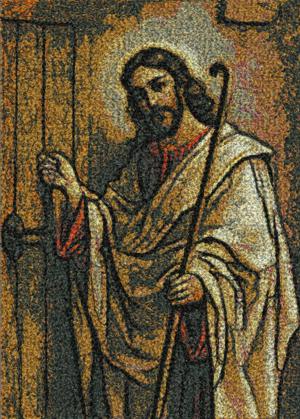
Christ Knocking at the Door

In the previous post “The Hard Stuff,” it sounds like I am having a pity party. God wants me to put my “self” aside and put Him first. God wants me to confess my sins. God wants me to repent. God wants me to submit to His will.

I wrote that I struggle with all this, confessing my selfishness and my controlling nature.

That’s the truth…

But what does Paul mean when he writes in Romans 12:1 “I urge you therefore, brethren, by the mercies of God, to present your bodies as a living and holy sacrifice, acceptable to God.” Billy Graham* comments on this verse: “This includes every area of our lives. It includes our abilities, our gifts, our possessions, and our families—our minds, wills and emotions. Nothing is excluded. We can hold nothing back. In principle, He must control and dominate us in the whole and the part” [143].

And I have been complaining that I struggle with confession, repentance and submission.

Now I find that God wants all of me and all that I have.

Graham states “our submission and yielding—must be total. It is a surrender without any conditions attached” [143].

From the Graham quote above, you may have not focused on the words “in principle.” On the next page he uses it again as he describes the commitment of the born again believer: “Our intention should be a complete and final act of submission ‘in principle’…” [144].

What does the phrase “in principle” mean?

Thank goodness God does not expect me to be perfect. Even though He expects total surrender, He knows that I will only be able to surrender “in principle.” At my age, I have had a relationship with Jesus Christ for twenty years. I was born again in 1998 at a time when I needed Jesus so much, a time of crisis in my life. Over the past twenty years, He has been working with me to grow me. The Holy Spirit has shown me areas of my life that need to be surrendered beyond the areas that I had to surrender in 1998. Graham says “as we place ourselves at God’s disposal, He leads us into new areas of commitment….we must be open to everything He wants to do in and through our lives” [144].

Here are key areas of fear in this process. One is that I will never be able to satisfy God. I will never be able to give Him enough confession, repentance and submission. The other is the idea that the life of the “submitted” Christian sounds like the life of a slave.

Nothing could be further from the truth.

God will never ask you to do more than you can do. He knows you; all your weakness and all your strengths. He knows what you are capable of. “The Holy Spirit may test us many times to see if we really mean business. He may call on us to surrender something in principle that He really does not want us to surrender in fact, but which He wants us to be willing to surrender” [144]. We are not a perfect people capable of living perfect lives, so we should not get worked up over perfect submission.

Secondly, the Christian is the freest person in the world since he knows the spiritual freedom that Christ brings. When we give our lives to Christ, we are no longer living for our old slave master sin. I know so well what that life is like because I am to this day, a sinner. I fall to sin and then I have guilt and guilt never feels good. Depending on how hard I fall and how far, sin can take over my life. My choices can make my life miserable. I truly become a slave to sin.

Not so if we give our lives to Christ. When we express to Him that we are ready and eager to do His will, He will take us up on our offer. He will begin the process of directing us away from sin toward a life free from sin, a life that is truly free. The Christian is the freest person in the world because he knows the spiritual freedom that Christ brings.
Graham finishes the part of his book on how to be filled with the Spirit with the familiar quote from Revelation 3:19, such a pleasant image of Jesus coming to the door and knocking. That image is meant to convey what Jesus can do for your life. It is simple but effective: “See I stand knocking at the door. If anyone listens to My voice and opens the door, I will go into his house and dine with him, and he with Me.”

One of the boldest things we can do in this life is to utter the simple phrase…

Come in Jesus. Welcome to my home…

From his book The Holy Spirit


Posted in Uncategorized | Leave a comment

The Hard Stuff…

Image result for selfish

I am blessed to be writing about the Holy Spirit right now.  Billy Graham’s book* is speaking directly to me. I am asking God to help me, to change me, to lead me in another life direction. So, today I am writing about a problem I have always had.

I have always had a problem with submission.

What does Graham say about submission? After developing a deep understanding of the power that sin has over your life, the next step in being filled with the Holy Spirit is to deal with your inability to submit yourself to God. “By submission I mean that we renounce our own way and seek above all else to submit to Christ our Lord and be ruled by Him in every area of our lives” [Graham, 140].

Why is this such a struggle for me? Maybe it is a struggle for you too. God is asking me to quit trying to control everything. God is asking me to get my “self” out of the way and put Him first.

David, Christ is at the center…

Not my will…

Not my “self”.

God intends Jesus Christ to be the Lord of my life.

What is He asking directly of me?

Hard stuff…

Confess, really confess my sin. Not one of those “I am sorry God” confessions, knowing that I really don’t mean it. Knowing I will be returning to my sin soon [in a thoughtless, weak moment]. Knowing that I will be confessing all over again, and again, and again, and again and getting nowhere in my progress of eliminating my sin.

God wants to take me in a new direction; He wants me to let go of my sin and make real progress. He wants me to draw closer to Him. His will be done, not mine. His Glory is my one desire, not my “self” at the center of my little universe. Now here is the tough part, especially if the sin is a long-term habit. Letting go of it will leave a hole in your life. Maybe the sin is exciting. Maybe the sin gives you a thrill. Maybe the sin helps you relax. You have thoughts like “now my life will be dull” or maybe “what will I do now for fun.” As I let go of the sin, I let go of the part of life associated with it. Confession can just be words though. You can easily return to the sin you are trying to leave behind. God does not desire that for us.

More hard stuff…

Repentance. Graham says that the original Greek word for repentance is “renounce.” Renounce means a complete and total change of mind. “To repent is not only to feel sorry for my sin, or even just to confess it to God. To repent of my sin is to turn from it, and to turn to Christ and His will” [Graham, 141]. If you have a habit of seeing people and immediately judging them according to your own scale of acceptability, you have a problem with judgement. God will change your penchant for judgement and bring it more in line with His will. You may mistreat someone in your life; you have evil thoughts about them and act in hurtful ways toward them. God will change your heart toward that person and God will help you eliminate your hurtful ways. He will bring you more in line with His will.

Graham says that confession and repentance are the negative sides of submission. He thinks yielding to God might be the positive side. “The fullest meaning of the word ‘yield’ is to place yourself at the disposal of someone…we do not simply sit back and hope that God will somehow work through us. No, instead we place ourselves at His disposal, and You may do with me whatever You will” [Graham, 143]. Romans 6:13 says it best: “Lord I am Yours, to be used in whatever way You want to use me. I am at Your disposal, and You may do with me whatever You will. I seek Your will for my life, not my own will.” Essentially this is saying you need to put yourself at the disposal of God.

Maybe yielding is easy for some…

Not for me…

God is asking me to quit trying to control everything.

God is asking me to get my “self” out of the way and put Him first.

For selfish controlling people, is this easy? Not so much…

Not so much at all…

*The Holy Spirit: Activating God’s Power in Your Life

Posted in Uncategorized | Leave a comment