Holy Spirit and the Bible…

I have read the Bible from beginning to end a couple of times but like many Christians, I have primarily been a reader of the New Testament. Christians think of the New Testament as “their book,” not giving much thought to the value of the Old Testament, maybe not acknowledging that it was the Bible that Jesus read.

As a Methodist, I have always known of a Christian education class called Disciple Bible Study but my church never offered it. It is a thirty-four week study and it requires at least four study periods per week in preparation for the weekly meetings, which usually last at least one and a half hours. Quite a commitment.

Finally, we had a pastor who decided he would lead a Disciple study and I enrolled. I will never forget when we got to the book of Isaiah. Here you have a Hebrew prophet foretelling details of the suffering of Jesus Christ more than 700 years before the suffering took place.

I was flabbergasted and immediately changed my view of the Old Testament. I can’t think of a better word than flabbergasted to describe me when I read passages like those from Isaiah 53, “He was despised and rejected by men, a man of sorrows, and familiar with suffering. Like one from whom men hide their faces he was despised, and we esteemed him not. Surely he took up our infirmities and carried our sorrows, yet we considered him stricken by God, smitten by Him, and afflicted. But he was pierced for our transgressions, he was crushed for our iniquities; the punishment that brought us peace was upon him, and by his wounds we are healed. We all, like sheep, have gone astray, each of us has turned to his own way; and the LORD has laid on him the iniquity of us all. He was oppressed and afflicted, yet he did not open his mouth; he was led like a lamb to the slaughter, and as a sheep before her shearers is silent, so he did not open his mouth.”

How could this be? I had had some very important personal experiences where I felt God intervened in my life but now I could see the special nature of His book for the first time. Maybe I should have believed in the power of The Book before this time, but I just wasn’t sold. Suddenly, I could see solid evidence of the Holy Spirit in the Bible, in the words of the prophet Isaiah. Suddenly for me, the Bible became a God-breathed, Holy Spirit-inspired book.

The truth is that when one is looking for daily Holy Spirit inspiration, one need not look any further than the Bible. Pastor Billy Graham states “The Bible is a constant fountain for faith, conduct and inspiration from which we [can] drink daily.” Isaiah is only one example of the Holy Spirit in The Bible. The Spirit spoke to David who penned the Psalms. God also spoke through the prophets Jeremiah and Ezekiel. Jesus stated in John 14: 26 that “The Holy Spirit. . .will teach you all things, and bring to your remembrance all that I said to you.” Graham says that statement embraces the Gospels. John 16: 13 “He will guide you into all the truth” takes in all the books from Acts to Jude and “He will disclose to you what is to come [John 16: 13]” encompasses the Book of Revelation.
“We do not know exactly how He imprinted His message on the minds of those He chose to write His Word, but we know He did lead them to write what He wanted” [Graham, 36]. “For no prophecy was ever made by an act of human will, but men moved by the Holy Spirit spoke from God” [2 Peter 1: 21].

That pastor who led the Disciple Bible Study may have been amused at the awe I expressed in his class, but that class was just the beginning for me. I have continued to read the Bible as a book inspired by God. A Book that was written by those who were led by the Holy Spirit. More and more examples of His touch have jumped out at me from the pages over the years. When Paul declares “All Scripture is inspired by God and profitable for teaching, for reproof, for correction, for training in righteousness” [2 Timothy 3:16] those words mean something special for me now.

Reading the Bible is not merely reading a book; it is the Holy Spirit speaking to me from God’s word.

My source of Holy Spirit inspiration…

Posted in Uncategorized | Leave a comment

The Holy Spirit in the Believer…

Related image

Judges 14: 19 When Samson needed God, “Then the Spirit of the Lord came powerfully upon him. He went down to Ashkelon, struck down thirty of their men…” In the Old Testament, the Holy Spirit came upon people and stayed with them for a season.

John 14: 17 “And I will ask the Father, and He will give you another Advocate to be with you forever— the Spirit of truth. The world cannot receive Him, because it neither sees Him nor knows Him. But you do know Him, for He abides with you and will be in you.” In the Gospels, the Holy Spirit dwelt with the Disciples in the person of Christ.

1 Corinthians, 6: 19 “Do you not know that your bodies are temples of the Holy Spirit, who is in you, whom you have received from God? You are not your own.” From the second chapter of Acts onward, the Holy Spirit is spoken of as being in the people of God.

When you analyze 1 Corinthians 6: 19, it sounds like the Holy Spirit has become very personal with all of us; in fact He has. Pastor Billy Graham says the Spirit has taken up residence in our minds and in our bodies. He has not come upon us, He has not dwelt with us, He is now in us.

How is this?

First of all, the Holy Spirit “illumines” our minds. One can point to scriptures like Romans 12: 2 “And do not be conformed to this world, but be transformed by the renewing of the mind.” Ephesians 4:23 states “that you be renewed in the spirit of your mind.”

I have had a personal relationship with Jesus Christ for twenty-three years and hanging around many, many Christians has given me a feeling that some Christians really don’t worry about using their minds too much; their idea is that feelings are much more important. I will be the first to admit that feelings are important. One of my favorite authors is John R. W. Stott who says “Nobody wants a cold, joyless, intellectual Christianity.” But he further says God desires feeling coupled with intellect: “Heaven forbid that knowledge without zeal should replace zeal without knowledge! God’s purpose is both.” In my personal experience, I have seen many wonderful people feel that they are being led by God to take action, only to see their feelings bear little fruit. If they had used their mind to think through their plans a bit better, maybe they would have experienced success. “Love the Lord your God with all your heart and with all your soul and with all your mind and with all your strength.” is Jesus’ condensation of all the Law in “the greatest commandment”, just because mind comes behind heart and soul does not mean that mind has less value. Pastor Graham says “It is the business of the Holy Spirit to lift the veil Satan has put over our minds, and to illuminate them so that we can understand the things of God. He does this especially as we read and study the Word of God, which the Holy Spirit inspired” [33].

Secondly, the Holy Spirit indwells our bodies. That first Corinthians quotation above makes it sound like we should be taking better care of ourselves [our bodies are temples]. In other words, maybe we should be careful about what we eat, drink, look at and read. Paul said, “But I buffet my body and make it a slave, lest possibly, after I have preached to others, I myself should be disqualified” [1 Corinthians 9: 27]. Too often the source of many temptations in life are centered around the body. We crave certain sensations. We fill our bodies with highly caloric foods. We look at things that bring pleasure but they also separate us from God. When one considers the words of Paul in Romans 7, you can hear the cries of a man who is trying to curb his bodily urges: “I am of flesh, sold into bondage to sin. For what I am doing, I do not understand; for I am not practicing what I would like to do, but I am doing the very thing I hate. But if I do the very thing I do not want to do, I agree with the Law, confessing that the Law is good. So now, no longer am I the one doing it, but sin which dwells in me. For I know that nothing good dwells in me, that is, in my flesh; for the willing is present in me, but the doing of the good is not. For the good that I want, I do not do, but I practice the very evil that I do not want.”

How do we conquer those urges? The very things that appeal to our bodies can be overcome by the power of the Spirit. Many try to use their own power to throw off sin. Earnestly calling on the Holy Spirit is the best ticket to getting bodily sin under control. Let the Godly power that indwells your body help you keep it clean.

As Christians, we all have access to the Holy Spirit. We may not have Jesus on earth but as He left He gave us something special: “But very truly I tell you, it is for your good that I am going away. Unless I go away, the Advocate will not come to you; but if I go, I will send Him to you [John 16:7].

Let us use the power that He and the Father gave us.

The Holy Spirit’s powerful indwelling in our minds and in our bodies is an amazing gift we should never take lightly.

Posted in Uncategorized | Leave a comment

The Holy Spirit in The Church

Image result for jigsaw puzzle piece

I will never forget the first sermon given by the pastor we have in our church right now. She got out of the pulpit and walked among the congregation passing out jigsaw puzzle pieces. Everyone got a puzzle piece and she proceeded to deliver a message that all the members of our church have a part to play in the ministry of the church. If we all do our part, the pieces all fit together to form a beautiful puzzle.

Everyone got a puzzle piece…everyone.

I think she was right on target. Everyone in the church does have a role to play and that role is partially determined by the gifts of the Holy Spirit to the people of the church. Ephesians 4:12 says that gifts come to specific people “for the equipping of the saints for the work of service, to the building up of the body of Christ.”

Pastor Graham* states “No Christian can say, ‘I have no gift’. Every believer has at least one gift from the Holy Spirit.” He goes further saying that “a weakness in today’s churches is the failure to recognize, cultivate, and use the gifts God has given people in the pews” [31]. The reason that eighty percent of the work in church is done by twenty percent of the people is that either people deny their gift(s) [laziness?], leadership fails to ask them to participate, or maybe a profound sense of unworthiness.

At the moment of salvation, a believer receives one of seven motivational gifts**: prophecy, serving, teaching, exhorting, giving, organizing, or mercy. This gift of God’s grace shapes how the believer views life, relates to others, and impacts the Body of Christ. “A motivational gift can be compared to a set of eyeglasses from God, given so that the believer can see people and circumstances through that particular set of ‘lenses’”. God works through the spiritual gifts in the Body of Christ to help the Church grow and remain healthy.

The gifts of the Holy Spirit also equip the Church to express the fullness of God’s love to the world. This category of gift is referred to as manifestation gifts. These spiritual gifts are given to the Church to benefit both believers and unbelievers. These gifts represent the work God does through the life of a believer in a given situation to demonstrate His supernatural power. The nine manifestation gifts are listed in I Corinthians 12:7–11: word of wisdom, word of knowledge, faith, gifts of healing, working of miracles, prophecy, discerning of spirits, diverse kinds of tongues and interpretation of tongues.

At times in church meetings, I get the sense that some church members think the church belongs to them. This is so wrong-headed. The New Testament speaks repeatedly about Christ as the foundation of the church and members are “little building stones built in a holy temple to the Lord” [1 Peter, 2:5]. Graham goes even further: Christ is head of the church universal, head of every congregation of believers, head of every person who has repented of his or her sin and received Jesus Christ as Savior.

Certainly the church is shepherded by a pastor who has gifts of ministry. The problem is that many think the pastor is the only one with spiritual gifts. That is not the case. The motivational, ministry, and manifestation gifts of the Holy Spirit all contribute to the orderliness of God’s design of working in the Church and the world. As instruments of God’s work in the church, we must seek to walk in the power of the Holy Spirit and to submit to God [pastors included]. Then when the Holy Spirit works among believers and bestows spiritual gifts, there will be peace and orderliness, not strife and confusion. Graham writes that too many people expect the pastor to have all the gifts and do all the work. Church members become mere spectators. As church members, we have a great responsibility to use our gifts as the pastor uses his or her gifts.

Yes, that means we are to take our puzzle piece and use it, fit it in the big puzzle of our congregation and transform the church according to God’s plan. If we do that, the Holy Spirit will be at work within the church.

From his book The Holy Spirit
From a telephone interview: Pastor Roy King, Bridge of Hope Church and Institute of Basic Life Principles Website

Posted in Uncategorized | Leave a comment

Let Your Light Shine

Related image

There is an old expression in my family. It is not unique to us, but growing up I heard this from a grandmother, aunt…I am not sure. The expression goes like this: “The world is going to hell in a handbasket.” I have always remembered that expression.

I use this saying to open Billy Graham’s* comments on the Holy Spirit because preventing the world from destruction is one of the reasons that man has received God’s gift of the Holy Spirit. I hope if Pastor Graham were alive today that he would not be too upset with the use of my familial saying.

But let’s stop and be “real” before you think that I advocate using our saintly lives to combat the evil of the world. We are not in any position to do that. We all know we “have sinned and fall short of the glory of God” [Romans 3: 23]. Alone, none of us has what it takes to live in righteousness. We all suffer that nasty sin nature that we inherited from Adam [our ancestor made some pretty disastrous mistakes in the Garden of Eden].

Essentially, we all have this natural tendency to sin.

But Graham says it best: “This sin nature is a root and sin can also be the fruit.”

Note the little word “can”. That little word makes all the difference.

We have choices.

We don’t have to sin, do we? We can go another way.

I found it very significant that many people who attended Graham’s crusades left the crusade shaking their fists in anger at the pastor. What was that about?
In his preaching, God was using him to make them aware of their sin and guess what? The Holy Spirit awakening and saying “you are not right” is not a pleasant experience. Maybe they were being called upon to change their ways and they just did not want to. It is not fun to suddenly be aware of a new label, especially if that new label is “sinner.” Awareness of sin is one major reasons that the Holy Spirit is in the world.

Maybe some of those angry people came to the point in their lives where they realize that Jesus is the way to truth. They see the need for God and to get to God they need to believe in Jesus Christ. When they are at that point, they realize the value of a righteous life. The Holy Spirit is used to teach us about righteousness.

Maybe some of those angry people choose to live as they want. Certainly God told Adam and Eve what not to do and they did it anyway. The Old Testament is full of examples of men who did as they pleased rather than doing what God told them to do.

Actually this opens us up to some pretty bad news. Choosing to go our own way will reap consequences. People who turn their backs on God and refuse the offer of everlasting life won’t receive everlasting life when life comes to an end. [Yes that is pretty bad news, isn’t it].

Rather than spending too much time on bad choices, let’s focus on the person who makes a good choice, accepts the need for Jesus, and begins the long road toward living a more righteous life. What does this have to do with combating that “world is going to hell” situation?

It is pretty awesome.

The Holy Spirit in man is God’s weapon against lawlessness. I know the everyday news is full of violence, perversion, hatred and fearfulness but God is depending on individual people to counteract all this negative news. To confront all this negativity we all have to accept the Apostle Paul’s mission that he accepted on the Damascus Road: “I am sending you to them to open their eyes and turn them from darkness to light, and from the power of Satan to God, so that they may receive forgiveness of sins” [Act 26: 18].

You have heard it before (countless times) but we are to be the salt of the earth and the light of the world. Salt was used in the time of Jesus to preserve things. We are to help preserve the law and combat the lawlessness. We are to be the light because light dissipates the darkness of evil.

I love this idea. Maybe I am an optimistic guy but the changing of the world is act by act, done by people just like you and me. Too often we think only the rich can have an impact or the powerful are the only ones who can accomplish a lot. Too often we think only megachurch pastors have the ability to change the world.

No, the ability to change the world resides in you and me.

When the world sees our good works, the world knows our light is shining.

When the world sees our moral choices, based on Christian values, the world sees our saltiness.

We don’t do this alone. It is done through the Holy Spirit working within us. We don’t have the power to do it on our own, but we are not powerless.

God, through the Holy Spirit which resides in us has a simple but profound message to all of us. He is saying this: “Let your light shine” [Matthew 5:16].

*From Graham’s book The Holy Spirit

Posted in Uncategorized | Leave a comment

Loss and Gain…

We all have to experience loss.

It is a part of life. The older we get, the more loss of friends and loved ones becomes an unwelcome theme of life. Since December of this past year, I have lost a very good friend who I used to work with in church, a classmate who I used to run around with in high school and college, and now a guy at church who I knew as a golfer, a good man, a devoted follower of Christ.

We all have to experience loss.

We also experience the emotions associated with loss: grief, fear, maybe even depression.

The loss of friends and loved ones is important, significant, and life-altering. But let’s imagine the loss the Disciples felt when Jesus told them He was going away. He predicted it, it happened and there they were; faced with grief, fear…leaderless.

In Acts 2:14, Jesus said “If I do not go away, the Helper [Holy Spirit] shall not come to you; but if I go, I will send Him to you.”

What would the Disciples have preferred? I would imagine they would have preferred their leader, their friend, their loved one to remain on this earth, but that was not the plan that God intended. Pastor Billy Graham* summarized God’s plan with the five past events of the Gospels: “the Incarnation, the Atonement, the Resurrection, the Ascension, and Pentecost. A sixth component is still future: the Second Coming of Jesus.”

Imagine the anguish the Disciples felt. They had no idea what Jesus meant when He said “the Helper” is coming. They just knew that the Man who had inspired them to lead lives devoted to God, the man who inspired them to live according to His model, the man who challenged the religious norms of the day and inspired them to challenge those norms was gone.

Add to the feeling of anguish the emotion of fear—the very real fear of retribution. Look what happened to their leader. Was that in store for them?

Maybe the future was foretold in the Jewish past.

The Jewish people have many feasts, one of them is Passover. Most Christians know that the Passover celebrates the time when the Israelites were freed from a long period of slavery in Egypt. The Jews killed an unblemished lamb and placed the lamb’s blood over the door of each Israelite house. That signified a deliverance from God’s judgement. On Jesus’s last Passover feast, He offered Himself for the salvation of men. He shed his own blood so we could all be free from God’s judgement. He put Himself in our place and atoned for our sins.

The Disciples celebrated Passover with Jesus, hearing His hints about His sacrifice, probably hoping that His predictions of His impending death were wrong.

But His predictions weren’t wrong.

The Jewish people also celebrate the feast of Pentecost, fifty days from Passover. For devout Jews, this feast meant the beginning of the harvest, the “first fruits.” The Christian Pentecost, which occurred forty days from the resurrection and ten days after the ascent of Jesus into Heaven, can also be seen as the beginning of the harvest, the beginning of God’s harvest in the world, to be completed when Jesus comes again.
Can you imagine that feeling the Disciples felt when the Holy Spirit descended on the one-hundred and twenty in the upper room.

Relief.

Jesus was with them again in the form of the Holy Spirit, just as He promised.
Graham asks two questions about these events. Why did Jesus have to go? We know that answer. So the Holy Spirit could come. Why did the Holy Spirit have to come?
I believe the Spirit had to come because Christians need help with the harvest. We can’t do the work alone, under our own power. We don’t know what to do; we need the knowledge that is imparted from the Holy Spirit. We don’t have enough strength to get through the good times and bad and continue on with our work; the Holy Spirit gives us that strength. When times get hard and we need comfort, the Holy Spirit sends reassuring messages our way to help us with the difficult times so we can recover and continue on with our work.

Graham basically says the Holy Spirit came because there is much work to do “in the world, in the Church and in the individual Christian.”

The next series of posts will explore that work in all three areas, but for the time being let’s focus on the feeling those one-hundred twenty felt when the wind rushed through the room, the fire descended and the speaking in tongues occurred.

Let’s add another feeling to the Disciples that day.

I am sure that relief was experienced, but let’s add another emotion.

How about elation!

*from his book The Holy Spirit

Posted in Uncategorized | Leave a comment

For Jesus and For You…

Image result for jesus and holy spirit

“The Holy Spirit will come upon you, and the power of the Most High will overshadow you; and for that reason the Holy Offspring shall be called the Son of God” [Luke: 35].
With those words spoken to Mary by an Angel, we learn that God is capable of bringing a virgin birth to pass. God bypassed the male element of birth. No man participated. The Holy Spirit played the prominent role.

Most Christians are very familiar with this idea and most believe it occurred.

Matthew is the book that begins the New Testament and it begins with Jesus’ genealogy followed by the story of Jesus’ birth. But we are still not at Acts 2, when the Holy Spirit manifested itself in the lives of believers.

Pastor Billy Graham* cites the familiar passages of scripture that recount the effect of the Holy Spirit on Jesus. He was baptized by the Spirit in John 1, led by the Spirit in Luke 4, anointed by the Spirit in Luke 4 and empowered by the Spirit in Matthew 12. Jesus offered Himself as atonement for sin by the Spirit in Hebrews 9, was raised by the Spirit in Romans 8, and gave commandments by the Spirit in Acts 1.

In a very extensive discussion by John F. Walvoord** [President of Dallas Theological Seminary], he details that “the humanity of Christ included all the essential elements. Christ possessed a true body, composed of flesh and blood and all the normal human functions [Hebrews 2:14].” He also possessed a human nature but without one important aspect. Christ was without sin. “It is essential to every important doctrine that the Person of Christ be sinless and to this, the Scriptures give abundant testimony (Isaiah 53:9; John 8:46; 2 Cor 5:21; Heb 4:15; 7:26; 1 Pet 1:19; 2:22; 1 John 3:5). The sinlessness of His human nature is a result of the work of the Holy Spirit in conception, as we have seen, His humanity being kept from all sin.”

Almost nothing is known of the life of Christ from His birth to the beginning of His public ministry, only the events surrounding His birth and the incident in the temple at the age of twelve.

Walvoord makes an argument for Jesus’s first twelve years: “It is entirely possible that the body of Christ, being devoid of sin, developed more rapidly and manifested perfection of body which could not be true in sinful men. In contrast to the picture often drawn of Christ, His body was probably unusually strong and graceful, devoid of the hereditary effects of sin as manifested in the race. The account in the temple of Christ at the age of twelve, while chiefly in reference to His mental powers, indicated that He was developed beyond His years in every way.”

The appearance of the Spirit in the life of Jesus after His baptism is well known. At the baptism, the Holy Spirit descended in the form of a dove, as Christ was coming up from the Jordan. From that point on, Christ had the power of prophecy, the power to preach and the power to perform miracles. Graham says “The Holy Spirit was also at work among the Disciples of Jesus before Pentecost. Jesus says in John 14:17 that “He [the Holy Spirit] abides with you.” Yet the operation of the Spirit was not in full force at this time: John 7: 39 says “But this He [Jesus] spoke of the Spirit, whom those who believed in Him were to receive; for the Spirit was not yet given, because Jesus was not yet glorified.”
Graham says we are not sure what the difference is, but when the Holy Spirit at Pentecost came, it was a much greater manifestation that anything anyone had experienced before.

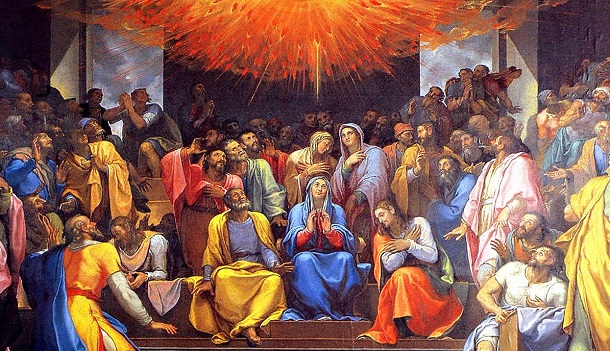
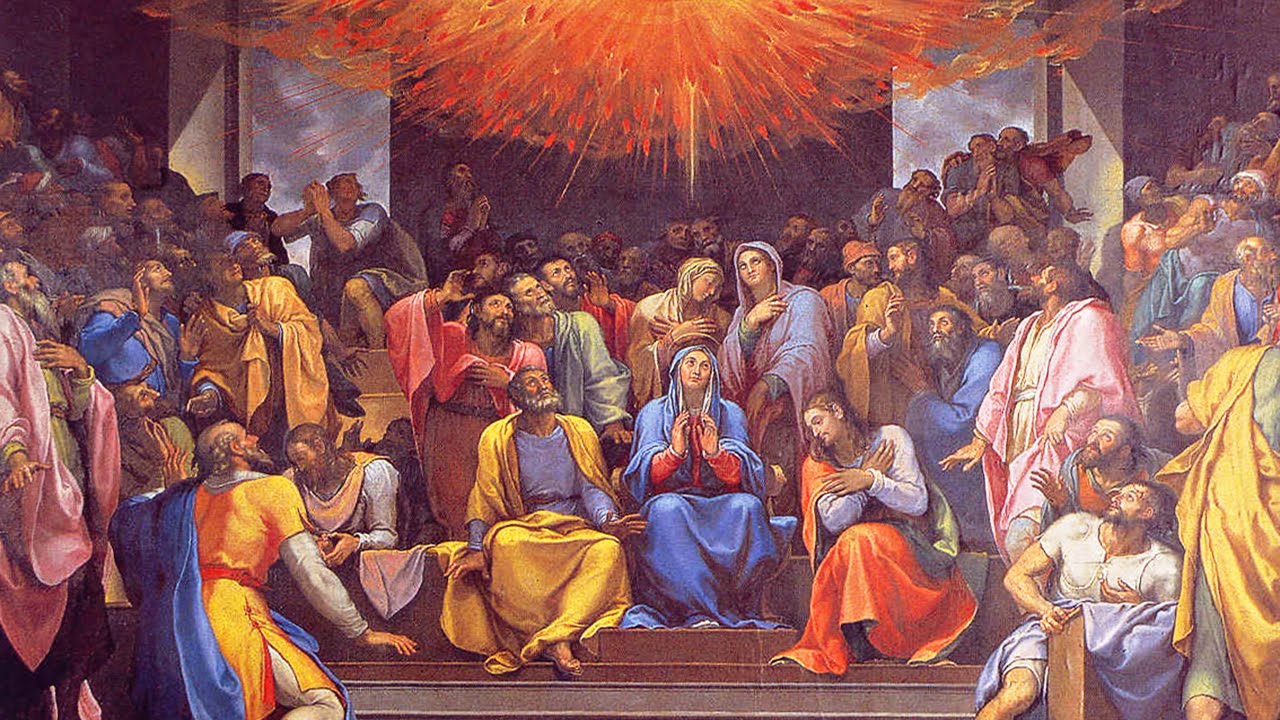
The powerful Holy Spirit at Pentecost is evident as one can turn to the words of Acts 2: “When the day of Pentecost came, they were all together in one place. Suddenly a sound like the blowing of a violent wind came from Heaven and filled the whole house where they were sitting. They saw what seemed to be tongues of fire that separated and came to rest on each of them. All of them were filled with the Holy Spirit and began to speak in other tongues as the Spirit enabled them.”

This stronger presence of the Spirit filled the whole house. About one hundred and twenty followers of Christ were present, including the Twelve Apostles (Matthias was Judas’ replacement), Jesus’ mother Mary, other female disciples and Jesus’ brother.
The catch is the Holy Spirit could not come unless Jesus went to Heaven. John 16:5-7 is Scripture that explains that: [Jesus says] “but now I am going to Him who sent me. None of you asks Me, ‘Where are you going?’ Rather, you are filled with grief because I have said these things. But very truly I tell you, it is for your good that I am going away. Unless I go away, the Advocate will not come to you; but if I go, I will send Him to you.”

That Advocate, that Holy Spirit was sent to the room and the one hundred and twenty followers.

That Advocate, that Holy Spirit was also sent for you and for me…

*From his book The Holy Spirit

**On the Bible.Org.Website

Posted in Uncategorized | Leave a comment

The Holy Spirit in the Old Testament

Image result for the old testament holy spirit

“When the day of Pentecost came, they were all together in one place. Suddenly a sound like the blowing of a violent wind came from heaven and filled the whole house where they were sitting. They saw what seemed to be tongues of fire that separated and came to rest on each of them. All of them were filled with the Holy Spirit and began to speak in other tongues as the Spirit enabled them.”

This Scripture from Acts 2 is assumed by many Christians to be the pivotal appearance of the Holy Spirit to man. Indeed it is dramatic but Pastor Billy Graham* cites many examples of the Holy Spirit’s appearance in the Old Testament. I was not so aware that the Holy Spirit played such a large role in the Old Testament. But Graham writes that we need to understand all aspects of the Holy Spirit, “especially when we think of this present age and the work of God in it.”

Graham freely admits that the work of God the Father is mostly emphasized in the Old Testament. The work of God the Son is mostly emphasized in the Gospels. From the day of Pentecost on, the emphasis is much more on the Holy Spirit. But when we read the “Spirit of God was moving over the surface of the waters” in Genesis we see the Holy Spirit. In Job 33:4 we read “The Spirit of God has made me, and the breath of the Almighty gives me life.” Psalms 104:30 reveals “Thou [God] dost send forth Thy Spirit, they are created; and Thou dost renew the face of the ground.” David is referring to the Spirit’s role in the creation of life.

So much of the Old Testament is about the blessings, the curses, the delivery and the punishment of the nation of Israel. In my reading of the Old Testament, the salvation of Israel is most often attributed to the Spirit of God. It is probably not an earth-shaking conception that the same sick behaviors, the same decay of morality and the erosion of civilized life we see in the Old Testament has not changed. The Holy Spirit was fighting this evil in the Old Testament, from Jesus’ birth to Pentecost and the Spirit is still fighting this evil today [post Pentecost].

Graham cites Othniel, Gideon, Jepthah and Samson as examples of men in the book of Judges who were special. The Holy Spirit came upon them. It takes a close reading of the Old Testament to pick out instances but in 2 Chronicles 24:20 “the Spirit of God came on Zechariah.” “The Spirit rested on them [men]” in Numbers 11:25. In Exodus, it says “I have filled him with the Spirit of God.”

David was anointed with oil and “The Spirit of the Lord came mightily upon David from that day forward” [1 Samuel 16:13]. Graham writes about the Spirit being given to chosen men and also withdrawn when the chosen ones disobeyed. Saul lost the Spirit, Samson lost the Spirit and David prayed in Psalms 51 “Do not take Thy Holy Spirit from me.”

Graham is clear in stating that it is not easy or even advisable to separate the Father, Son and Holy Spirit. Certainly the order of the Bible seems to encourage separation. Incorrectly many Christians assume that all the references to the Holy Spirit must be in the New Testament, maybe even post Acts 2, but that is just not the case.

Billy Graham is quoted as regretting not reading the Bible more: “I would spend more time studying the Bible and meditating on its truth, not only for sermon preparation but to apply its message to my life” but his reading has yielded great support that the Holy Spirit permeates God’s Great Book. I wonder if he is being too self-critical.

He summarizes his argument for the Holy Spirit in the Old Testament with the following words “We have seen that the Holy Spirit was at work before the world began. Then He renewed and fed His creation. He was active throughout the Old Testament, both in the world of nature and among His people, guiding and delivering them through the judges, prophets, kings and others. And He told of a coming day when the Anointed One would come” [19].

The dramatic appearance of the Holy Spirit in Acts 2 does get our attention and rightfully so, but The Holy Spirit was always there in the world, creating, empowering and correcting man. The fruit of the Spirit is love, joy, peace, forbearance, kindness, goodness, faithfulness, gentleness and self-control as we see in Galatians but the Spirit was hard at work before Acts 2.

You see the Holy Spirit has always been hard at work; alongside our Father.

*from Graham’s book The Holy Spirit


Posted in Uncategorized | Leave a comment

The Trinity Mystery

Image result for triune god


Billy Graham, in his book The Holy Spirit, recounts a story of a seminary student who asked a question about the inferiority of the Holy Spirit since it comes third. As we refer to the Holy Spirit, we usually say Father, Son and Holy Spirit, with the Spirit in the third position. Graham explains that the third position does not imply inequality, but does imply functionality. The Father came first, followed by the Son who was God incarnate, died and rose again. Following the Son is the Spirit who does His work in the age of the Spirit, even unto today.

But this raises another question; why do we say Father, Son and Holy Spirit? Why is this grouping called the Trinity? How did this grouping come about?

Almost all Christians believe in the Trinity. For us this means that God exists in three Persons and these three are one God, co-equal, co-eternal, having precisely the same nature and attributes. Now all Christians believe this but most Christians struggle to understand it and explain it. Many throw up their hands and say things like “it is a mystery!” or “it is a paradox!”

Even as the Bible unfolds the revelation of God progressively, there are indications of the Holy Spirit in the Book of Genesis. However, Graham admits that the New Testament references to the Spirit are much more numerous. But where does Trinity come from?

According to Wikipedia, the first recorded use of Trinity was by Theophilus of Antioch in the year 170. Tertullian, a Latin theologian who wrote in the 3rd Century is credited with being the first to use the Latin words “Trinity” to explain the Father, Son and Holy Spirit.” This means that the idea of the Trinity came about after the Bible was written.

Scripture in the New Testament is very close to the idea of the Three in One. One can find instances like the Apostle Paul in 2 Corinthians 13:14 where he says “The grace of the Lord Jesus Christ, and the love of God, and the fellowship of the Holy Spirit, be with you all.” Graham states “His benediction clearly indicates the Holy Spirit is one with the Father and one with the Son in the Godhead” even though the words “Trinity” are not used.

The word Trinity is just not in the Bible.

Why did it come about? Graham says the most confusing part of the subject of the Trinity is the claim that Christianity is monotheistic. Polytheism was the norm in many cultures when Christianity came about; the Romans worshipped twelve Gods for example. Christians did not want to be associated with pagan concepts, so they emphasized one God [monotheism]. First Corinthians 8:4 says “There is no God but one” and 1 Timothy 2:5 explicitly says “there is one God.” The thorny problem is the incarnation of God in Jesus and the Holy Spirit are there also and they are on par with God.

Sounds like polytheism…

Until Christian doctrinal leaders develop the doctrine of the Trinity.

Graham uses a story from Dr. David McKenna to illustrate the practical problem of the Trinity. McKenna had one of those “stump the father” episodes with his small son. His boy said “Is God the Father?” McKenna said yes. “Is Jesus Christ God?” McKenna said yes. “Is the Holy Spirit God?” Another yes, and then the child said “How can Jesus be His own Father?”

McKenna used the car they were sitting in to explain how this could be. I sure can relate since I am not mechanical at all. He said under the hood is one battery [God] and that battery can turn on the lights, blow the horn and start the car. How this happens is a mystery but it happens. I am sure the boy accepted the mystery.

God exists in three Persons and these three are one God, co-equal, co-eternal. Father is the source of all blessing, the Son is the channel of all blessing, and the Holy Spirit is at work in us making God alive and operative in our lives.

Did this concept come about in a very pragmatic way to avoid polytheistic theology? Is it revealed in the Bible and Church leaders were inspired by Scripture to explain the Triune God using the term Trinity?

Does it really matter?

It does…

Pastor Don Hemingway writes “The Trinity is a doctrine that all Christians believe but no one really understands….If you try to explain the Trinity, you will lose your mind. But if you deny it, you will lose your soul.”

Maybe the best attitude to have is represented by the Massachusetts’s Senator Daniel Webster. Webster who was a fervent Christian was asked “How can a man of your intellect believe in the Trinity?” He replied “I do not pretend fully to understand the arithmetic of Heaven now.”

Emphasis should go on the word now…

Posted in Uncategorized | Leave a comment

And That Person Can Be Me…

The concept of the Holy Spirit as a self-conscious individual, a human entity inhabiting the earth; that idea gives me trouble. I expressed that in my previous post “Holy Spirit as Person.” Maybe the confusion that I have is just mine alone. Pastor Billy Graham in his book The Holy Spirit says the Holy Spirit is a person and furnishes several examples of human-like traits to support his assertion.

At the end of his discussion of the Holy Spirit as person, he has a single sentence that helps me with the Holy Spirit being a person. “He is a person. He is divine as well.”
That is when I can come aboard.

Here is evidence of divinity. The Spirit is eternal which means that there was never a time when He was not. One can reference Genesis 1 verse 2 and read “the Spirit of God was hovering over the waters.” The Holy Spirit was, is and always will be and His presence is found throughout God’s word.

It is found in Luke 1:35 where we find He is all-powerful. Indeed we find that His power overshadows all of us.

We learn He is omnipresent in Psalms 139:7: “Where can I go from Thy Spirit? Or where can I flee Thy presence?” Short answer: you can’t flee the Holy Spirit.

He is omniscient in 1 Corinthians 2:10-11 where we learn that God is revealed through His knowledge of the thinking of man. The Spirit knows how man thinks: “Who among men knows the thoughts of man except the spirit of man, which is in him? Even so the thoughts of God no one knows except the Spirit of God.”

He is creator in Genesis and in other places in our Bible like Colossians 1 where Paul writes “For in Him all things were created, both in the heavens and on earth, visible and invisible, whether thrones or dominions or rulers or authorities—all things have been created through Him and for Him. And He is before all things, and in Him all things hold together.”

Lastly, He is God. “And we all, with unveiled face, beholding the glory of the Lord are being changed into His likeness from one degree of glory to another, for this comes from the Lord who is the Spirit” [2 Corinthians 3:18].

In my church and in many churches the Apostles Creed is recited and the Holy Spirit seems to be on par with God and Jesus. “I believe in God the Father almighty, maker of heaven and earth and in Jesus Christ his only son our Lord: who was conceived by the Holy Spirit.” Later in the Creed, we say “I believe in the Holy Spirit” reciting a belief statement very similar to God and Jesus.

Now the idea of the Holy Spirit gets even more confusing for many because now the Holy Spirit is on par with God and Jesus. How could that be? This idea is called ontological equality, meaning the Father, Son and Spirit are equal in value, although separate in function.

The Holy Spirit now is one of three parts of God: Father, Son and Holy Spirit. The Bible declares that there is only one living God, yet we learn from scripture and from Pastor Graham that He comprises three separate personages.

From the “All About God” Website one can read common explanations that may help us conceptualize this difficult idea: “One way to partially visualize this concept is to examine the nature of water (H2O). Water is a single compound that can exist in three states – liquid, ice and vapor. An egg is another picture. It is comprised of the white, the yoke and the shell, yet it is still one egg. Of course, by no means do these examples paint a complete picture of our God, but they are illustrative of the fact that His three “persons” in no way invalidate His oneness.”

Pastor Billy Graham has begun his book The Holy Spirit right where he should. Chapter 1 deals with “Who is the Holy Spirit?”. He explains that the Holy Spirit is a person, the Holy Spirit is divine and I have tried to explain that divinity is an attribute that I can accept in my understanding. I have tried to establish the idea that Father, Son and Holy Spirit are the one and same, which will lead to a discussion of the idea of Trinity, but before we go forward, let me go back.

Writing on St. John Studies is something I do because I like writing but it is also something I do because I learn as I write. Maybe my confusion about Holy Spirit as person is a little less confusing if I think about the impact of the Holy Spirit on me.

Maybe as I learn to let the Holy Spirit lead me, guide me, comfort me and transform me, I can claim the Holy Spirit as a major force in my life. Maybe, just maybe the Holy Spirit can be a person.

And that person can be me…

Posted in Uncategorized | Leave a comment

Holy Spirit as Person…

Image result for pentecost

Pentecost is a day of celebration occurring fifty days after Easter. This year, it fell on May 20 and our pastor and choir director tried to give our church a representation of the Holy Spirit. A wind sound was piped into the church and various choir members rang choir bells at random times.

Did our congregation get it? Did this presentation explain the Holy Spirit?

I’m not sure, because the Holy Spirit is one of the most confusing aspects of Christianity.
Statistics would make one think we should get it. Charismatic Christianity is a form of Christianity that emphasizes the work of the Holy Spirit, spiritual gifts, and modern-day miracles as an everyday part of a believer’s life. This form of Christianity cuts across all denominations. In 2011, there were an estimated 584 million Christians who identified as charismatic worldwide. They made up 9 percent of the world’s population and 27 percent of all Christians.

All those folks claim that the Holy Spirit is a major part of their lives. But who is the Holy Spirit? Can we think of the Holy Spirit as a person?

Pastor Graham just says it: the Holy Spirit is a person. “We see from the Bible that the Holy Spirit has intellect, emotions and will. In addition to this, the Bible also ascribes to Him the acts we would expect of someone who was not just a force, but a real person” [p. 2-3].

How does he support this idea?

Graham points to scripture that says the Spirit speaks, intercedes, testifies, leads, commands, guides, appoints, can be lied to, can be insulted, can be blasphemed and can be grieved. He makes a strong point that all these attributes are indeed attributes of human personality.

But Tom Kirkpatrick in his article “Is the Holy Spirit a Person?” feels that the word “person” has multiple meanings over time. What can be confusing for Christians is the idea that person means a self-conscious individual, a human entity inhabiting the earth. I am not sure that Graham means that at all. I don’t believe the Bible means that the Holy Spirit is a self-conscious individual.

To add to the confusion, why does our Bible have so many references to the Holy Spirit as a person, with even the most common pronoun “he” being used to refer to the Spirit? That certainly would lead one to assume that the Holy Spirit is a real person.

I am convinced that this Holy Spirit as a person idea is a way to explain the power that God and Jesus gave to man, what Kirkpatrick calls “projecting Their will, Their influence, Their nature and Their creative power throughout the universe, including affecting the minds of human beings.”

Jesus told His disciples that they would be filled with power when they received the Holy Spirit, not that a person would come and fill them with power. The apostle Paul explained that Christians have been given this spirit “of power, of love and of a sound mind.” The words power, love and sound mind are all abstract concepts, not literal terms [power is not a thing you can pick up for example]. In 2 Peter 1:3-4 and 2 Corinthians 5:17 Paul explained the effect of the Holy Spirit on the believer, having the ability to create a new nature, a divine nature, a “new creation” in the image of Christ’s character. So let’s not denigrate the power of the Holy Spirit, if it can help us be new people. Many think of the Holy Spirit as a “gift” that will be poured out on people but the idea of gift seems to say that The Spirit is a thing, not a person.

It seems like I am splitting hairs on the meaning of Holy Spirit as person, but if the Christian thinks of the Spirit as a literal person, that can be a stumbling block. When Graham writes: “The Holy Spirit is not an impersonal force, like gravity or magnetism. He is a Person with all the attributes of personality,” those words confuse me.
Until he ends his discussion of the Holy Spirit as person with these simple words: “He is divine as well.”

Can the Holy Spirit speak, intercede, testify, lead, command, guide and sound like wind and random bells?

I think the answer is yes, if that person is Divine.

Posted in Uncategorized | Leave a comment