Loss and Gain…

We all have to experience loss.

It is a part of life. The older we get, the more loss of friends and loved ones becomes an unwelcome theme of life. Since December of this past year, I have lost a very good friend who I used to work with in church, a classmate who I used to run around with in high school and college, and now a guy at church who I knew as a golfer, a good man, a devoted follower of Christ.

We all have to experience loss.

We also experience the emotions associated with loss: grief, fear, maybe even depression.

The loss of friends and loved ones is important, significant, and life-altering. But let’s imagine the loss the Disciples felt when Jesus told them He was going away. He predicted it, it happened and there they were; faced with grief, fear…leaderless.

In Acts 2:14, Jesus said “If I do not go away, the Helper [Holy Spirit] shall not come to you; but if I go, I will send Him to you.”

What would the Disciples have preferred? I would imagine they would have preferred their leader, their friend, their loved one to remain on this earth, but that was not the plan that God intended. Pastor Billy Graham* summarized God’s plan with the five past events of the Gospels: “the Incarnation, the Atonement, the Resurrection, the Ascension, and Pentecost. A sixth component is still future: the Second Coming of Jesus.”

Imagine the anguish the Disciples felt. They had no idea what Jesus meant when He said “the Helper” is coming. They just knew that the Man who had inspired them to lead lives devoted to God, the man who inspired them to live according to His model, the man who challenged the religious norms of the day and inspired them to challenge those norms was gone.

Add to the feeling of anguish the emotion of fear—the very real fear of retribution. Look what happened to their leader. Was that in store for them?

Maybe the future was foretold in the Jewish past.

The Jewish people have many feasts, one of them is Passover. Most Christians know that the Passover celebrates the time when the Israelites were freed from a long period of slavery in Egypt. The Jews killed an unblemished lamb and placed the lamb’s blood over the door of each Israelite house. That signified a deliverance from God’s judgement. On Jesus’s last Passover feast, He offered Himself for the salvation of men. He shed his own blood so we could all be free from God’s judgement. He put Himself in our place and atoned for our sins.

The Disciples celebrated Passover with Jesus, hearing His hints about His sacrifice, probably hoping that His predictions of His impending death were wrong.

But His predictions weren’t wrong.

The Jewish people also celebrate the feast of Pentecost, fifty days from Passover. For devout Jews, this feast meant the beginning of the harvest, the “first fruits.” The Christian Pentecost, which occurred forty days from the resurrection and ten days after the ascent of Jesus into Heaven, can also be seen as the beginning of the harvest, the beginning of God’s harvest in the world, to be completed when Jesus comes again.
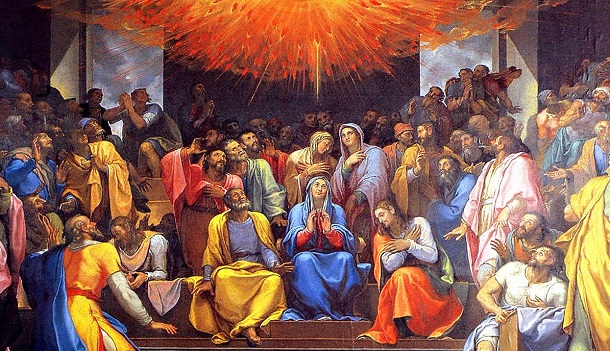
Can you imagine that feeling the Disciples felt when the Holy Spirit descended on the one-hundred and twenty in the upper room.

Relief.

Jesus was with them again in the form of the Holy Spirit, just as He promised.
Graham asks two questions about these events. Why did Jesus have to go? We know that answer. So the Holy Spirit could come. Why did the Holy Spirit have to come?
I believe the Spirit had to come because Christians need help with the harvest. We can’t do the work alone, under our own power. We don’t know what to do; we need the knowledge that is imparted from the Holy Spirit. We don’t have enough strength to get through the good times and bad and continue on with our work; the Holy Spirit gives us that strength. When times get hard and we need comfort, the Holy Spirit sends reassuring messages our way to help us with the difficult times so we can recover and continue on with our work.

Graham basically says the Holy Spirit came because there is much work to do “in the world, in the Church and in the individual Christian.”

The next series of posts will explore that work in all three areas, but for the time being let’s focus on the feeling those one-hundred twenty felt when the wind rushed through the room, the fire descended and the speaking in tongues occurred.

Let’s add another feeling to the Disciples that day.

I am sure that relief was experienced, but let’s add another emotion.

How about elation!

*from his book The Holy Spirit

Posted in Uncategorized | Leave a comment

For Jesus and For You…

Image result for jesus and holy spirit

“The Holy Spirit will come upon you, and the power of the Most High will overshadow you; and for that reason the Holy Offspring shall be called the Son of God” [Luke: 35].
With those words spoken to Mary by an Angel, we learn that God is capable of bringing a virgin birth to pass. God bypassed the male element of birth. No man participated. The Holy Spirit played the prominent role.

Most Christians are very familiar with this idea and most believe it occurred.

Matthew is the book that begins the New Testament and it begins with Jesus’ genealogy followed by the story of Jesus’ birth. But we are still not at Acts 2, when the Holy Spirit manifested itself in the lives of believers.

Pastor Billy Graham* cites the familiar passages of scripture that recount the effect of the Holy Spirit on Jesus. He was baptized by the Spirit in John 1, led by the Spirit in Luke 4, anointed by the Spirit in Luke 4 and empowered by the Spirit in Matthew 12. Jesus offered Himself as atonement for sin by the Spirit in Hebrews 9, was raised by the Spirit in Romans 8, and gave commandments by the Spirit in Acts 1.

In a very extensive discussion by John F. Walvoord** [President of Dallas Theological Seminary], he details that “the humanity of Christ included all the essential elements. Christ possessed a true body, composed of flesh and blood and all the normal human functions [Hebrews 2:14].” He also possessed a human nature but without one important aspect. Christ was without sin. “It is essential to every important doctrine that the Person of Christ be sinless and to this, the Scriptures give abundant testimony (Isaiah 53:9; John 8:46; 2 Cor 5:21; Heb 4:15; 7:26; 1 Pet 1:19; 2:22; 1 John 3:5). The sinlessness of His human nature is a result of the work of the Holy Spirit in conception, as we have seen, His humanity being kept from all sin.”

Almost nothing is known of the life of Christ from His birth to the beginning of His public ministry, only the events surrounding His birth and the incident in the temple at the age of twelve.

Walvoord makes an argument for Jesus’s first twelve years: “It is entirely possible that the body of Christ, being devoid of sin, developed more rapidly and manifested perfection of body which could not be true in sinful men. In contrast to the picture often drawn of Christ, His body was probably unusually strong and graceful, devoid of the hereditary effects of sin as manifested in the race. The account in the temple of Christ at the age of twelve, while chiefly in reference to His mental powers, indicated that He was developed beyond His years in every way.”

The appearance of the Spirit in the life of Jesus after His baptism is well known. At the baptism, the Holy Spirit descended in the form of a dove, as Christ was coming up from the Jordan. From that point on, Christ had the power of prophecy, the power to preach and the power to perform miracles. Graham says “The Holy Spirit was also at work among the Disciples of Jesus before Pentecost. Jesus says in John 14:17 that “He [the Holy Spirit] abides with you.” Yet the operation of the Spirit was not in full force at this time: John 7: 39 says “But this He [Jesus] spoke of the Spirit, whom those who believed in Him were to receive; for the Spirit was not yet given, because Jesus was not yet glorified.”
Graham says we are not sure what the difference is, but when the Holy Spirit at Pentecost came, it was a much greater manifestation that anything anyone had experienced before.

The powerful Holy Spirit at Pentecost is evident as one can turn to the words of Acts 2: “When the day of Pentecost came, they were all together in one place. Suddenly a sound like the blowing of a violent wind came from Heaven and filled the whole house where they were sitting. They saw what seemed to be tongues of fire that separated and came to rest on each of them. All of them were filled with the Holy Spirit and began to speak in other tongues as the Spirit enabled them.”

This stronger presence of the Spirit filled the whole house. About one hundred and twenty followers of Christ were present, including the Twelve Apostles (Matthias was Judas’ replacement), Jesus’ mother Mary, other female disciples and Jesus’ brother.
The catch is the Holy Spirit could not come unless Jesus went to Heaven. John 16:5-7 is Scripture that explains that: [Jesus says] “but now I am going to Him who sent me. None of you asks Me, ‘Where are you going?’ Rather, you are filled with grief because I have said these things. But very truly I tell you, it is for your good that I am going away. Unless I go away, the Advocate will not come to you; but if I go, I will send Him to you.”

That Advocate, that Holy Spirit was sent to the room and the one hundred and twenty followers.

That Advocate, that Holy Spirit was also sent for you and for me…

*From his book The Holy Spirit

**On the Bible.Org.Website

Posted in Uncategorized | Leave a comment

The Holy Spirit in the Old Testament

Image result for the old testament holy spirit

“When the day of Pentecost came, they were all together in one place. Suddenly a sound like the blowing of a violent wind came from heaven and filled the whole house where they were sitting. They saw what seemed to be tongues of fire that separated and came to rest on each of them. All of them were filled with the Holy Spirit and began to speak in other tongues as the Spirit enabled them.”

This Scripture from Acts 2 is assumed by many Christians to be the pivotal appearance of the Holy Spirit to man. Indeed it is dramatic but Pastor Billy Graham* cites many examples of the Holy Spirit’s appearance in the Old Testament. I was not so aware that the Holy Spirit played such a large role in the Old Testament. But Graham writes that we need to understand all aspects of the Holy Spirit, “especially when we think of this present age and the work of God in it.”

Graham freely admits that the work of God the Father is mostly emphasized in the Old Testament. The work of God the Son is mostly emphasized in the Gospels. From the day of Pentecost on, the emphasis is much more on the Holy Spirit. But when we read the “Spirit of God was moving over the surface of the waters” in Genesis we see the Holy Spirit. In Job 33:4 we read “The Spirit of God has made me, and the breath of the Almighty gives me life.” Psalms 104:30 reveals “Thou [God] dost send forth Thy Spirit, they are created; and Thou dost renew the face of the ground.” David is referring to the Spirit’s role in the creation of life.

So much of the Old Testament is about the blessings, the curses, the delivery and the punishment of the nation of Israel. In my reading of the Old Testament, the salvation of Israel is most often attributed to the Spirit of God. It is probably not an earth-shaking conception that the same sick behaviors, the same decay of morality and the erosion of civilized life we see in the Old Testament has not changed. The Holy Spirit was fighting this evil in the Old Testament, from Jesus’ birth to Pentecost and the Spirit is still fighting this evil today [post Pentecost].

Graham cites Othniel, Gideon, Jepthah and Samson as examples of men in the book of Judges who were special. The Holy Spirit came upon them. It takes a close reading of the Old Testament to pick out instances but in 2 Chronicles 24:20 “the Spirit of God came on Zechariah.” “The Spirit rested on them [men]” in Numbers 11:25. In Exodus, it says “I have filled him with the Spirit of God.”

David was anointed with oil and “The Spirit of the Lord came mightily upon David from that day forward” [1 Samuel 16:13]. Graham writes about the Spirit being given to chosen men and also withdrawn when the chosen ones disobeyed. Saul lost the Spirit, Samson lost the Spirit and David prayed in Psalms 51 “Do not take Thy Holy Spirit from me.”

Graham is clear in stating that it is not easy or even advisable to separate the Father, Son and Holy Spirit. Certainly the order of the Bible seems to encourage separation. Incorrectly many Christians assume that all the references to the Holy Spirit must be in the New Testament, maybe even post Acts 2, but that is just not the case.

Billy Graham is quoted as regretting not reading the Bible more: “I would spend more time studying the Bible and meditating on its truth, not only for sermon preparation but to apply its message to my life” but his reading has yielded great support that the Holy Spirit permeates God’s Great Book. I wonder if he is being too self-critical.

He summarizes his argument for the Holy Spirit in the Old Testament with the following words “We have seen that the Holy Spirit was at work before the world began. Then He renewed and fed His creation. He was active throughout the Old Testament, both in the world of nature and among His people, guiding and delivering them through the judges, prophets, kings and others. And He told of a coming day when the Anointed One would come” [19].

The dramatic appearance of the Holy Spirit in Acts 2 does get our attention and rightfully so, but The Holy Spirit was always there in the world, creating, empowering and correcting man. The fruit of the Spirit is love, joy, peace, forbearance, kindness, goodness, faithfulness, gentleness and self-control as we see in Galatians but the Spirit was hard at work before Acts 2.

You see the Holy Spirit has always been hard at work; alongside our Father.

*from Graham’s book The Holy Spirit


Posted in Uncategorized | Leave a comment

The Trinity Mystery

Image result for triune god


Billy Graham, in his book The Holy Spirit, recounts a story of a seminary student who asked a question about the inferiority of the Holy Spirit since it comes third. As we refer to the Holy Spirit, we usually say Father, Son and Holy Spirit, with the Spirit in the third position. Graham explains that the third position does not imply inequality, but does imply functionality. The Father came first, followed by the Son who was God incarnate, died and rose again. Following the Son is the Spirit who does His work in the age of the Spirit, even unto today.

But this raises another question; why do we say Father, Son and Holy Spirit? Why is this grouping called the Trinity? How did this grouping come about?

Almost all Christians believe in the Trinity. For us this means that God exists in three Persons and these three are one God, co-equal, co-eternal, having precisely the same nature and attributes. Now all Christians believe this but most Christians struggle to understand it and explain it. Many throw up their hands and say things like “it is a mystery!” or “it is a paradox!”

Even as the Bible unfolds the revelation of God progressively, there are indications of the Holy Spirit in the Book of Genesis. However, Graham admits that the New Testament references to the Spirit are much more numerous. But where does Trinity come from?

According to Wikipedia, the first recorded use of Trinity was by Theophilus of Antioch in the year 170. Tertullian, a Latin theologian who wrote in the 3rd Century is credited with being the first to use the Latin words “Trinity” to explain the Father, Son and Holy Spirit.” This means that the idea of the Trinity came about after the Bible was written.

Scripture in the New Testament is very close to the idea of the Three in One. One can find instances like the Apostle Paul in 2 Corinthians 13:14 where he says “The grace of the Lord Jesus Christ, and the love of God, and the fellowship of the Holy Spirit, be with you all.” Graham states “His benediction clearly indicates the Holy Spirit is one with the Father and one with the Son in the Godhead” even though the words “Trinity” are not used.

The word Trinity is just not in the Bible.

Why did it come about? Graham says the most confusing part of the subject of the Trinity is the claim that Christianity is monotheistic. Polytheism was the norm in many cultures when Christianity came about; the Romans worshipped twelve Gods for example. Christians did not want to be associated with pagan concepts, so they emphasized one God [monotheism]. First Corinthians 8:4 says “There is no God but one” and 1 Timothy 2:5 explicitly says “there is one God.” The thorny problem is the incarnation of God in Jesus and the Holy Spirit are there also and they are on par with God.

Sounds like polytheism…

Until Christian doctrinal leaders develop the doctrine of the Trinity.

Graham uses a story from Dr. David McKenna to illustrate the practical problem of the Trinity. McKenna had one of those “stump the father” episodes with his small son. His boy said “Is God the Father?” McKenna said yes. “Is Jesus Christ God?” McKenna said yes. “Is the Holy Spirit God?” Another yes, and then the child said “How can Jesus be His own Father?”

McKenna used the car they were sitting in to explain how this could be. I sure can relate since I am not mechanical at all. He said under the hood is one battery [God] and that battery can turn on the lights, blow the horn and start the car. How this happens is a mystery but it happens. I am sure the boy accepted the mystery.

God exists in three Persons and these three are one God, co-equal, co-eternal. Father is the source of all blessing, the Son is the channel of all blessing, and the Holy Spirit is at work in us making God alive and operative in our lives.

Did this concept come about in a very pragmatic way to avoid polytheistic theology? Is it revealed in the Bible and Church leaders were inspired by Scripture to explain the Triune God using the term Trinity?

Does it really matter?

It does…

Pastor Don Hemingway writes “The Trinity is a doctrine that all Christians believe but no one really understands….If you try to explain the Trinity, you will lose your mind. But if you deny it, you will lose your soul.”

Maybe the best attitude to have is represented by the Massachusetts’s Senator Daniel Webster. Webster who was a fervent Christian was asked “How can a man of your intellect believe in the Trinity?” He replied “I do not pretend fully to understand the arithmetic of Heaven now.”

Emphasis should go on the word now…

Posted in Uncategorized | Leave a comment

And That Person Can Be Me…

The concept of the Holy Spirit as a self-conscious individual, a human entity inhabiting the earth; that idea gives me trouble. I expressed that in my previous post “Holy Spirit as Person.” Maybe the confusion that I have is just mine alone. Pastor Billy Graham in his book The Holy Spirit says the Holy Spirit is a person and furnishes several examples of human-like traits to support his assertion.

At the end of his discussion of the Holy Spirit as person, he has a single sentence that helps me with the Holy Spirit being a person. “He is a person. He is divine as well.”
That is when I can come aboard.

Here is evidence of divinity. The Spirit is eternal which means that there was never a time when He was not. One can reference Genesis 1 verse 2 and read “the Spirit of God was hovering over the waters.” The Holy Spirit was, is and always will be and His presence is found throughout God’s word.

It is found in Luke 1:35 where we find He is all-powerful. Indeed we find that His power overshadows all of us.

We learn He is omnipresent in Psalms 139:7: “Where can I go from Thy Spirit? Or where can I flee Thy presence?” Short answer: you can’t flee the Holy Spirit.

He is omniscient in 1 Corinthians 2:10-11 where we learn that God is revealed through His knowledge of the thinking of man. The Spirit knows how man thinks: “Who among men knows the thoughts of man except the spirit of man, which is in him? Even so the thoughts of God no one knows except the Spirit of God.”

He is creator in Genesis and in other places in our Bible like Colossians 1 where Paul writes “For in Him all things were created, both in the heavens and on earth, visible and invisible, whether thrones or dominions or rulers or authorities—all things have been created through Him and for Him. And He is before all things, and in Him all things hold together.”

Lastly, He is God. “And we all, with unveiled face, beholding the glory of the Lord are being changed into His likeness from one degree of glory to another, for this comes from the Lord who is the Spirit” [2 Corinthians 3:18].

In my church and in many churches the Apostles Creed is recited and the Holy Spirit seems to be on par with God and Jesus. “I believe in God the Father almighty, maker of heaven and earth and in Jesus Christ his only son our Lord: who was conceived by the Holy Spirit.” Later in the Creed, we say “I believe in the Holy Spirit” reciting a belief statement very similar to God and Jesus.

Now the idea of the Holy Spirit gets even more confusing for many because now the Holy Spirit is on par with God and Jesus. How could that be? This idea is called ontological equality, meaning the Father, Son and Spirit are equal in value, although separate in function.

The Holy Spirit now is one of three parts of God: Father, Son and Holy Spirit. The Bible declares that there is only one living God, yet we learn from scripture and from Pastor Graham that He comprises three separate personages.

From the “All About God” Website one can read common explanations that may help us conceptualize this difficult idea: “One way to partially visualize this concept is to examine the nature of water (H2O). Water is a single compound that can exist in three states – liquid, ice and vapor. An egg is another picture. It is comprised of the white, the yoke and the shell, yet it is still one egg. Of course, by no means do these examples paint a complete picture of our God, but they are illustrative of the fact that His three “persons” in no way invalidate His oneness.”

Pastor Billy Graham has begun his book The Holy Spirit right where he should. Chapter 1 deals with “Who is the Holy Spirit?”. He explains that the Holy Spirit is a person, the Holy Spirit is divine and I have tried to explain that divinity is an attribute that I can accept in my understanding. I have tried to establish the idea that Father, Son and Holy Spirit are the one and same, which will lead to a discussion of the idea of Trinity, but before we go forward, let me go back.

Writing on St. John Studies is something I do because I like writing but it is also something I do because I learn as I write. Maybe my confusion about Holy Spirit as person is a little less confusing if I think about the impact of the Holy Spirit on me.

Maybe as I learn to let the Holy Spirit lead me, guide me, comfort me and transform me, I can claim the Holy Spirit as a major force in my life. Maybe, just maybe the Holy Spirit can be a person.

And that person can be me…

Posted in Uncategorized | Leave a comment

Holy Spirit as Person…

Image result for pentecost

Pentecost is a day of celebration occurring fifty days after Easter. This year, it fell on May 20 and our pastor and choir director tried to give our church a representation of the Holy Spirit. A wind sound was piped into the church and various choir members rang choir bells at random times.

Did our congregation get it? Did this presentation explain the Holy Spirit?

I’m not sure, because the Holy Spirit is one of the most confusing aspects of Christianity.
Statistics would make one think we should get it. Charismatic Christianity is a form of Christianity that emphasizes the work of the Holy Spirit, spiritual gifts, and modern-day miracles as an everyday part of a believer’s life. This form of Christianity cuts across all denominations. In 2011, there were an estimated 584 million Christians who identified as charismatic worldwide. They made up 9 percent of the world’s population and 27 percent of all Christians.

All those folks claim that the Holy Spirit is a major part of their lives. But who is the Holy Spirit? Can we think of the Holy Spirit as a person?

Pastor Graham just says it: the Holy Spirit is a person. “We see from the Bible that the Holy Spirit has intellect, emotions and will. In addition to this, the Bible also ascribes to Him the acts we would expect of someone who was not just a force, but a real person” [p. 2-3].

How does he support this idea?

Graham points to scripture that says the Spirit speaks, intercedes, testifies, leads, commands, guides, appoints, can be lied to, can be insulted, can be blasphemed and can be grieved. He makes a strong point that all these attributes are indeed attributes of human personality.

But Tom Kirkpatrick in his article “Is the Holy Spirit a Person?” feels that the word “person” has multiple meanings over time. What can be confusing for Christians is the idea that person means a self-conscious individual, a human entity inhabiting the earth. I am not sure that Graham means that at all. I don’t believe the Bible means that the Holy Spirit is a self-conscious individual.

To add to the confusion, why does our Bible have so many references to the Holy Spirit as a person, with even the most common pronoun “he” being used to refer to the Spirit? That certainly would lead one to assume that the Holy Spirit is a real person.

I am convinced that this Holy Spirit as a person idea is a way to explain the power that God and Jesus gave to man, what Kirkpatrick calls “projecting Their will, Their influence, Their nature and Their creative power throughout the universe, including affecting the minds of human beings.”

Jesus told His disciples that they would be filled with power when they received the Holy Spirit, not that a person would come and fill them with power. The apostle Paul explained that Christians have been given this spirit “of power, of love and of a sound mind.” The words power, love and sound mind are all abstract concepts, not literal terms [power is not a thing you can pick up for example]. In 2 Peter 1:3-4 and 2 Corinthians 5:17 Paul explained the effect of the Holy Spirit on the believer, having the ability to create a new nature, a divine nature, a “new creation” in the image of Christ’s character. So let’s not denigrate the power of the Holy Spirit, if it can help us be new people. Many think of the Holy Spirit as a “gift” that will be poured out on people but the idea of gift seems to say that The Spirit is a thing, not a person.

It seems like I am splitting hairs on the meaning of Holy Spirit as person, but if the Christian thinks of the Spirit as a literal person, that can be a stumbling block. When Graham writes: “The Holy Spirit is not an impersonal force, like gravity or magnetism. He is a Person with all the attributes of personality,” those words confuse me.
Until he ends his discussion of the Holy Spirit as person with these simple words: “He is divine as well.”

Can the Holy Spirit speak, intercede, testify, lead, command, guide and sound like wind and random bells?

I think the answer is yes, if that person is Divine.

Posted in Uncategorized | Leave a comment

Ask…

Image result for the holy spirit

Can you imagine what the disciples felt? Jesus knew His time was short and He wanted to tell them He had to leave them. And then He said this…

“But now I am going to Him who sent Me; and none of you asks Me, ‘Where are You going?’ But I have said these things to you, sorrow has filled your heart. But I tell you the truth, it is to your advantage that I go away; for if I do not go away, the Helper will not come to you; but if I go, I will send Him to you [John 16: 5-7].

Talk about confusing. I bet they thought “what is He talking about?”

What He was talking about is giving them the power of the Holy Spirit.

The catch…

The Holy Spirit will come after He is gone.

Is this a promise for all believers today? Is the Holy Spirit something we can count on to help us in life as we go through the situations we face?

The answer to that question is a resounding YES.

Pastor Graham* writes “No conditions were attached [to this promise]. Jesus didn’t say that He would send the Helper (or “Comforter”) to some believers and not to others. Nor did He say that we had to belong to a special organization or be higher on the scale of spiritual performance than someone else. He simply said “If I go, I will send Him to you.”

The disciples had to go through their time of agony, their time of waiting, their time of faith. They had to witness the crucifixion, death and burial of Jesus and they probably had doubts that the promise of the Helper was real. They probably felt alone.
God said that they should wait and wait they did.

Possibly when Jesus rose from the dead and was glorified and then made his appearances to the disciples they thought this “ghost” was what He meant by Helper. Of course, Jesus had them touch Him so they could see He was indeed a real person, back from the dead.

But this was not what Jesus promised. He left them again and they had to wait some more.

A fifty day wait.

“And when the day of Pentecost had come, they were all together in one place. And suddenly there came from heaven a noise like a violent rushing wind, and it filled the whole house where they were sitting. And there appeared to them tongues of fire distributing themselves, and they rested on each of them. And they were all filled with the Holy Spirit and began to speak with other tongues, as the Spirit was giving them utterance” [Acts 2:14].

These members of the early church were transformed.

But can a believer be transformed today too? Can a believer get help from the Helper?
The answer is yes, if we come to The Lord. Peter said “Repent and let each of you be baptized in the name of Jesus Christ for the forgiveness of your sins; and you shall receive the gift of the Holy Spirit” [Acts, 2: 38].

When Jesus said He had to leave so the Helper would arrive, He was not just talking to the Disciples. He was sending a message to us. Graham states “we are no longer waiting for the Holy Spirit—He is waiting for us. We are no longer living in the time of promise, but in the days of fulfillment.”

It is interesting that Graham says “He is waiting for us.”

What does that mean? For me, that is a power that could be accessed to help us in life.
What else do we need to do to have this access?
Ask.

I know that sounds too good to be true. Ask.

In Luke 11: 13 pay attention to the following words: “If you then, being evil, know how to give good gifts to your children, how much more shall your Heavenly Father give the Holy Spirit to those who ask Him.”

Ok, it is a bit more complicated than that. Some believers ask questions like who is this person Jesus has promised? How can this person transform our human nature? How can the Helper give you supernatural power to face the crises of life?

I have a feeling that all our questions will be answered as we get further into Billy Graham’s book, The Holy Spirit.

*Billy Graham The Holy Spirit

Posted in Uncategorized | Leave a comment

Far from Divine…

Image result for the holy spirit billy graham

Well here I am…

Try as hard as I can, I have done it again. I start every day thinking about what I did yesterday, thinking about what I did wrong.

Thinking about my sins.

Wishing I had not done what I did.

It is very early in the day so I have not done much to get me in trouble with God, but I know as the day continues, I will trip up. I will sin again, probably multiple times. I don’t know what will trigger it, but I know it will happen.

It is just me being me.

You see, I am a human, far from Divine.

The big question is how am I supposed to live this life? Am I supposed to feel defeated? Am I supposed to be discouraged all the time? When I sin, I know I feel discord. My wife says I get “grumpy”. That is mild for what I am feeling. Sometimes it is inner strife and I choose to let it show on the outside as “grumpy.”

Is this the life God intended me to live?

Short answer: no.

Billy Graham begins his book The Holy Spirit with a very plainspoken discussion of what we all need. All men and women fail to live sinless lives: Romans 3:23 “for all have sinned and fall short of the glory of God.” Graham says man has two great spiritual needs. One of those needs is forgiveness and the other is goodness.

For many those deep-seated needs go against their nature. To own up to sins and ask for forgiveness means acknowledgement of wrong-doing and a certain amount of humility. For many, to need anything is tough. The asking part is the hardest part. Many people don’t want to admit any need at all and they certainly don’t want to ask anyone for it…even God.

Goodness is problematic for some also. Often times in our world today it seems that goodness has gone “out of style.” What good is goodness in a world where winning is everything. We even have a phrase “good guys finish last” that touts the idea that it is ok to win by any means as long as you win.

Maybe that is why Graham says “Consciously or unconsciously [man] longs for both [forgiveness and goodness]. There are times when man actually cries for them, even though in his restlessness, confusion, loneliness, fear and pressures he may not know what he is crying for” [xi].

In His infinite knowledge, God knows man needs forgiveness and to address those needs, He sent His only Son to die for our sins. This is His gift of forgiveness, His knowledge that humanity is in a constant struggle against sin. The Apostle Paul calls Jesus God’s “indescribable gift” in 2 Corinthians 9:15.

But to be honest, forgiveness is not enough. God knows that men and women need to move beyond their state of affairs to a life that is “good.” I don’t know how many times I have searched for answers for my sins, especially those that reoccur. I have used this example before but reoccurring sin is like going around and around the mountain when I really want to go up the mountain. Sinning, repenting, asking for forgiveness, receiving forgiveness and sinning again is a life that is going nowhere. This is where the Holy Spirit comes in, the power to get us to the next level of that mountain.

Graham was known as a powerful evangelist, but his writing skills are powerful also. Here is a prime example of his ability to drive home his point. “If we wish to be men and women who can live victoriously, we need this two-sided gift God has offered us: first, the work of the Son of God for us; second, the work of the Spirit of God in us [xii].

I am excited about the book The Holy Spirit. I need the power of the Holy Spirit to help me with my aforementioned “inner strife.” I know that the Holy Spirit is the source of power that I need, the power to change a stagnant life to a more vibrant life. The power that I need to get rid of some defeat, discouragement and discord in my life.

The power to quit repeating some of those nagging sins that reoccur.

The power to draw just a little closer to God.

Posted in Uncategorized | Leave a comment

Oh Foolish Galatians…

The Holy Spirit  -     By: Billy Graham

“And when the day of Pentecost was now come, they were all together in one place. And suddenly there came from heaven a sound as of the rushing of a mighty wind, and it filled all the house where they were sitting. And there appeared unto them tongues parting asunder, like as of fire; and it sat upon each one of them. And they were all filled with the Holy Spirit, and began to speak with other tongues, as the Spirit gave them utterance. Now there were dwelling at Jerusalem Jews, devout men, from every nation under heaven. And when this sound was heard, the multitude came together, and were confounded, because that every man heard them speaking in his own language. And they were all amazed and marveled, saying, Behold, are not all these that speak Galileans?” [Acts 2 1-7].

The Holy Spirit…

The life principle of the early church.

The Book of Acts provides Acts 2 and four other separate and dramatic instances of the outpouring of the Holy Spirit on believers [4: 28-31, 8:15-17, 10:44 and 19:6]. If you have had teaching on the Holy Spirit, you know this “helper”” guides us in discerning the truth. The Holy Spirit directs your steps into the abundant life that Jesus intends for us. The Spirit can give you spiritual gifts such as wisdom, prophecy, tongues, interpretation of tongues, etc. This same spiritual power gives you the power to proclaim Jesus and guarantees your hope of heaven.

Yet why are there so many questions about the Holy Spirit in Christian circles?

Pastor Billy Graham, in his book The Holy Spirit, writes that “the misunderstanding and even ignorance” of the Holy Spirit is a major reason why he has written his book. The most common questions about the Holy Spirit range from the simple like, is the Holy Spirit God, to the more complex like how can I recognize the guidance of the Holy Spirit?

Graham knew he wanted to write a book on The Holy Spirit because studying The Holy Spirit would give him needed insight. Many times people who study and write are given a chance to learn as they express themselves, but Graham is really driven by Christians who have little understanding of this important aspect of their faith lives.

Graham was such a popular world-wide evangelist that he came into contact with all kinds of people. Graham’s staff estimates that over three million people came to Christ as a result of his preaching. This amazing response put him in the forefront of religious leaders of his day and he found himself in contact with famous people throughout the world. In the preface of his book he reports that Pope John stated that The Holy Spirit is the church doctrine that Christians most needed to understand. Karl Barth, the noted theologian, personally told Graham that the next main emphasis on Christian theology should be The Holy Spirit.

Graham knew that this task would not be easy. He stated “The subject is so infinite—and our minds are so finite.”

But like me, don’t you want to know what happens when we are filled with The Spirit, slain by The Spirit, walk in The Spirit or become baptized in The Spirit. I look forward to the spiritual gifts The Spirit provides. I want to know more about them. I want to know when I am feeling The Spirit. I want to know how to pray in The Spirit. Can I speak in tongues today? Is speaking in tongues evidence of The Holy Spirit?

We may be confused and lacking knowledge today but from the earliest days, people were confused. Paul writes in Galatians 3 “O foolish Galatians, who hath bewitched you that ye should not obey the truth, before whose eyes Jesus Christ hath been evidently set forth, crucified among you? This only would I learn of you, Received ye the Spirit by the works of the law, or by the hearing of faith? Are ye so foolish? having begun in the Spirit, are ye now made perfect by the flesh?” Why is he addressing the Galatians this way? Because they have the wrong idea about The Holy Spirit. Like many Christians today, they understood the role The Holy Spirit played in their conversion but they did not realize “The Helper” was available in the ongoing life of the believer. Isn’t the ongoing presence of “The Helper” good news?

Today we have to admit that we are still confused.

Pastor Billy Graham’s book was written to clear up our confusion.

Let’s look forward to exploring it together. Maybe together, we can avoid being “foolish Galatians.”

Posted in Uncategorized | Leave a comment

Moving Day…

Image result for uhaul truck

It’s moving day…

This move does not require a U-Haul truck rental. You don’t have to call a moving company. You don’t even have to load up your car.

Like a physical move, it requires a commitment. The idea is that you need to be somewhere else, so it does require some commitment and dedication to being somewhere else. The problem with this move is that it is not to a place where you may want to be but it is to a place where maybe you know you need to be.

It is a move within the Kingdom of God. It is a move that refocuses our hearts and minds.

Like most of life for the Christian, we hardly ever move in a straight line. Pastor Labberton says the move he is calling for “undulates, wobbles and slips.”

Yesterday my pastor spoke of her struggles; we all have them, times when we are excited about God and times when we are not excited at all. We have times when we feel He is close and then there are those times when we have moved away and He does not seem close anymore. Mountaintop experiences are wonderful but guess what, we don’t stay on that mountaintop forever. We all have our times in the valley.

We are finishing a book that urges us on every page to help our neighbor; locally, regionally, world-wide. We are finishing a book that urges us to examine our internal thoughts about people and take stock of our external actions. The book I have been blogging on since December 2017 has urged me to quit thinking so much about me and start paying attention to others; the needy, the displaced, the hurting, my neighbors.

This moving day is a move from isolation to involvement. It is so tempting to remain in isolation, to close the doors to the world, limit watching television and ignore social media. That allows us to kid ourselves that things are ok with the world. Poverty does not exist, trafficking is not real and drug addiction is just a fantasy. But all these things are real and isolation will do nothing to stop them. Even when we see evidence of people in dire need we may mentally protect ourselves by choosing to ignore others’ troubles. Many of us have grown very good at compartmentalizing our lives. We can attend to the “good stuff” and ignore the bad.

This move may mean pain because if we move, we are going to see people who are desperate, maybe victims of violence and maybe suffering from neglect. We may find out that they experience this daily, but this type of person may also have a chance to experience great joy. Labberton says the needy may suffer but they also may be rescued and healed by God. “Grace always gives in the midst of need” [209]. So maybe the move will not be totally dire.

From the beginning of the Dangerous Act of Loving Your Neighbor, Labberton has tried to get the Christian to see that moving into the world of the needy is a move into the heart of God: “Any who claim to be followers of Jesus Christ…this is not an optional side tour, a temporary distraction. It’s a move that the Bible depicts as a move toward home. It’s where we were all meant to live, where we are no longer fooled into thinking that the divisions we are so accustomed to are final or true” [209-10].

I sit here trying to get my thoughts together in the midst of a remodeled home. It is in the 90’s outside and I am cool from the air conditioner and ceiling fan. I know how much money was expended to get my wife and I to a level of stylish comfort that we wanted. Just a few months ago, we were all about the countertops, the cabinet finish and the matching flooring. Right in the middle of all this, I was blogging on a book that encouraged me to let go of my small-heartedness.

All that concern for our creature comforts seems so silly and so wasteful.

Let’s hope that The Dangerous Act of Loving Your Neighbor will help me to meet some needs. Maybe God will unveil opportunities for me to act to help the less fortunate. I already have had opportunities, things that I have done to help some people who are struggling, but I know I could do more.

It’s moving day.

Yes, we are moving to a new book. My next post will be from Billy Graham’s book, The Holy Spirit, but maybe it is moving day for me in other ways too. Maybe I can grow to love the Lord our God with more of my heart, more of my mind, more of my soul and more of my strength. Maybe I will grow to love my neighbor more and love them as I love myself.

“This is why we are.”

“This is how we are to live—seeking a just hope”

Today—everyday—is moving day.

Posted in Uncategorized | Leave a comment