Losing it All…

Damage in Rio Vista after Sunday's storms.

Over this past weekend, the picture above was too much on the news.  That picture was from Texas.

Severe storms and floods have been hitting Texas and many have lost all.

Then we start reading Chapter 8 in Dr. Chapman’s book and we learn about Emily.

Wasn’t it fascinating to think about God’s gifts?

Most of us ask God for things too much when we pray.  It’s almost like God is not God; he’s Santa and we present him with a wish list when we pray.

God is not like that.

But God has given us a lot.

Emily got up one morning and she decided to thank God for all her gifts.  She became determined to thank God for everything she had.

What did that do?

It made her realize that she had a lot.

She started with her bed, the pillows, the mattress, the sheets,the blanket and on and on.  She started going all around the house touching things and thanking God.

Running water, indoor plumbing, rugs, mirrors, chairs, clocks, on and on and on.

What if we lost it all?

In a tornado?

What if we were homeless?   My Sunday School class is developing an interest in working with Micah Mission Center.  It will be a shock.  Micah is a hangout for people who are trying to get off the street.  Many people who are there are drug addicts or prostitutes and some are just plain homeless.  They are living under bridges or trying to camp out under cheap plastic.

I have been to Micah and when I was there, the place was abuzz with activity.

I was talking to the Director, Brad Shuck, and he told me of a woman who came into the Center and she was living under a bridge.  She had a simple request.  She wanted a roll of toilet paper.  When Brad gave her a roll, she broke down and cried.

Can you relate?

Probably not; because we take our tables, air conditioners, lamps, coffee pots, books, tvs and couches for granted.  We have not lost it all.

We take toilet paper for granted.

Does it come from God?

Of course it does.

Should we appreciate it and give thanks for it?

Sure we should.

We don’t.

We might someday…if we lose it all.

Give Thanks!

Posted in Uncategorized | 1 Comment

Exploring New Roads

Last week the focus was on learning about self; as we discussed how much we pay attention to ourselves, how well we can imagine others’ views of the world, how well we have developed our communication repertoire, how secure we are in our sense of self, and how we can navigate the process of learning new ideas [from awkwardness to integrated behavior].

This week, Dr. Chapman is asking us to consider the beauty of learning new things.

I put the road map above to symbolize how we live life sometimes.

When you are driving, have you ever taken a new road, an unfamiliar road?  Have you ever done that just for fun?

Have you ever been lost and enjoyed it?  [I have a relative who has overwhelming fear at the idea of being lost.]

Have you ever taken a vacation in such a strange place that you did not know anything at all about the location and you had to discover where to go and what to do once you got there?

Believe it or not it’s kind of like learning new things.

As human beings, we often like the familiar, even though the familiar can become habitual and habits can become boring.

Don’t get me wrong, I don’t advocate ridding our lives of all habit.  A few years ago, I started a nightly habit of flossing my teeth every night and I am glad I did.  [Dr. Oz says that it is a very good thing to do for your overall health].  When I go to the dentist, the hygienist raves about how my flossing is paying off as she cleans my teeth.

But everything does not need to be habitual, especially if it leads to boredom.

One of the key features in effective long-term intimate relationships is how partners negotiate the novelty-predictability spectrum.  To explain, couples need to figure out how to have novelty from time to time along with predictability.

I once knew of a couple who was addicted to drugs.  They lived life fueled by the need to get high.  Sometimes they had money and sometimes they did not.  Sometimes they had a job and sometimes they lost their employment.  Sadly the need for the high continued and they had to satisfy that.  They resorted to bumming money off of family and friends.  They sold stuff and pawned stuff and sadly they even stole things to get their “fix.”

Why do I tell this story?  Because that couple lived a life of too much novelty and not enough predictability.

How can one get that nice blend of novelty and predictability?

No one wants to have multiple daily surprises.  But no one wants everyday boredom either.  Dr. Chapman says “there is nothing wrong with order.  In fact, doing the same things in the same order may even conserve time.”   He admits that shaking things up is good for us mentally.  “We are also innately creative.  As we tap into our creative nature, life becomes more exciting and less predictable…variety stimulates the mind.  It is easier to keep the mind active if you change your routine.”

Have you ever found yourself mindlessly saying the Lord’s Prayer in worship service?  Have you said the Apostles Creed without thought?  Have you ever spent time with a pastor that used the same phrases over and over again and he said them quickly, as if they were automatic?

Well get ready…

This week Dr. Chapman is going to challenge us all to try to explore new roads.

At the end of the road we take we will find God.  It won’t hurt us to experience a little excitement and creativity as we travel along the way.

I believe that He appreciates that.

Posted in Uncategorized | Leave a comment

Self -Monitoring

Self Monitoring: Do you Censor What you Say?

http://personality-testing.info/tests/SMS/

Dr. Chapman is getting ready to ask us to learn how to speak different love languages than our own in upcoming chapters so this week he has encouraged us to discover our preferred love language.

All this week I have tried to supplement his chapter by discussing components of effective interpersonal communication.

I have encouraged you to take the love language profile so you can see your preference.  Then I wrote about people who are so comfortable with their own self-concept that they meet the needs of others.  I added the ability to perform a wide range of behaviors [a well-developed communication repertoire] and yesterday the mental ability to understand other points of view [mental frameworks].

Today I have begun the post with an interesting scale that I encourage you to take.  It is about paying attention to yourself–technically called self-monitoring.  This is not necessarily a bad thing.  In fact if you are trying to change your communication behavior, it is a good thing.

People who score high in self-monitoring have the ability to pay close attention to their behavior and use their observation to shape the way they behave.  Sound self-centered?  Maybe you could see it that way, but self-monitoring is a key component in making changes.  People who score low in self-monitoring don’t pay any attention to their behavior and they are often perceived as incompetent in interpersonal situations.  They often are not even aware of their blunders.

High self-monitors have a “detached view” of themselves.  To explain this, they have the ability to see themselves as other see them.   Interpersonal communication scholars Ronald Adler and Russell Proctor describe high self-monitors as “they have the detachment to ask themselves ‘how am I doing’ and to change their behavior if the answer isn’t positive.”  In short, they are constantly gathering information from their environment and adapting.  They are trying to fit in.

Where does this “fit in” with the discussion of love languages?  Well Dr. Chapman will be asking us to adapt to the ones we love.  Do we just speak the language we prefer to people who don’t prefer it?  Can you put your preference aside and speak a language that your loved ones need?

High self-monitors will be able to do that.

Low self-monitors will struggle.

Again Adler and Procter state that low self-monitors are so unaware of others that they are “blissfully ignorant of their shortcomings.”  They “overestimate” their communication skills.  Studies of communication skills in humorous situations report that low self-monitors think they are funny despite reports from partners who say they are not funny at all.

Low self-monitors are not able to see how they are coming across to others.

Take the scale.  It is free.  The sponsoring agency is probably a graduate school somewhere and they will ask you if they can tabulate your results; that is all.  They will not try to sell you anything.  Skip the add-on activity if you prefer and go right to results.

A little knowledge about yourself is good.

Self-monitoring is a key skill in becoming adept at learning how to use others’ love languages and that is the whole point of  God Speaks Your Love Language.

Posted in Uncategorized | Leave a comment

Cognitive Complexity

Illustration of the brain

Ok you have knowledge of your love language and you have knowledge of your loved one’s love language.

Wednesday the discussion was about how a person with a “comfortable” sense of self will have an easier time meeting the needs of others.

Yesterday we discussed the person who has the ability to exhibit a wide range of communication behaviors vs the person who has a limited repertoire of behaviors.

Today it’s all about cognitive complexity.

Wow where did that term come from?

Believe it or not, I was introduced to this idea in graduate school and today it is a key term in explaining why some people are good at understanding others and others are not.

Without boring you too much, let’s dig into it a bit.

Explaining with the use of extremes, let’s say that two types of people exist in the world:  ones with a high level of cognitive complexity and ones with a low level of cognitive complexity.

High level people can think about other people in a very complex way.  They construct “frameworks” which help them imagine what other people around them are experiencing.

Say someone seems to be mad at you.  They are a friend.  You go to church with them.  In fact that’s how you know them, through church.  You have worked on a project or two with them and have enjoyed the experience.  You thought they enjoyed working with you too.   Now they are upset and don’t seem to want to work with you anymore.  You have approached them about another upcoming project and have been rebuffed.  They seem irritated and frustrated and despite your friendly overtures, they are not indicating any interest in working with you.

Let’s look at this from a low level view.

“This person hates me.”

That may be the only explanation you come up with regarding this person’s behavior and you are sticking to it.  You really don’t try to understand any more.

Let’s look at this from a high level view.

“In the past, we got along so something has changed.  This person might hate me because I have done something to offend but I can’t really imagine what that would be.  This person has had a very sick spouse.  Maybe the pressure of caring for the spouse is getting to them.  I heard from another friend that the person’s job has become more demanding.  It is taking more hours from their day and they are having to learn new stuff.  This person loves to work on projects at church, especially creative projects and maybe they are upset that they are having to choose between work and their creative impulses.  Maybe they have become mean.  Maybe they are going through a health problem and they are sick and they refuse to share that information.”

Many of you may prefer the low level view.  It’s simple and after you come up with the conclusion, you can move on to other things.

However, many people who study communication feel the low level view ignores reality.  People are complex and they have different viewpoints and different motivations for their behavior.

How does all of this relate to Dr. Chapman’s love languages?

He wants us to learn to speak a love language that is not our preference.  Using my situation as a particular example:  I score high on physical touch and words of affirmation.  My wife scores high on acts of service and quality time.  How am I going to provide love language messages that she needs?

I am going to have to imagine what acts of service and quality time activities will please her.  Without that ability to create a framework that would fit her love language needs, I will never be able to speak the language she needs.

What is my tendency: to approach her with physical touch or words of affirmation.   Both of those love languages don’t work for her.

I am going to have to create a new framework for my wife outside of my world.  I am going to make an effort to understand her world, her needs.  I don’t need to make her become me.  She is fine the way she is.

I just need to increase my ability to use cognitive complexity.

Posted in Uncategorized | Leave a comment

A One Trick Pony

Ok you have knowledge of your love language and you have knowledge of your loved one’s love language.

Where do you go now?

Yesterday the discussion was about how a person with a “comfortable” sense of self will have an easier time meeting the needs of others.

Today, we will discuss the person who has the ability to exhibit a wide range of communication behaviors vs the person who has a limited repertoire of behaviors [maybe a one trick pony, so to speak].

Why is this important?

People who can choose between a larger range of responses to others can communicate better.

Duh.

Why do I bring this up?  People who take interpersonal communication seriously [that should be all of us] report that the best communicators one-to-one are people who can make choices about their communication depending on the situation they are in.

Poor communicators say the same things over and over, never varying their responses.

When you have a larger variety of responses at your disposal, you can pick from your repertoire the response that has the best chance of success.

Let me give you an example.  You are married to a person who has a “love tank” that you can fill with acts of service.   You know they want you to clean out the garage so they can pull their car in [they want to work on the exterior of the car].  They have stated this and given you several polite hints.

Your love language is words of affirmation.

How can you respond to your spouse?

1.  “I will do that.  You are a lovely wife.  I appreciate you.”

2.  You ignore the request, hoping she will see that you are busy with your own projects.

3.  You joke about it, saying ‘I am a slob. You should have married a neater guy.

4.  You give her a big hug.

5.  You can see she is irritated and later in the day, you go to the corner market and get her an ice cream bar.

6.  Later in the day, you take her on a picnic and then you go to a movie together.

7.  You start working on the garage and get it cleaned out by the end of the day.

Here are seven responses that may work and they may not.

However this is not “rocket science;”  you know the one that will work best.  The wife is an “acts of service” person so only number seven will work for her.

The first response might work with a person who responds to words of affirmation so keep it in your tool box, but it won’t work for your wife. She will think it is “all talk.”   Number two is going to infuriate the wife if you do it more than once.  It is a response but you have to be in an emergency for people to forgive you for this one.  Joking about the situation is a little better than no response but an “acts of service wife” will not appreciate it.  A big hug is a total waste.  She does not respond to physical touch and that is meaningless.  Getting her a gift if just a distraction and she is wise; she knows that and won’t appreciate your gift.  Quality time is a nice idea but again [like the gift] it won’t do the trick.  It will only distract.

Number seven is the only one that will work.

Acts of Service people are big believers in “show me.”  If you love me “show me” how much you love me by doing something for me.

In a recent newsletter sent to my email box, Dr. Chapman gives some examples of acts of service that can give you insight about this person’s love language needs:  “Today is all about noticing [for the person trying to fill the love tank of an acts of service spouse.  Take notice of some things that may be small irritations to your spouse. Maybe it’s the trash that needs to be taken out, the stain on the carpet or couch, the stack of papers that needs to be organized, the unmade bed, or the overflowing junk drawer. Whatever it is, take the initiative. Acts of Service are intentional.”

Don’t get me wrong, the six responses above can work but not with her.  They may be effective tools to leave in your communication toolbox but they are not the correct tool to use in this situation.

From one of my favorite books entitled Looking Out Looking In by Ronald Adler and Russell Proctor, they say it best: “Like a piano player who only knows one tune or a chef who can prepare only a few dishes, these people [who have few choices] are forced to rely on a small range of responses again and again, whether or not they are successful.”

It is good to have a wide range of behaviors and when you know which response will work, go ahead and choose it.  Options are nice, but is tough to live the life of the “one trick pony.”

Guess what; it is also tough to be married to the “one trick pony.”

Posted in Uncategorized | Leave a comment

“I Am What I Am and That’s All That I Am”

Oh boy, showing my age today…

I remember as a kid watching tv and a cartoon character named Popeye.   Some of you may recall him.  He was a sailor who had extraordinarily large forearms.  He smoked a corncob pipe and had a scraggly “pirate sounding” voice.

Popeye would always encounter trouble, usually in the form of a bully named Bluto.

Popeye was not up to the task when Bluto started roughing him up but Popeye had a secret weapon—a can of spinach.  I remember that when he needed strength, he grabbed a can and squeezed it with his hand and the spinach came out of the top of the can, right into his mouth.

This gave him the strength he needed to fight Bluto.  He was transformed into a very strong man.

As he did this, he always seemed to say the same thing:  “I am what I am and that’s all that I am.”

Can you say that sentence?  “I am what I am and that’s all that I am?”

As you take your love language profile, can you accept yourself?

This is a key to change in the early stages, believe it or not.

We should not be in the business of changing others.  We need to analyze ourselves and learn to accept who we are.

First we have to admit that we all have a self-concept, a picture of ourselves that has been “built” through the years by others’ images of us that they have shared, social comparisons to others, teachings from our culture and how we wind up evaluating ourselves.  It is a complex process but as years go by, the self-concept is formed.

How aware are you of your self-concept?   Some people have great awareness while others have little.

Some people think about what they do and seem to be able to imagine how they are coming across to others.   They have the ability to adapt to feedback from others if things are not going well.  Others are literally a “bull in the china shop.”  They have little self-awareness and don’t worry about it.  Their attitude is “take me or leave me. I don’t care.”

If you find yourself listening to others, seeking information about yourself and sharing with others you will likely grow in knowledge about yourself.

What if you take the love languages profile but don’t accept the results?

Is it because you really don’t see yourself as the profile says you are or are you not self-aware?

If you are lacking in self-awareness you will not pay attention to how you are expressing yourself.

Dr. Chapman says it best in these words: “If my primary love language is words of affirmation, then I will tend to use words to express my love for my wife.  I am giving her what would make me extremely loved.  But if that is not her primary love language, words will not mean to her what they would mean to me.”

Can you learn to fill someone’s love tank with a new way of expression even though it is not your love language?

You can, if you are comfortable with yourself.

If you have tremendous needs that must be filled, you will struggle with this.  Egocentrism is not a key to having success with love languages.  Selfishness will not help you have success with  love languages.  Lack of self-awareness will not help you fill someone else’s love tank.

Being comfortable with yourself will help.

If you are comfortable with yourself and your needs have not been met, you are ok with it.  You are willing to put someone else first.  You know what to do to express love to another because you pay attention to their habits of communication.

It is time for you to squeeze the spinach can and tackle this problem.

Learn to express the language that they need to hear because you are ok.

You can say “I am what I am and that’s all that I am.”

And you mean it.

Posted in Uncategorized | Leave a comment

Let’s Get Started

Dr. Chapman is wanting us to change.

He wants us to learn our own love language preferences.

One more time:

find out your love language at  http://www.5lovelanguages.com/profile/.

He wants us to learn to speak the love language of others, people we care for, people we love.

Why is this so hard?

Habit.

A habit is a routine that has occurred so often that it is an unconscious, repeated behavior or response.  Habits become unnoticed in our behavior because we do not self-analyze much.  Habits can be efficient but they can also be horrible if the habits are damaging.  What happens psychologically is that we have neural pathways that form in our brains and we make those stronger with repeated thoughts and actions.  Why are habits hard to break?  It takes hard work.

Let’s say you want to change your communication habits.

Today I am going to write about the stages one goes through to learn a new communication skill.

Let’s be real.  The first thing I hear from people when they are trying a new skill is “I feel strange.”  Why is this the most normal response?   Because you are disrupting your neural pathways [that’s the technical answer].  The less technical answer is you are doing something new and you are very self-aware.  Your new behavior may be better but the fact that it seems strange makes it seem not so great in the beginning.  What would be easier?  Your old habits.  You can easily revert back to them and the strangeness will go away but your communication will not improve.  This first stage is called beginning awareness.

Let’s say you are sticking with your efforts.  What’s next?  You are performing the behavior but you are awkward at it.  You lack grace.  Here’s a behavior example that is not communication related but you will get the point.  About two months ago, I bought a new bike.  It was a form of exercise I thought I would try in the warm months of the year.  Of course, I have been a bike rider before so the basics of riding were in place.  This bike was different.  It had a high seat so I can get full leg extension as I peddle it.  There is no kick stand.  So what do you have to do?  Get off the seat when you come to a stop.  The owner of the bike store is a friend so he graciously went with me on a ride as I began to use the bike.   He explained how you have to hit the brakes and slide off the seat at the same time.  I am much better at this after two months but believe me, I was very awkward at this skill on that inaugural ride and the next 3 or 4 rides.  It’s the same with a new communication skill.  We want to be smooth but we are not.  People who study learning new communication skills say “you have to be willing to look bad in order to get good.”  At this stage called awkwardness, frustration can set in easily and again, you revert to your old habits and the awkwardness goes away.

Everything improves in the third stage.  You feel you are developing a new skill.  You have to think about what you are doing but you are able to do it.  You are less awkward but this is caused by thinking and planning.  You don’t just automatically do a new behavior, you work through it and perform it.  That’s a good way to think about this skillfulness stage.  To others it may look like you are doing something naturally but you know you are not.  You are thinking your way through your new behavior.  Really this stage could be renamed the “consciously skilled” stage.

Time passes.  You repeat your new behavior several times.  You have good results.  Your confidence builds.  You get good feedback from others.  Guess what happens?  Your behavior slowly becomes more automatic.  Integrated is a good way to describe what is happening.  The new behavior is becoming natural to you. This integration stage is what you want.  You want to add a new behavior to your repertoire.

If you are trying to speak a new love language, now you know what you face.  Competence does not come overnight.  It is a long haul.  It is a commitment on your part.

But what is the payoff?

Better relationships with the ones you love.  A better relationship with God.

Let’s get started!


http://www.5lovelanguages.com/profile/

Posted in Uncategorized | Leave a comment

It’s a Wonder…

Bypassing: according to Dr. Joseph DeVito, bypassing is a pattern of miscommunication that occurs when the speaker and listener miss each other with their meanings.

Bypassing is caused by many things.

Causes can be physical noise in the environment, the medium we choose to communicate with, the words we choose, varying cultures, psychological/attitudinal barriers and just variety in perception.

Let me explore all of those with examples.

Say you are at a race track and loud cars are whizzing by at different intervals and they are loud!  You are trying to carry on a conversation but you are fighting this very distracting noise.  Words get lost and you have to make guesses about what is being said.

You are talking on a cell phone and the connection is weak and you can’t get all the message due to the poor reception.   That’s a problem as you miss parts of the message.

Words get used in conversation that can trigger responses in other people.  My wife absolutely hates certain words and if people use them around her, she will get upset and stop listening or at least get distracted away from the message.  Additional problems are caused by differences in vocabulary comprehension.  Some people have a strong knowledge of a large number of words while others don’t have that.  Words can be used which cause bypassing due to complex vocabulary vs. a weak vocabulary.

Cultural misunderstanding can be common in communication.  My daughter-in-law is from Colombia, South America and some of the expressions Americans use can be very confusing to her.  “You do the math,” “I want take out tonight” and “heads up” are expressions we use without problem but she is often confused by little short-hand talk like this.

Bypassing can also be caused by attitude or psychological barriers.  Mood often interferes.  Say I have a sleepless night and that is followed by a grouchy day.  My wife asks me to do a job for her and I grumble.  That is more of my mood talking than how I really feel about her.

Perceptual differences are the last problem because we all don’t see the world the same.  Essentially, what is important for one person may not be important for another.  Additionally, we literally don’t see the world the same.  It could be our angle of sight, our comprehension of the situation or even our ability to see, hear or smell reality.  Some of us have sensory deficits.

Dr. Chapman knows all these potential reasons for bypassing occur but his prime focus is bypassing caused by not understanding the love language needs of your partner.

He states, “If my primary love language is words of affirmation, then I will tend to use words to express my love for my wife.  I am giving her what would make me extremely loved.  But if that is not her primary love language, words will not mean what they would mean to me.”

Bypassing

What can we do to get beyond this problem?

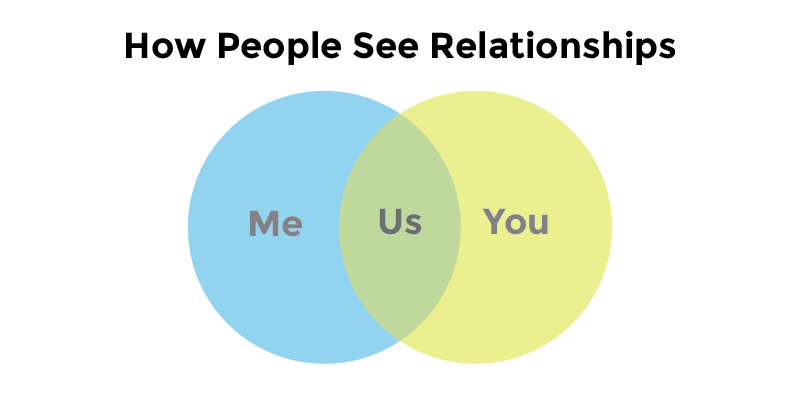
What can we do to get our conversation bubbles to overlap?

Here are the short answers:  find out what your love language preference is.  If you have not taken the free profile, take it and learn the love language that you like.  It is easy to do at  http://www.5lovelanguages.com/profile/ .

Find out what your partner’s love language preference is.  Can you get them to take the profile?  That’s the quickest route.  However, some people don’t want to participate for a multitude of reasons.  If there is a problem with your partner not wanting to take the profile, you have to pay attention to how they express themselves.  What do they complain about most often and what do they request most often?  These simple questions can yield clues to their love language preference.

This week, we will explore what we can do to help make our circles overlap, rather than bypass.

When you stop and think about it, it’s a wonder anyone understands another.

Let’s not let different love languages be the problem for bypassing.

Posted in Uncategorized | Leave a comment

Everybody’s Different

Well maybe that is an overstatement but it is hard to find two people who are exactly alike.

Yesterday I posted a quiz that dealt with male and female differences.  I promised I would give you a little interpretation of the quiz.  Here goes…[again I have to credit the “Wise County Christian Counseling Website.”

1. True [Men understand women better than women understand men.]

“Long ago men accepted the fact that there is no way they are ever going to understand women. They understand that they don’t understand them. Women, however, still believe that they understand men—and they don’t. Women tend to believe if a man were (1) more mature; (2) mentally healthy; and/or (3) in touch with reality—then he’d be more like a woman. Expecting a man to be like a woman is the first step to misunderstanding men.”

2.   False [Women talk more than men.]

“The earlier studies that indicated that women talk more than men (e.g. one showed that men use 7,000 words a day and women use 20,000) have now been overturned and invalidated. Men talk just as much as women—when they feel connected. Connection is the key.”

3.   YES, YEP, AFFIRMATIVE, CONFIRMED [Men need more touching than women.]

“ ‘When two people touch, oxytocin is released. This is the bonding chemical that makes you feel close and want to snuggle. Oxytocin is also an amnesic, i.e. it makes you forget the bad times and disappointments. Estrogen enhances the effects of oxytocin and testosterone offsets the effects of oxytocin. Because the average man has more testosterone than the average woman, he needs more touching to feel close and bonded. Most men are “touch deprived.” Many women miss this important fact and fail to take advantage of an easy way to get closer to a man.’ “

4.   FALSE [Men hate to talk.]

“Men don’t hate to talk.  It’s just that they don’t get high from it like women do. If you look at the brain activity of a woman when she is talking, the pleasure and reward center is lit up like a Texas football field—they get off on it! It’s not that way with men. For eons women have used bonding and staying in communication as a primary coping mechanism, even more than the traditional strategies of fight or flight. Because of the survival value of talking, she is reinforced with feelings of pleasure and reward. A smart man knows one way to a woman’s heart is through conversation. A smart woman knows connect first; talk second.”

5.   FALSE [Men aren’t as in touch with their feelings as women.]

“In fact, there is evidence that men feel as deeply, even more deeply, than women. They do tend to use fewer emotional words than women which can lead women to wrongly believe that a man isn’t in touch with his feelings. To accuse a man of being insensitive and unfeeling is not only wrong—it’s rude.”

6.   SO VERY FALSE  [Relationships aren’t as important to men as they are to women.]

“This is not the truth. If you look at research, when a man gets divorced or loses his mate: depression goes up; drinking goes up; suicide goes up; unemployment goes up; his salary goes down; his health goes down. Relationships are vital to men in every way!”

7.   FALSE  [Work is the most important thing in a man’s life.]

“While it is true that a man (as well as society) judges a man by his ability to provide via work, a man will tell you that work has meaning because of the important people in his life. A woman may argue, “Well, he would go to work if I weren’t in his life!” And she would be right—but it wouldn’t have the same meaning. The woman in his life gives his life meaning over and above everything else. If you can get this one fact firmly anchored in your psyche, you will be one giant step toward understanding men.”

8.   TRUE  [Men think about sex more than women do.]

“All embryo are female until the 8th week of gestation when a flood of testosterone turns females into males. The primary result of this hormone bath is killing off of brain cells in the emotional language center and increasing brain cells in the sex and aggression center. So, yes, men do think about sex more than women, but this only applies to about 2/3 of men; the other 1/3 are more sensitive and emotional and need intimacy and relationship contact to think about sex, much like 2/3 of women.”

9.   FALSE  [Men are more aggressive than women.]

“If you factor in female ways of aggression, i.e. words and relationships, women are just as aggressive as men; in fact, there is some evidence that women are more aggressive than men.”

10.  FALSE  [A man’s greatest vulnerability is fear of control.]

“Men are far more susceptible to shame than to fear. The greatest vulnerability of a man is appearing weak, inadequate or failing at being a protector, provider, parent and/or lover. Generally speaking, women do not understand how important it is to a man to please his partner as well as the people he loves. This is why a loved one’s unhappiness and/or criticism have such a devastating effect on a man.”

11.  FALSE  [You connect to a man the same way you connect to a woman.]

“Women connect more through talking; men connect more through touching. If you want a man to talk, connect with him first. Women talk to connect; men have to connect to talk. Touch him; affirm him; ask for his help (“Honey, would you just listen to me for a couple minutes while I figure something out?”) Men love to help, they love to please; they also need and want connection.”

12.  FALSE  [A man’s favorite words are “Honey, we need to talk.”]

“ ‘However, it could be if most of your conversations went something like this: “Honey, do you realize how much I love and appreciate you? I realize I don’t always say it, but you make me so happy in so many ways. I just don’t tell you this enough. That’s all I needed you to hear. Thanks for listening!’ “

10-12 correct answers   You really understand men and women communication differences.

6-9 correct answers   Adjusting your perceptions for gender uniqueness is going to make your life 100% easier!

5 or less    Now you know why it’s been so difficult; you just don’t understand gender communication differences.  

I don’t like to quote much information on a post but this quiz was so correct in its reflection of current gender communication research.  I thought it would benefit the reader to take it.

Everybody’s different and Dr. Chapman is going to get into details about what we can do to bridge the differences.

I can tell you a couple of things.  1.  Trying to turn someone else into the person you want does not work.  2.   Acting like differences don’t exist does not work.  3. Taking the attitude that “my gender” has it all together; the other gender is really goofed up does not work either.

Oh by the way, touch comes up twice in the survey and since I am a person who has physical touch as my primary love language, the research is real.  I can’t turn my wife into a “toucher” though [she is not a toucher].  I realize she and I have differences.  And I don’t think being a man is any better than being a woman.

Let’s see what Dr. Chapman is up to in Chapter 7.

Here’s a tip:  If you have not taken you love language profile, now’s the time to do it.

http://www.5lovelanguages.com/profile/

Left click on the link and find out your love language.  It’s easy and the results are sent to your email box.  It’s free.

You need to know…because everybody’s different.

Posted in Uncategorized | Leave a comment

Touch: One Element of Gender Misunderstanding

The Misunderstood Male [from the Wise County Christian Counseling Website]

Take this simple true or false quiz to see how savvy you are about men.  Questions and answers are based upon gender research and developmental studies.  Answer true or false.

__1.     Men understand women better than women understand men.

__2.     Women talk more than men.

__3.     Men need more touching than women.

__4.     Men hate to talk.

__5.     Men aren’t as in touch with their feelings as women.

__6.     Relationships aren’t as important to men as they are to women.

__7.     Work is the most important thing in a man’s life.

__8.     Men think about sex more than women do.

__9.     Men are more aggressive than women.

__10.   A man’s greatest vulnerability is money.

__11.   You connect to a man the same way you connect to a woman.

__12.   A man’s favorite words are “Honey, we need to talk.”

Just what you need, another “test”.  Tomorrow I will share the answers.  The quiz is simple and as I considered posting it, I was really interested in statement 3.  What do you really think?

As an interpersonal communication teacher, a common complaint I hear associated with physical touch is the woman who says “I don’t touch my husband because when I do, he thinks I want to get intimate.  Sometimes I just want him to hug me or hold my hand.”

Hence, what happens.

No touching whatsoever.

Here is where I bring in the old adage that “women are crock pots; men are microwaves.”  You know what I mean.  The male response to touch may be driven by testosterone and that can lead to overreaction.

Can we have a compromise?

Can men learn that touch does not always lead to intimacy?  I think so if men work at it.

Can women learn that men are capable of a warm, soothing response to touch and lose the fear of touching a male?  I think so.

Over the years, several authors have exploited the problem of male and female misunderstanding.  John Gray gave us Men are From Mars, Women are From Venus.  Deborah Tannen gave us You Just Don’t Understand.  Both books explain that men and women are very different and the differences play out in everyday life.

  1. Women will talk to build relationships; men will not.  The talk has to have some purpose and building relationships is not high on a man’s list.
  2. Women will talk longer than men to establish rapport.  That is a valuable goal.  Men will talk less and rapport building is not high on a man’s list.
  3. Men are listeners to solve problems.  Women are listeners to allow the person with a problem to solve their own problem.  Male fixing is a turnoff for many women.  All they want to do is express their troubles. They don’t want someone to run in and fix their problem.
  4. When men have problems they tend to withdraw.  Women like to explore their feeling through talk and when they speak to others, they can release some of their stress.
  5. Women tend to touch for support and sometimes intimacy.  Men tend to touch for intimacy and sometimes support.

I know God made man and God made woman.  As they say in France “vive le difference”; we would not want man and woman to be the same.

However as one who wishes there was a little more peace and understanding in the world, can’t we just try to understand each other…a little better?

Posted in Uncategorized | Leave a comment